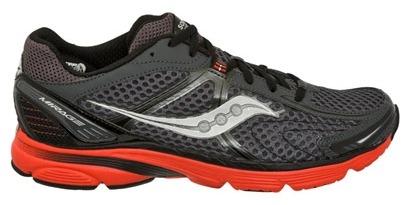
 An interesting article titled “Appealing to Runners, Even the Barefoot Brigade,” by Andrew Adam Newman was published in the New York Times a few days ago. The article takes a look at the state of the running shoe industry, with a particular focus on the minimalist shoe segment.
While sales of toning shoes are dropping off precipitously, running shoe sales continue to grow, up 18% overall compared to last year. Even more interestingly, the article reports that sales of so-called “minimalist” style shoes have risen by 283% over the same period. Is this a bubble that’s going to burst at some point, or a “fad” doomed to slowly fade away? Or, is this a sign of a long-term movement away from more traditional, heavy running shoes with extensive cushioning and heel lifts. Time will tell, but I for one find it very unlikely that I will ever go back to the shoes I wore a few years ago, if for no other reason than since going almost completely flat, wearing my old pair of Brooks Adrenalines now makes me feel like I’m standing on a steep downhill slope.
If I had to guess, some of the initial exuberance over minimalist and barefoot-style running will die down, but I think the segment will retain a strong place in the running shoe market. Whereas shoes like racing flats have always been around and available to hard-core runners, nowadays everyday runners are finding that running in a lightweight shoe with less cushioning is a perfectly valid option. What’s more, there are now many varieties to choose from, ranging from well-cushioned shoes like the Nike Free or Saucony Kinvara, down to barefoot-style models like the Merrell Trail Glove or Vibram Fivefingers. More are on their way from other shoe giants (e.g., Brooks), and Saucony, one of the more progressive companies in this movement, is now even lowering heels on some of the shoes in it’s flagship line (e.g., the Triumph 9) from a traditional 12mm heel-forefoot differential to 8mm. Choice for the everyday runner has finally arrived, and for me this is the most important result of the barefoot/minimalist movement. No longer are we locked into just a few stability variants based off of a more-or-less common template.
To give a bit more insight onto the current state of things in the shoe business, I wanted to share some comments that were sent to me by a manager at a specialty running shop. Eric Johnson is a blogger, triathlon coach, and manager at The Starting Block in Springfield, Missouri.
First off, Eric emphasized that at his store they “…do not push minimalist shoes over traditional shoes, but we educate about potential pros and cons and the consumer picks based upon that info.” He went on to describe his store’s minimalist offerings:
“The minimalist-type shoes we carry are as follows (recognizing that most of these aren’t true minimalist): Saucony Mirage, Saucony Kinvara, all Newton models, Saucony Kilkenny spikeless racing flat, and most Vibram Fivefingers (VFF). The Mirage is our #1 shoe, closely followed by the Newton Isaacs. Our brand sales (in order of most dollars) are Saucony, Asics, Vibram, Newton, Brooks, Mizuno, and Adidas. A year ago VFFs were in last place – now they are nearly overtaking Saucony and Asics (all three are super close). And, again, we really do not push them. We educate, but almost never suggest someone start in a Vibram. People come in frequently asking about minimalist shoes. From a running store standpoint, consumers are much more educated than ever before.”
We’ll be getting the Brooks Pure line and New Balance Minimus in October…in the past year we’ve cut a lot of non-minimalist shoes and have added mainly minimalist. Our sales in moderate stability and motion control shoes have plummeted. We are selling mostly neutral/cushioning and light stability traditional shoes as well as the minimalist.”
Regarding the Vibram Fivefingers, which his store stocks, he said the following:
“VFFs are so popular we actually have an entire corner of our store dedicated to them. Incredible. If I had to give my best estimate as to “who” is buying them, I’d say a third are athletes (majority runners, but some lifters), a third are people who don’t like wearing shoes, and a third just want them because of the fad. We had tons of military guys buying them until recently – I heard the military banned them from use in PT tests. So now they usually get Newtons.”
I also asked Eric about his experience, if any, with customers getting injured in Vibram Fivefingers:
“I’ve only seen one guy with a metatarsal stress fracture and he was a guy whose soft tissue adapted quickly so he proceeded to log high mileage on hard surfaces pretty quickly (40+ mpw in Vibrams, 40+ in Newtons simultaneously).
Now the question is how many people are buying VFF’s, having pain, and giving up? Hard to say. Probably a lot – most people have no patience. I get virtually zero returns on them other than an occasional defect though (as opposed to all my other shoes, which do come back a lot). And I do get stories from people who overcame debilitating injuries using VFFs.
We’ve all heard about the big increases in metatarsal stress fractures and calf/PF/Achilles issues at PT offices, but it makes you wonder also how many people with patellar tendinitis, joint pain, ITBS, etc. that had been through the rigmarole with those same practitioners are now successfully running due to minimalist shoes or barefoot style running technique changes.”
Interesting stuff from an industry in flux, and from a guy at the front lines of fitting runners to shoes. It will be might interesting to see if this trend continues, but I highly doubt that minimalism will go the way of toning shoes.
You might also like:
 Top 3 Hybrid Trail Running Shoes of 2012
 Asics Going Minimalist with the Gel Lyte33 and Gel Fuji Racer?
 Preview of late 2011-early 2012 Minimalist Shoes from Merrell, Vivobarefoot, Inov-8, GoLite, Altra, and Teva (via Damien Tougas at Toesalad)
 Saucony Peregrine Review: A Rugged, Low-Drop Trail Running Shoe
Newton Running: Q&A With Ian Adamson, Newton’s Director of Product Development
Saucony Peregrine Review: A Rugged, Low-Drop Trail Running Shoe
Newton Running: Q&A With Ian Adamson, Newton’s Director of Product Development

 About Peter Larson










Ive noticed in the past month at my gym the Nike Free and FiveFingers have become trendy. (it’s a very fashion conscious male consumer at this location.)
But I’m also seeing more Nike frees in the wild on people as a daily wear shoe.
13 months ago I ran in Nike Air, then Free Run+, now Brooks Green Silence and VFF Bikila LS. I’m also Using the VFF to weight lift.
I think the spike in interest will die down eventually, though I hope not. However, the concepts are still new or unknown to many. I continue to run into other runners at races or in my travels who only know it as that ‘fad on the fringe’. People running with significant heel-strike complaining about knee problems, people thinking it is only a fashion fad and not a form issue. The list goes on.
Personally, I am barefoot for everything except running, but have been slowly transitioning, currently in Brooks Silence on roads and Trail Gloves on trail. Really, really looking forward to Brooks Pure line.
Everything about minimalist shoes (low/zero-drop, less cushioning, less support) combined with a proactive, reasonable approach to adapting a more natural running form seems good. I’ve seen everyone from myself to my D1-xc friends to my “dreadmill” gym buddies have great results with minimalist shoes.
So my question for you is:Is there any reason why people should run in traditional (thick cushioning, medial support, high heel) running shoes anymore? Ever? Even my non-runner friends?
ex. My non-runner buddy wants to get into running, but I know they aren’t serious about it. They ask me what shoes they should get; what do I tell them?
“Saucony, one of the more progressive companies in this movement, is now even lowering heels on some of the shoes in it’s flagship line (e.g., the Triumph 9) from a traditional 12mm heel-forefoot differential to 8mm.”
Just for the contrast, what I found yesterday about Asics:
“This year, Asics also added the Plus 3 feature to some of its best shoes. The Plus 3 feature is an additional 3 millimeters of height on the models designed for female runners. Take note that the added height only applied to the women’s shoes. This is one of the special considerations that Asics makes especially for women. The aim of the added height is to ease the tension felt by the achilles. The bestselling Asics running shoes all came out with added height this year. This includes the Asics Gel Kayano 16 and the Asics Gel Nimbus 12.”
Well, my feet have a strong preference for Asics shoes but I will definitelly continue in my transition to make Hyperspeed 4 my principal running shoe rather than get a pair of ones mentioned above…
My wife and I are running a 5K this morning. Last year, out of the 200 people running, we were the only ones in VFF’s or other minimalist shoe. This years race should be interesting. I know I’ll be seeing more…
Pete,
I participated in a natural running form clinic last weekend and it was interesting to observe the wide range of attendees. Participants included competitive long distance runners (such as myself), tri-athletes, middle of the pack runners, and recreational runners. Age ranges were likely late 20’s to 50.
I feel the minimalist movement is one that is here to stay for a vast spectrum of runners who previously were in traditional shoes.
Keep up the excellent work.
Britt
i was going to play basketball the other day for the first time in a few years and put on my old nike basketball sneakers and felt like i couldnt stand up straight. i decided not to play after all and just went to the gym for my daily exercise. any kind of sneaker with a heel lift is a huge problem for me. id imagine you shouldnt play bball in vff’s with all the jumping and sprinting and whatnot. i wonder if the minimalist “trend” keeps up, if they’ll experiment with minimal sneakers for other sports.
Altra markets their Instinct shoes to multi sport athletes and Reebok just developed a multi sport shoe, focused on Crossfit training. Its coming. I think Nike has training shoes and basketball shoes based on the free platform.
It is interesting to note that for the first time I can remember, Runner’s World did not feature any motion control shoes in their fall shoe guide… I am on my 3rd pair of Kinvaras, and I think I am damaged goods, because I can no longer run comfortably in a shoe with a raised heel…
I have a question for all you minimalist running shoe fans. What is your definition of a “minimalist” running shoe? In other words, in looking here through Pete’s RunBlogger reviews, I am seeing an awful of lot of shoes with relatively thick midsoles that you all are still calling “minimalist shoes” and a very far stretch from being barefoot or being in Vibram FiveFinger shoes. In other words, are the shoe manufacturers using the “minimalist” or “barefoot-like” buzzwords to sell shoes to all of you with no regard to minimum midsole thickness, midsole durometer or shoe weight?
Here is my simple question to all of you: please provide me, if you can, with the physical characteristics that demarcate the transition between a “minimalist running shoe” and a “traditional running shoe”.
In other words:
1. What shoe weight is the maximum allowable at a men’s size 10 shoe to still be considered a “minimalist shoe”?
2. What midsole thickness at the metatarsal heads is the maximum allowable at a men’s size 10 shoe to still be considered a “minimalist shoe”?
3. What midsole thickness at the rearfoot is the maximum allowable at a men’s size 10 shoe to still be considered a “minimalist shoe”?
4. What heel-height differential (i.e. difference between rearfoot midsole thickness and metatarsal head midsole thickness) is the maximum allowable in a men’s size 10 shoe to still be considered a “minimalist shoe”?
Or, alternatively, does the shoe manufacturer simpy need to say “this is a minimalist shoe”, regardless of the physical characteristics of the shoe, and you all will then believe what the shoe manufacturer tells you: the shoe must be a “minimalist shoe” because they told me it is “minimalist”?
Cheers,
Kevin
This sounds a bit
like Wittgenstein’s challenge to come up with a rigorous definition of the word
“game”. Every possible characteristic you can come up with has
exceptions, so no single list of characteristics will include everything we
would call a game. I presume that, likewise, no single list of specs of a
minimal shoe will suffice.
The best possible (yet fallible) definition will probably look like the
sort of definitions that are used in clinical standards and include stuff
like “if at least five of the eight
symptoms are present, including either symptom A or B…”
I think I leave that to a panel of experts.
RH:
So, in other words, if Acme Shoe Company comes out with a shoe that has a 20 mm thick heel, a 10 mm thick forefoot and that weighs 11 oz, but calls the shoe the “newest and most protective minimalist shoe on the market”, you will accept Acme’s proclamation as fact that it is a minimalist shoe? Or do you actually have some mathematically quantifiable physical criteria as to what determines a “minimalist running shoe” vs a “traditional running shoe”?
Cheers,
Kevin
I’m not sure we have a dictionary definition yet. As such, I can only speak for myself. I’ve been running in Vibrams for almost two years up to a full marathon with no problems. Here’s my personal, subjective definition. This is also the minimum for me to consider purchasing a new shoe (I have many other “minimalist” shoes besides Vibrams)
1) Zero drop. (if 1-2mm drop appears from manufacturing errors only that’s OK)
2) wide toe box: outlined for the natural shape of the human foot. Why aren’t shoes shaped like the human foot?!?!
3) zero arch support. After 2 years of never, ever using arch support my feet have never felt better.
4) sole thickness is tough to pin down. I would say about 10mm. I could go higher for a casual, non-athletic shoe
5) weight: for running, 8oz is the most I’ll go. For casual office shoes I’m happy with my Terra Plana Vivobarefoots which weigh more but meet all the other above criteria.
I think a lot of die-hard minimalist would more or less agree with me. Obviously there’s a lot of disagreement in the details.
Since I have
already mentioned one philosopher, I hope you will excuse a vague answer.
I think the answer
would depend on context. More precisely, you can only define a shoe as
minimalist, if you have an idea what the purpose of a shoe should be. I’d say
that traditionally, the purpose of a running shoe is protection, cushioning and
motion control. In the minimalism debate these seem to be the three main things
to be minimalist about. I suppose it’s take your pick: none of the above, a bit
less of the above, only protection, some cushioning and no motion control, some
motion control but no cushioning.
I wouldn’t call
myself a minimalist, but if my personal choice of shoe is to be the definition,
it would simply be no motion control (If I am a minimalist, I’m a rather minimal
minimalist). Motion control shoes give me blue toes and blisters and I think I
can do without them at my current fitness level. As to the thick midsole: I guess
that is motion control too, but I have no problem with that.
So if ACME shoe company told me their shoe is minimal, I would ask in
what respect. (Minimal for the money I
pay?)
RH:
Your vagueness is acceptable as long as you and others don’t want to be scientific about the study of running shoes. As for me, I prefer being precise and scientific when I discuss the biomechanics and structure of running shoes.
Cheers,
Kevin
Hi Kevin,
I don’t think one can, or even one should try to scientifically define a “Minimialist shoe” as it’s really just a loose term that is that something that has bubbled up from the grass roots and latched onto both marketers and those simply seeking less shoe as way of conveying a series of qualities with a simple moniker.
If you want to be scientific you have to not try and use a single label, rather one would study the seperate parameters that one might minimize in different shoes. For instance one could study the effect of heel drop on gait, this would be directly measurable in each shoe. One could also study the effect of toe box width w.r.t foot width and the toe splay on landing. One could study the amount of arch support. And so on.
Perhaps the labelling systems used on foods these days might help – rather than formally labels the % fat, % carbs, % protien, number of callories per 100g etc, you’d provide information on weight, amount of arch support, flexibility, heel drop, relative size of toe box, sole type etc.
Personally I’d love to be able to scan my whole foot and then be able to compare online how well my own personal foot matches to the lasts that the different manufacturers use for their shoes. This obviously a bit more than just simple on the box labelling, but access to full 3D data. The various bits of technlogy are up to this, it only needs to be put together and then adopted by manufactuteres. Perhaps one day…
Robert.
Kevin,
Please don’t get me wrong. Of course I am not against the scientific study of what shoes work best. I just don’t think it hinges on the exact definition of a minimal shoe. Minimal = good is, as yet, no theorem of science. So even if we could come up wit one single definition what a minimalist shoe is, we have no guarantee it is a good shoe.
A similar approach, -not quite one size its all, but paradigm, translated into one off-the shelf-solution fits all- is, in my opinion, the reason that motion control shoes seem to work poorly. I am a firm believer in motion control. I do believe that, when podiatry is a finisched science, a horde of podiatricians with with top notch equipment and an orthopedic shoemaker could in theory supply me the exact motion control shoe that would allow me to train with a minimum of injury. Since different aspects of my body would respond at a different rate to my training (e.g. muscle vs tendons), they would also have to supply me with a pair of new shoes every two weeks. Unfortunately, that is not how buying a pair of motion control shoes works. Since the dimensions of my body are point on a continuum, probably no standard off the shelf shoe would be exactly right. i don´t know if here is a standard measure for pronation, but suppose it is measured in mms (for argment, suppose it is max height difference between inside and outside ankle). If I overpronate 4.49 mm with my left foot and go to a shoe store, it is measured visually -based on a one minute run and with the straight eye- with a a margin of error of, say, 4 mms. On the basis of this measurement, I get assigned an off the shelf shoe that corrects either 6mm or 8 mm for both feet. We disregard that this is, among others, dependent on my weight. So all in al, I get a shoe that may be marinally better than a randomly selected shoe, for my current state of training. It is based on science and on our best understanding of how injury works, but unfortunately, we cannot translate it into practice.
A rigorous definition of minimalism would amount to the same thing, at least if you mean it to be an industrial standard.
Hi Kevin,
You obviously haven’t been reading this blog, or searching this blog for answers as Pete’s already written an entry on the topic of what he uses as guide to what might be viewed as a minimialist shoe:
link to runblogger.com…
This is pretty useful guide. I’d personally like see some metrics drawn up that we’d could review shoes by, the minimalist category like all categories of shoes is open to marketting abuse/opportunitism, so having a set of metrics that indepedent reviews can use a guide would be good.
Personally I don’t care specifically about a shoe being in any “minimalist” category. What I want it is it supports my personal gait properly rather than interfere with it – if you are mid-foot/forefoot striker like myself that the best shoes are zero drop, anything more is at best a redudent chunk of weight and instability to carry around with you, at worse it interefers with your natual gait and feels horrible to run in.
There are shoes that are marketed as minimialist that don’t work for me, ones that are not marketd as minimalist that do work for me. Over the last few months I’ve been running in happly plimsoles and light weight hybrid walking shoe/sandles as well as trail running shoes, none of which were marketed as minimialist but I bought and use them as they tick the boxes as shoes that don’t interfer with my running gait. All the shoes are light weigth, low drop, nice wide fitting and very flexible so likely satisify Pete’s metrics for minimialist.
A couple of years back when I came back to running after a twenty five year break I dug out my old cross country shoes I used to wear at school. All of these shoes are light, flexible, modest heel drop but I could even get them on my feet anymore, not that my length of foot has changed, but it’s width possible has, or also just as likely I just crammed my feet in the shoes as was just a kid and didn’t know any better. This old shoes would tick a number of Pete’s boxes for a “minimialist” shoe, but would be an epic fail on the toe box. I’d guess most racing flats of old were also fail in this respect.
So I think one has to put the ability to run comfortably with a mid-foot/forefoot strike as my own personal yard stick of a good running shoe. A shoe that is marketed as “minimalist” is probably more likely to answer my needs compared to traidtional shoes from, but I’m naturally cynical of marketting so it’s facts about shoe that I try to dig down and find.
Robert
I think Kevin is looking for actual measurable numbers which Pete did not give in his post that you mentioned.
I agree that minimalist needs are different for everyone, but as far as I am concerned I would say that a minimalist shoe has to weight less than 7.5 oz, have a heel height less than or equal to 14mm, a forefoot height less than or equal to 10mm, and a heel to toe drop less or equal to 4mm (this is the big one). Also you can’t be a minimalist shoe and have “protective” features like a post. I would call the Saucony Kinvara and Mirage are reduced shoes, but running in a reduced shoe is far better than running in a traditional training shoe. The only number value I tie to a reduced shoe is that it’s heel to toe drop is less than or equal to 6 mm.
I run in the adizero rocket, saucony kinvara, and MT101. All great shoes that allow me to run midfoot, but I would not call any of them minimalist shoes.
Just remember its about form, form, form and the shoe that allows you to run good form. Shoes are tools, not injury prevention devices and who really cares what title is connected to them.
Also I don’t think anyone ever said I can only wear toning shoes and all other shoes bother my feet and I don’t think there are any toning shoe blogs as popular and followed as Runblogger or BFRU. This is why minimalism is here to stay, it is followed because it works.
Robert, thanks for the link to Pete’s 2010 article. I have only been following this blog for a few months. And Charles, you have hit the nail on the head. If the “minimalist running shoe” is indeed to become a new shoe category, then it will need to have some defined physical parameters that the “minimalist experts” all can agree on before a running shoe can be included as being “minimalist”.
In looking at the shoes in Pete’s 2010 article, some of the midsoles were 20+ mm thick at the heel. I wouldn’t exactly call these shoes “minimalist shoes” since they don’t look remotely like the thin-soled Vibrams, which, to me, is a true “minimalist shoe”. But, hey, what do I know, I’m just a sports podiatrist that has been lecturing on running biomechanics for the past quarter century and has been running for over four decades. ;-)
Cheers,
Kevin
I think its either kind of utopian to think that all shoe manufactureres would voluntarily abide by some set of specifications for a minimal shoe category … especially when sales are rising at rates suggested in Pete’s blog post. Its almost a given that manufacturers, or perhapes more correctly their marketing departments are going to start splashing the minimal, or barefoot like label around in places where it may well not be warranted.
For me when i purchase a shoe i would ask mysefl is it minimal (non-minimal) enough for me…. and that is a judgement call that each person has to make individually.
A Car manufacturer may go to great pains to tell me that their new V12 SUV is environment friendly and super economical.. it may even be 50% more economical than any other vehicle in its class…but its still not environmentally friendly enough for me…and ill be purchasing a compact.
For me, the heel drop needs to be less than 10 mm. The NB MT101 is a great shoe but at 10 mm heel drop, it is more of a transition shoe for me. I’ve even resisted the NB Minimus because it is a whopping 4 mm heel drop. Weight? 10 ounces top, probably less. Thickness? something between 15-20.
For me, there is also a perception of cushioning, regardless of thickness. A shoe like the GoLite Tara Lite is not really a minimal shoe in my mind because it cushions such that there is not much ground feel, even though it’s sole is not that thick.
or in the words of Potter Stewart: “I know it when I see it”.
Kevin,
Like many of the others here have said, I don’t feel a particularly strong need to put any kind of strict bounds on what we call a minimalist shoe. Shoes are simply too variable in too many ways. Personally, I look for shoes that are less than 10 oz in men’s size 10, and have a heel-forefoot differential less than about 8mm, though my personal preference for most of my running is a differential of 5mm or less. Others have different criteria that they view as most important. I view minimalist shoes as a spectrum rather than a category per se. Shoes like the Vibram Fivefingers or Huarache sandals would be the extreme end of that spectrum toward minimalist, and I simply refer to them as barefoot-style, being well aware that there is a big difference between Vibrams and full barefoot.
As Robert said, when studying shoes scientifically, it’s far better to vary one component of the many that can be altered and look at the effects, than to just look at a “minimalist shoe,” which could be any number of widely divergent things.
Minimalist will also mean different things to different people depending on which type of shoe they are moving from (i.e., their starting point). In general though, it’s simple movement away from what we think are the overbuilt and heavy shoes that until very recently have populated the shelves at most shoe stores.
Pete
Pete:
As scientists, we do tend to classify or categorize items within the groups that we are studying so we can discuss them more intelligently, more precisely and with a minimum of ambiguity. We do this to avoid confusion and to improve the level of understanding of the subject being studied.
All I am asking here is for you, or someone else who is more knowledgeable than me on what constitutes a “minimalist shoe”, to give me an approximate number value to shoe weight, heel thickness, forefoot thickness, and heel height differential that you believe best reflects the category of shoes that are now known as “minimalist shoes”. Yes, we all know that some shoes are more “minimal” than others within the category of running shoes known as “minimalist shoes”. I am more interested in how heavy and thick and heel-elevated you would allow a shoe to be before it became one of those “overbuilt and heavy shoes that until very recently have populated the shelves at most shoe stores”, that you have spoken of on numerous occasions on RunBlogger.
Certainly, as a scientist and someone who has an advanced degree in one of the biological sciences, you can understand how important the taxonomic classification scheme of Carl Linnaeus of 1735 was to the development of the science of biology. Therefore, someone with your level of interest in “minimalist shoes” and background in the classification of other groups of biological items, should be able to provide me with a definition of what you exactly mean when you say a shoe item is within the category of running shoes known as “minimalist shoes”.
In other words, I want a definition I can lecture about and discuss with some scientific precision. Subjective “feelings” such as “I know a minimal shoe when I see one” just aren’t sufficient when we are trying to understand the biomechanical effect of these shoes on the human foot and lower extremity during running.
Cheers,
Kevin
And by attempting to strictly classify things we often run into trouble. In my world, the debate about what constitutes a species is one that will never be settled upon. There are whole meetings where scientists argue about how different groups of animals should be classified. Developmental biologists try to apply developmental stages to what is really a continuum, and this also causes problems. I see no consistent way to classify shoes that can vary in so many ways – better to focus on individual properties and the effects that they have.
Pete
Pete:
Let me ask the question another way since there is a lot of variance here (Charles: 7.5 oz, 14 mm, 10 mm and 4 mm heel drop, Pete: 10 oz, 8 mm heel drop) as to a precise definition of the term “minimalist shoes”. Does everyone agree with Charles’ definition of a physical characteristics of a “minimalist shoe”?
When you use the term “overbuilt and heavy” as an apparent negative characteristic of many running shoes, and since the terms “overbuilt” and “heavy” are relative terms, at what shoe mass for a men’s size 10 shoe is a shoe considered “heavy”. Is a heavy shoe 7 oz, 8 oz, 9 oz, 10 oz, 11 oz, 12 oz, etc?
In addition, how much is “too much heel drop” for a shoe to be considered a “minimalist shoe”? Is it 2 mm, 4 mm, 6 mm, 8 mm, 10 mm, 12 mm, etc?
I would think that these would be fairly straightforward questions that you would have been asked already and, as a result, you would have answers readily available for scientists and medical professionals, like myself, who are wanting to learn more about what running shoes fall into the “minimalist shoe” category and which running shoes fall into the “non-minimalist shoe” category.
Cheers,
Kevin
As I said before, my personal preference is for a shoe less than 10 oz, and preferably less than 8mm heel lift, though usually I run in shoes less than 4mm lift. Other people’s preferences may vary widely from that. I see no reason to impose my personal preference on the running public when it comes to defining what minimalist means, nor did anyone charge me with that duty. Minimalist is a spectrum more than it is a category. Do you define custom orthotics into neat little categories?
Pete
Pete:
I have been providing definitions for foot orthoses for the past two decades for the podiatry profession.
I have no problems providing definitions to those that are interested in my area of specialization.
Definition of a Foot Orthosis: A foot orthosis is an in-shoe medical device which is designed to alter the magnitudes and temporal patterns of the reaction forces acting on the plantar aspect of the foot in order to allow more normal foot and lower extremity function and to decrease pathologic loading forces on the structural components of the foot and lower extremity during weightbearing activities. (K. Kirby, 1/7/98)
Prescription foot orthoses are foot orthoses which are fabricated utilizing a three dimensional representation of the plantar foot and are specifically constructed for an individual using both weightbearing and nonweightbearing measurement parameters and using the observation of the foot and lower extremity functioning during weightbearing activities.
Non-prescription foot orthoses are foot orthoses which are fabricated in average sizes and shapes in an attempt to match the most prevalent sizes and shapes of feet within the population without utilizing a three dimensional representation of the plantar foot of the individual receiving the orthosis.
Depending on their intended purpose, prescription foot orthoses can also be further subdivided into three main types, functional foot orthoses, accommodative foot orthoses, and functional/accommodative foot orthoses.
Functional foot orthoses are prescription foot orthoses which are designed with the intent to alter the function of the joints of the foot and lower extremity during weightbearing activities.
Accommodative foot orthoses are prescription foot orthoses which are designed with the intent to alter the magnitude and temporal loading patterns of symptomatic or injured plantar structures of the foot during weightbearing activities.
Functional/accommodative foot orthoses are prescription foot orthoses which are designed both with the intent to alter the function of the joints of the foot and lower extremity and to alter the magnitude and temporal loading patterns of symptomatic or injured plantar structures of the foot during weightbearing activities.
(From Kirby KA: Foot and Lower Extremity Biomechanics II: Precision Intricast Newsletters, 1997-2002. Precision Intricast,Inc., Payson, AZ, 2002, p. 8.)
What is your definition of a “minimalist running shoe”, Pete? Could I say that any running shoe less than 10 oz in weight for a size 10 men’s shoe and any shoe with less than a 8 mm heel height differential (i.e. heel drop) would be your best definition currently of what a “minimalist running shoe” is? If you don’t have a definition that you feel you can provide, then who could provide me with that definition? Do you know of anybody that can??
Cheers,
Kevin
Kevin,
You asked for a specific definition based on largely quantitative parameters – the definitions you provided for orthotics are very different, more akin to neutral vs. stability vs. motion control in terms of the intended corrective purpose of a shoe. We of course have defined shoe categories that are well known – road shoes, trail shoes, track shoes, cross country shoes – all have an intended and easily definable purpose for which they are used. I’ve given you my personal feelings about what constitutes minimalist twice already, and see no point in elaborating further since you seem not to be listening. I don’t view minimalist as a category with defined limits in the sense you are looking for – for me it’s a spectrum, so I feel no compelling need to try to put limits on it.
Pete
Pete:
I don’t see how you can say I’m not listening since I quoted you numerous times in my questions. According to you, since the term “minimalist” is not a “category with defined limits”, then if I was to give a lecture or write an article stating that the Brooks Beast was a minimalist shoe, then you wouldn’t mind since as you put it, “I don’t view minimalist as a category with defined limits”.
I fail to understand this logic. Please explain.
Cheers,
Kevin
No, you are not listening. I’ve said twice that my personal criteria for minimalist are about 10oz or less, about 8mm lift. Maybe third time is a charm?
For others, the exact definition will differ. I have friends who would restrict minimalist to Vibrams, huaraches and the like. My point is that I really don’t see a point to drawing a line in the sand on what I view as a spectrum or continuum of shoe options. You’re more than welcome to call the Brooks Beast minimalist if you so choose, I really don’t much care. It’s more minimalist than a cast or boot I suppose.
Someone brought up the analogy of fuel efficiency in cars. You’re more than welcome to call a Hummer fuel efficient, and relative to a tank it probably is. But most folks would laugh at you if you did so, especially those who drive a Prius. Similarly, I think most folks would laugh if you claimed the Brooks Beast was a minimalist shoe. It’s at the far opposite end of the spectrum.
So maybe for shoes you have an immobilizing cast at one end and barefoot at the other. More minimalist = closer to barefoot function. Is barefoot-like better? To me that’s more a question for each individual to determine for themselves as I don’t really think science, which works mostly with comparisons among group means, is particularly good at providing individuals with answers. Clearly lots of folks think that less shoe is in fact better.
Furthermore, the shoe companies started to pump out shoes to meet demand
from runners who wanted more minimalist options. Back when I ditched my
stability shoes in 2009 there were very few options available aside from
Vibrams, Nike Frees, and racing or XC flats. Very different from toning
shoes, where the product and need were manufactured and pitched together to
a public through enormous marketing efforts.
Pete
I think Saucony provides a great example of what I am talking about with regard to a spectrum. They have shoes like the Guide, Hurricane, etc. at the 12mm (or more) lift, 10oz plus end, and then shoes like the Saucony Hattori at the very minimalist end (though the Hattori is still quite a step from the Vibrams). In between you have shoes like the Cortana, Mirage, Kinvara, and Grid Type A4. They are now also moving some of their traditional line down to 8mm drop to fill in the spectrum even more. Ultimately, this is the approach I like as it gives a graded series of options for runners to choose from, and I don’t know where I’d necessarily draw the line to create specific categories. So maybe you have a line, with ultra-cushy on one end, and ultra minimal on the other, and each shoe falls somewhere along it, noting that each is going to vary in a lot of ways. Brooks has this Float vs. Feel set of axes that I actually think is kind of useful since it doesn’t restrict things to one spectrum.
Take Mizuno as another example. They don’t have a shoe they market as “minimalist,” but their flats like the Ronin and Musha at the upper end and Universe at the lower end are options that deviate from the more traditional 12mm lift, 10oz plus shoes that most runner’s are exposed to.
Look at ISPO 2012 winner in performance footwear:
link to runningpad.de
Hi. I found your blog perusing the net for some info on running shoes. See, I am just now getting into running (for fun/exercise at least, whereas in the past it was strictly from the police/necessity). I’ve given myself a little 7-day challenge to see if I can at least to 7 consecutive days…I was wondering if you had a suggestion on one or two of the biggest things to look for in a running shoe. I’m guessing weight might be one of them…?
Hey great blog, a really good read, Yes yes I’m doing the shameless plug of my blog, but with good reason you see, really need the support of followers and fellow runner, hopefully you can give me tips and advice on all things running, I’m a newbee, as you prob can tell after reading my blog, love your advice and critique. Much love
53,000 steps and then a blog
http://53000stepsandthenablog….
All of those following along:
Can any of you who enjoy and encourage running in “minimalist running shoes” give me a good definition of what the term “minimalist running shoe” means.
In other words, how would you want Webster’s dictionary to define “minimalist running shoe”?
Cheers,
Kevin
If you made me king for a day, my definition would be similar to my previous post (please see above):
1) zero drop
2) zero arch support
3) 12mm or less in height from foot to ground
4) wide toe box/foot-shaped last, ie, the foot accommodates the shape of a “natural” human foot and does not artificially constrain the toes.
5) flexibility: I’m not an engineer, but perhaps one could come up with specific force limit for maximum, allowable rigidity.
6) less than 8 oz, size 10
I have a question for you, Dr. Kirby: millions (or more) people on this planet go barefoot from cradle to grave, on every surface from concrete to grass, and I’ve come across studies providing evidence that they have objectively healthier feet. Additionally, shoes appear to permanently alter the “natural” shape of the human foot. Finally, until the Industrial Revolution people have been more or less barefoot (I was able to pick up and examine a replica of a typical “shoe “worn by a typical European circa the 17th century and I found it to provide less protection and support than my Vibram Five Fingers. It was just a bundle of soft leather). Based on these facts, how can you support putting people in supportive, structured shoes, particularly at a young age?
btw: two years in barefoot-type shoes with no arch support, even at work, and my feet feel better than ever. No pain. Only injury in the last two years was a slight muscle pull (hamstring) from doing intense speed work.
-Aaron
Aaron:
People walk into my medical office in shoes…I don’t put them in them.They do it by choice.
What is your definition of a supportive, structured shoe? Is that a mocassin, sandal, mule, clog, boot, pump, or oxford? Is it a Goodyar welt, cemented, stitchdown, direct moded, vulcanized or Littleway? Is the upper made of nylon, leather, vinyl or other materials? How deep is the toe box and how much is the toe spring of the shoe? I could go on and on. Unless you are more specific in describing the thousands of shoe designs currently available, no one will know what you are talking about.
Finally, please tell me of the scientific studies that provide “evidence” that people who go barefoot have “objectively healthier feet”. I taught the shoe biomechanics, shoe history and running biomechanics classes for five years at the California College of Podiatric Medicine in San Francisco and I have never heard of such a study. Please enlighten me.
Cheers,
Kevin
Kevin – you’ve just done a very nice job pointing out that there is an incredible amount of variety when it comes to footwear design! Hence why I see no point in defining strict categories for something that can be built in so many ways.
Regarding the ill effects of footwear – here’s one example – bunions. Would you deny that bunions and hallux valgus affect the stabilizing ability of the big toe during stance? What are the causes of bunions? Below quoted from the American Podiatric Medical Association website, a group to which I assume you belong:
“Bunions form when the normal balance of forces that is exerted on the joints and tendons of the foot becomes disrupted. This can lead to instability in the joint and cause the deformity. They are brought about by years of abnormal motion and pressure over the MTP joint. They are, therefore, a symptom of faulty foot development and are usually caused by the way we walk, and our inherited foot type, our shoes, or other sources….
Wearing shoes that are too tight or cause the toes to be squeezed together is also a common factor, one that explains the high prevalence of the disorder among women.”
Pete
Pete:
I think I have probably worn my welcome here. I enjoy your website Pete and find your comments to be spot on, on most occasions. I can see I am irritating you immensely now so I will quit bothering you and the others on this forum…….at least for a while until I get some more free time.
My purpose for wanting a precise definition of the term “minimalist running shoe” is simply because I talk to my runner-patients every day about shoes, give lectures nationally and internationally on running biomechanics and running shoes, write articles about shoes, and am interviewed frequently by the popular press on the topic of barefoot running and “minimalist shoes”. I simply wanted to have the most recent definition of “minimalist running shoes” that wasn’t ambiguous and that most everyone here agreed on so that I could be more informed.
Keep up the great work!
Cheers,
Kevin
It’s not irritating Kevin, it’s just that you want minimalist shoes to be a category, and I don’t view it that way. We have simply have a different view on the subject, and you seem unwilling to accept that. I view minimalist as a relative term, not as the name of a category – i.e., one shoe can be more minimal than another. I also get interviewed about shoes, write and publish about them, serve on panels (I’ll be on one for shoe retailers in Colorado this weekend), etc. If someone asks me what minimalist means, I would describe it just as I have here. A more minimalist shoe is one that more closely approximates barefoot function. Each individual will likely have a threshold whereby they can run in a shoe and approximate their barefoot gait, and this is dependent on any number of factors, form genetics, to past shoe wear, etc. No shoe will exactly replicate the barefoot condition, but some get a lot closer than others.
I’ve given you my personal definition 3 times, and explained why I don’t view it as a limit that necessarily applies to all people. Don’t know what more you want, so forgive me if I find your line of questioning to be a bit tiresome.
Pete
Maybe, when the author of “Born to Run”, Chris McDougall called me the “Angry Podiatrist”, he meant that I made others angry with me? ;-)
link to chrismcdougall.com…
Time to work on my lectures. Have a nice weekend everyone.
Cheers,
Kevin
Again, not angry, just don’t much enjoy arguing in circles. It’s a response I have stemming back to college when one of my best friends, who was a Philosophy major, refused to ever let an argument die even when it was clear that we both were pretty firmly going to hold our positions.
By the way, I can name another podiatrist that makes me a lot angrier than you do :)
I believe he refers to you as Darth Vader :) You know who I’m talking about?
As a frequent visitor of this blog you’re not irritating me at all. On the contrary, I would love to hear someone that “lectures nationally on…running shoes” provide input to the studies I referenced above.
Leaving running aside, I am also interested in how you reconcile your approach with shoes to the fact that humans have been barefoot or minimally shod until only a handful of generations ago and millions of people continue to go barefoot with no adverse health problems. I understand the need to treat people that go to you for help. However, I do not see the need to put the average human in a shoe with arch support, toe spring, a stiff last, an unnaturally narrow toe box, or a raised heel in early childhood or if they do not exhibit any foot pain or problems (again, see studies referenced above). I would like to hear your rebuttal and, again, would not find it irritating in the least.
Thanks,
Aaron
For the purposes of our conversation it is not necessary – and even counterproductive – to delve into the minutiae of “structured” shoes. As Potter Stewart said “I know it when I see it,” and as my law professors always told me “do not fight the hypo.” Everybody knows exactly what I’m talking about.
I wish I had the free time to spend a day at my local university, but for the time being I had these on hand:
“Our findings suggest that shoe-wearing in early childhood is detrimental to the development of a normal longitudinal arch.”
-Rao and Joseph. The influence of footwear on the prevalence of flat foot. A survey of 2300 children. J Bone Joint Surg Br (1992) vol. 74 (4) pp. 525-7
Barefoot populations are less likely to have both high and low arches. They also develop a wider forefoot and apply preasure more evenly across their feet when measured on a forece plate.
-K. D’Aout, T.C. Pataky et al. The effects of habitual footwear use: foot shape and function in native barefoot walkers. Footwear Science (2009) Vol. 1, No. 2, 81-94
“Our findings suggest an association between the wearing of shoes in early childhood and flat foot.”
-Sachithanandam and Joseph. The influence of footwear on the prevalence of flat foot. A survey of 1846 skeletally mature persons. J Bone Joint Surg Br (1995) vol. 77 (2) pp. 254-7
“I know it when I see it” is a pretty apt quote. I pretty much know which shoes are going to suit my needs by simply looking at their construction and how they feel on my feet. There are plenty of shoes at the more minimalist end of the scale that I would never run in. Nike Waffle is one example, Terra Plana Evo is another. The former is so narrow I could barely get it on, latter creases in the forefoot and causes blistering on the toes. The Newton Sir Isaac is the second best selling shoe in Eric’s shoe store, but I didn’t like them at all. But, the Newton Distance racer feels great. All of these shoes are very different, and lumping them into one category makes zero sense.
The US Navy has provided their definition: link to runblogger.com…
The directive gives a conceptual defenition, but states that minimalist footwear, as defined operationaly, is allowed. Unleash the philosophers!
Pete,
What would you recommend to be a good transistional shoe to minimalist running? In other words, what should my first “minimalist shoe be”? Thanks…
Depends on a lot of things, such as where you are starting from. I generally recommend something like the Saucony Kinvara/Mirage or perhaps one of the new Brooks Pure shoes as a transitional shoe.
Sent from my iPad
Thanks for the response Pete. I’ve been looking at the Kinvara as a starter minimalist shoe. Love the blog by the way, keep up the good work!