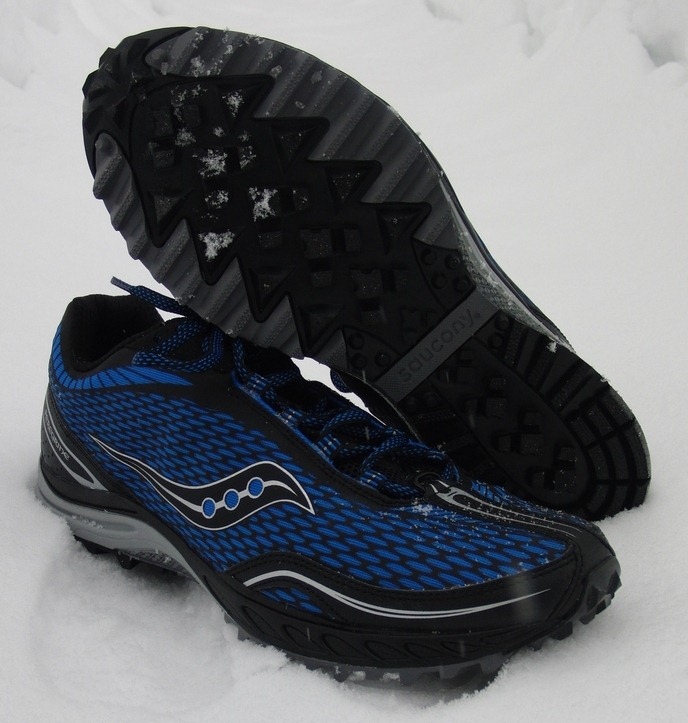
 Given the fact that the Saucony Kinvara is one of my favorite road shoes (mostly for marathon racing and long runs these days), I was excited last winter when I found out that Saucony would be releasing a trail running sibling to the Kinvara: the Saucony Peregrine.
You can tell from the photos included in this post that I’ve had my Saucony Peregrine’s for quite some time now (these were a personal purchase). I first started running in the Peregrines while the streets and sidewalks around my home were covered with a healthy layer of snow and ice. They performed great in those sloppy and sometimes slick conditions, but for some reason they didn’t initially grab me in the way that some other shoes have. However, I’m glad that I didn’t jump the gun and write this review earlier based on those initial impressions. As the weather has warmed up and the shoes have broken in a bit, I’ve actually come to like them quite a lot. The Peregrine is probably the most “maximal” of the trail shoes that I currently run in, but it is a great step-down shoe for those who might be looking for a trail shoe that provides a bit less underfoot.
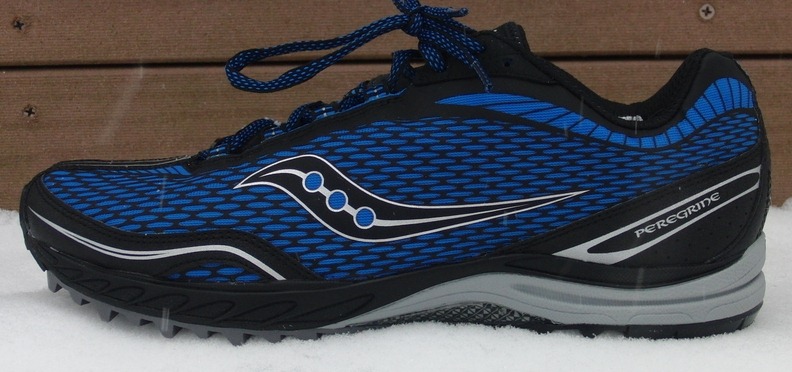

The Saucony Peregrine is a really nice looking shoe – rugged and subdued, but I like the blue color with the black webbing. Very well designed. It’s extremely comfortable in terms of fit and feel, sharing the softish Progrid-Lite midsole of the Kinvara. If you like a firm trail shoe, this is not the shoe for you. The interior of the Peregrine is plush and very nice – I’ve run sockless in them on several occasions with no problems. The material that Saucony used to line the interior in the region of the forefoot and midfoot is fantastic and feels great against the bare foot – I’d love to see it incorporated into more shoes. If I had to use a single word to describe this shoe for me, it would be “comfortable.”
Having worn/reviewed dozens of shoes over the past few years, I’ve become very attuned to slight variations in fit. I could tell immediately that the Peregrine was built on the same last as the Kinvara, but after putting a bunch of miles on them I had the distinct sense that there was a bit more room in the forefoot of the Peregrine. I emailed a friend at Saucony, who in turn got in touch with their design department, and they confirmed that although it is built on the Kinvara last, they did indeed add a bit of volume to the forefoot. The fit is really nice on my foot, and I’m quite pleased that my feet were sensitive enough to be able to sniff out that difference! Though still not as wide in the forefoot as the New Balance MT101, they are plenty roomy for me.
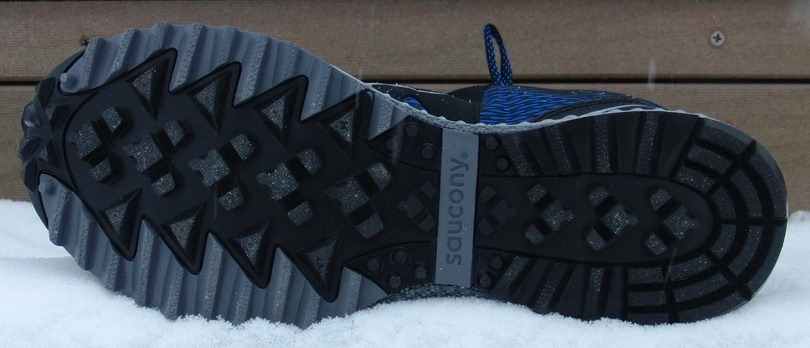
The outsole of the Peregrine is rugged and well lugged – grip was great on the ice and snow last winter. The lugs are not so large that running on the road is uncomfortable, but unlike the New Balance MT101, I probably would not recommend the Peregrine as a hybrid road/trail shoe. This one is better suited for the dirt.
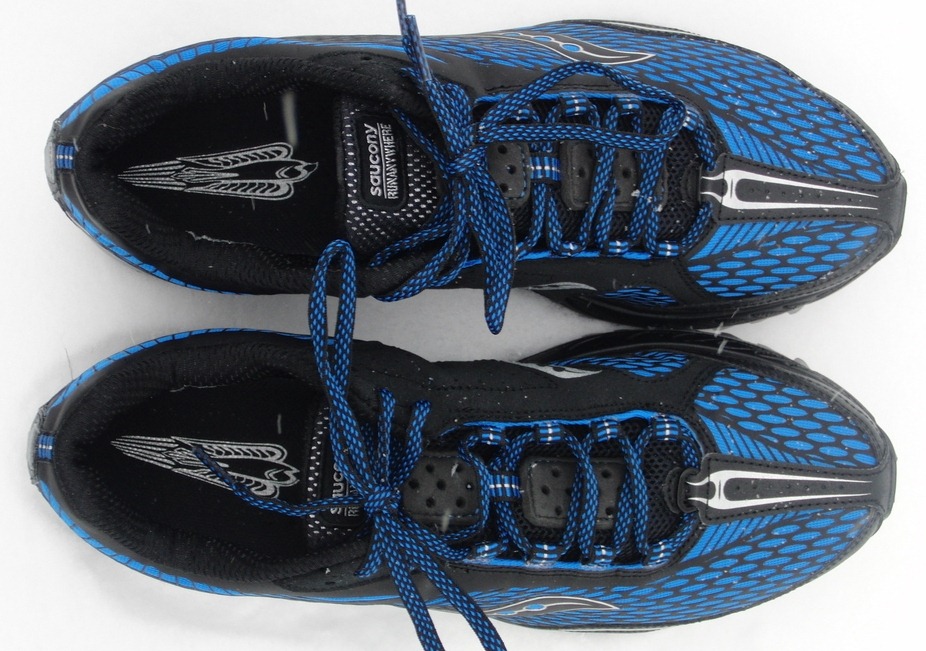
In terms of specs, the Peregrine midsole is touted as 4mm drop (24mm heel, 20mm forefoot), but as with many Saucony shoes, the insole adds a bit to the heel raise. I use my flat Nike Free insoles in them to minimize heel lift. Running without any insole is also an option as the bed below the insole is smooth (unlike the scratchy mesh material under the insole of the Saucony Grid Type A4) – this would add further volume to the shoe. Weight in my size 10 is just a hair under 10oz, so nearing my self imposed 10oz limit on shoe weight. However, they don’t feel terribly heavy to me, so no major complaints there. It may just be that I don’t notice weight as much when running on trails.
Conclusions
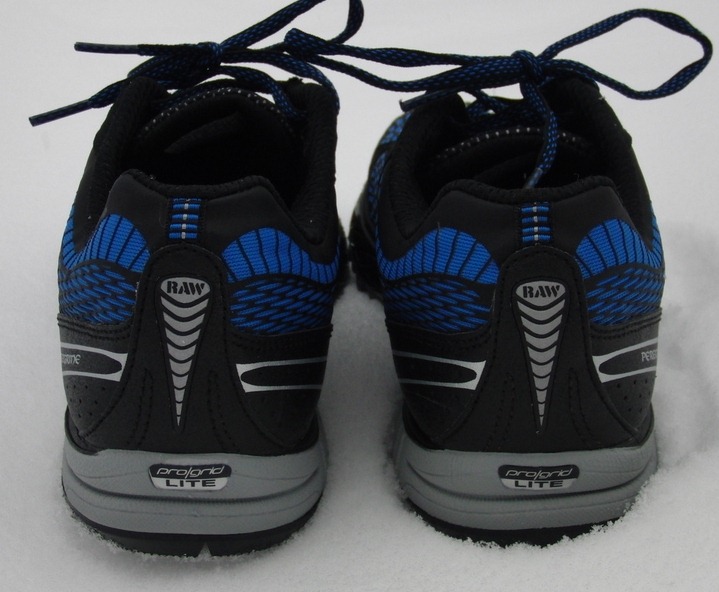 The Saucony Peregrine is the most substantial trail shoe that I currently wear (just got a pair of the 5mm drop La Sportiva X-Country, which will likely be comparable in that sense), but they are incredibly comfortable and offer a great fit and feel for my foot. As I’ve stated previously here on Runblogger, I generally either like shoes with a bit of softness, or shoes with virtually nothing at all under my foot. With regard to trail shoes, the Peregrine fits in the former category, whereas shoes like the New Balance Minimus Trail or Merrell Trail Gloves fit in the latter. They all serve their purpose in my rotation, and my choice of which to wear largely depends on how I feel on a given day.
In summary. if you’re looking for a rugged shoe with a bit of cush, and are interested in a transitional-style trail shoe with less than the usual heel-forefoot drop, the Saucony Peregrine is an excellent choice.
Check out the Saucony Peregrine page on the Saucony website for more information.
You might also like:
 Saucony Virrata Review and Comparison to the Saucony Kinvara 3: Guest Post by Alex Raggers
 Saucony Grid Type A5 Running Shoe Review: A Phenomenal Racing Flat!
 Brooks Pure Grit Trail Shoe Review
 Saucony Hattori LC Lace-Up Review – A Massively Improved Update to Saucony’s First Zero Drop Shoe
 Saucony Kinvara TR Trail Shoe: First Run Thoughts


 About Peter Larson











SO glad you reviewed this shoe…I’m planning on getting it next paycheck!
Thanks for the review. Ordered a pair along with the Kinvara’s and cannot wait to try them. I think given that I’m making the transition this sounds like it’ll fit me well!! Fingers crossed!
I don’t have the Saucony Peregrine because I didn’t find it. I run with Xodus. Some friends have the Saucony Peregrine and the think as you. Good “Excelent” trail :)
Pete, do they have the same internal structure (i.e. the four section banded plastic structure underneath the mesh material that connects from the bottom to the top lacing portion that helps in forming the shoe to the foot) on the outside portion really starts to feel like a tightened band (like a rubber band) in the middle outer portion of my left foot after 2-3 miles and is really constrictive. I’ve tried lacing the shoes in various degrees of slack but I always get that constrictive band feeling on the outside of my left foot. If I’m running anything longer than 5-6 miles its almost impossible for me to continue without basically slacking the laces to nothing mode to finish. There is no way I could even do a half in these. I have no such problem in any other shoe I own. The NB MT101’s are the best fitting and most comfortable shoe I’ve ever had on my foot. It’s like my own foot with a small bit of cushion. I really really wanted to love the Kinvara but it just doesn’t work for me. I need a new trail shoe and I know the MT 101 covers everything but the La Sportiva trail shoes seem to be calling my name from the raves of my Ultra running buds. Thoughts?
Great review.
For a point of comparison for anyone who likes the Saucony Xodus, I’ll add that the fit of the Peregrine actually feels (to me anyway) less like the Kinvara and more like a leaner Xodus with a lower heel. Might come purely from that volume in the toebox which you reference.
I’ve worn the Xodus for years and loved them. I also ran most of my road mileage for a few months last year in the Kinvara but eventually stopped wearing them, as the forefoot of the sole was just a bit too narrow to accommodate my “sixth toe,” particularly as they began to wear. Even the Minimus, despite boasting a wide toebox, feels tight to me in that region–partially because of that metatarsal band, but also because of the way the insole meets the shoe’s upper. The Peregrine feels perfect to me in terms of fit.
I also agree with Pete that it’s certainly more of a transitional shoe and not a true minimalist shoe. That said, having done quite a bit of trail running in my VFF Bikilas over the past year, I’ve found that I like a little more sole on the rocky, rooty trails of Pennsylvania. The Peregrine offers the right amount of light protection for my taste. It’s a great middleground between my bulky, beloved Xodus and a barefoot-style shoe.
My only 2 complaints:
1) As some have pointed out in other reviews, the lugs have some trouble shedding mud, so the shoes can get heavy and occasionally require a quick soak or some shuffling through grass.
2) I love the heelfit of the Kinvara. The Peregrine has a more traditionally padded heel/ankle. Would have liked to see them shed some padding in that area.
Great review, Pete (as always). The info is helpful since I’m looking for a mid way shoe. I currently have Salomon XA Comp 5 and VFF’s. I slowly made the transition to the VFF’s and love running in them (just up to 6 miles). The Salomon’s just seem like too much shoe for me now, but this is what I have for longer distances (7 to 30 mi).
I’ve been thinking seriously about getting the NB-MT101, but now wonder if that’s too big of a transitional step for long distance running. Particularly now since I’ve had several weeks off from running due to a metatarsal injury. (Wore VFF”s on a 10 mi run with lot’s of gravel and rocks. Didn’t intend to run this distance in the VFF’s… long story). From what you described, sounds like the Peregrine would be a good middle shoe to (re-)transition before trying to go all the way to a minimalist shoe.
The MT101 is also a reasonably moderate step, and it has a
heel-forefoot drop double that of the Peregrine. Both are good
choices. Be careful with this VFFs!
OK, thank you for reminding me that the NB MT-101 has a bit more heel to toe drop. Perhaps I was confusing them with the NB Minimus Trail or reviews that I read about the NB MT-110. So, at this moment it seems like the Peregrine is closer to what I’m looking for (or at least until the NB MT-110 is available – 2012?). Or… I can get the NB MT-101 and have the heel shaved down. ???
As you can see, I’m still a little undecided. ;)
Btw., your reviews are so thorough and helpful — I suggest your site to friends when they’re looking at changing to a new running shoe.
I’d say get the Peregrine now, and by the time the MT 110 comes out
you may be ready to buy a new pair!
Building on the success of the award winning Kinvara, Saucony invites the mild pronator into the minimalist category with the introduction of the ProGrid Mirage. The addition of a midfoot support bridge provides motion control, while still allowing the runner to enjoy the advantages of a minimalist shoe.
How is the toebox and arch support compared to the Kinvara?
Toebox a bit roomier, arch support similar.
Interesting that Same Winebaum thought this would be a good road shoe, while you do not. Is this because its too firm or the tread is not conducive to road running in your opinion?
It’s not so much that you can’t use it on roads, it’s just overkill – pretty
solidly lugged. Definitely not too firm though.
Nice review about this shoe. I must agree that it is one good looking shoes.
I just bought a pair of these to go with my Kinvaras, which are my go to shoe for distance runs and marathons. Whilst I find the fit is the same, to me on the run they feel like much more shoe due to the fact that the sidewall and sole are more substantial and stiffer. When holding them alongside the KInvara and flexing the sole the difference is big. So in my march towards minimalism I would definitely say that these are a step in the opposite direction. Maybe I was expecting too much in hoping for it to feel exactly the same as the KInvara, but without the ice skating properties on steep trails….?
I’ve had these for a month and pretty much agree with the whole review. They feel great, but for most applications they seem like overkill. Personally, I’d rather go with something more minimal even on moderately rooty and rocky trails. While it’s hard to fault them, I think the Peregrines will be relegated to hiking duty with occasional use on exceptionally gnarly trail runs.
That said, I will try them without the insoles to see if I get more ‘feel’. Also, maybe after a few months they’ll ride lower as the foam compresses.
UPDATE. Well I spent the week breaking them in, with promising results. I took the insoles out, which helped a lot – those babies are thick and spongy. Then I wore them on a long hike and 2 runs.
I now feel the Peregrines will be my go-to shoe for anything from moderately technical on up. They still ride too high to be useful on flat, repetitive terrain – it’s hard for me to monitor my footstrike. But on anything that goes up, down and around a lot, I’m not monitoring anyway – my foot will do what the trail dictates, and I just need to keep my cadence up basically.
Bottom line, now that they’re riding a bit lower I’m digging the balance of lightness and structure on the Peregrines. The lugs are still kind of overkill, but with no insoles the ride is sufficiently low.
Glad they’re working out! I’d also love to see a version with a bit less
midsole.
Have you tried the new Exodus 3? They have a 4mm drop like the Peregrins, but seem a bit more substantial up top. I think they’d put up with more abuse than the Ps, but they are both nice shoes for the trails.
Have not tried it – a bit on the heavy side for my taste.