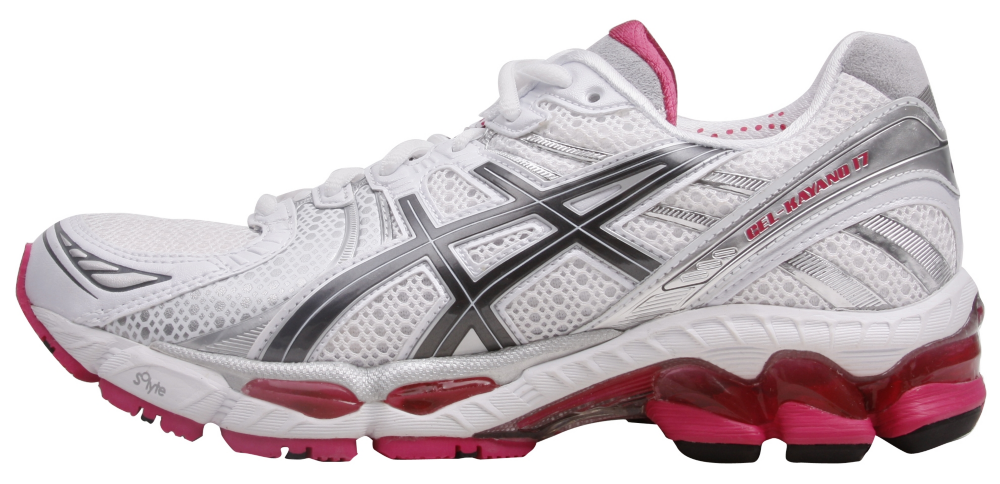
 I’ve been following with interest a spirited debate that is taking place over on my friend Bill Katovsky’s Zero Drop blog. Like me, Bill is an advocate for greater variety in shoe choice, and his approach on his blog is to poke fun at the status quo in addition to providing the occasional shoe review. He also has published a number of interesting guest posts – his blog is well worth a look if you haven’t seen it already.
Anyway, yesterday he posted a comment by ASICS head of research Simon Bartold in which he essentially refers to the minimalist running movement as “nonsense,” and says this about ASICS future running shoe plans:
“We (ASICS) are now working on a training shoe that is less structure and lightweight, but still offering stability and holding true to a rearfoot srike pattern design. I have based this on the premise that, no matter what is being said about technical running footwear, there is no evidence that it really ‘aint broken, so we will tweak, but no need to fix. The minimalist movement works on the premise that by reducing heel height, i.e. the overall gradient, by maybe 6 mm, it induces a midfoot or even forefoot strike pattern. I have not been able to identify one single piece of credible evidence to support this.. so.. we will stick to our guns. Once more the ether is thick with unsupportable nonsense. pose, chi, toning, barefoot, minimalist….when will it end?”
Based on this comment, ASICS appears pretty content to avoid following its major competitors (e.g., Saucony, New Balance, Nike and soon Brooks) into the minimalist fray. To be honest, I don’t really care if they do – there are plenty of options out there nowadays from other companies, and it’s ASICS loss if the movement continues forward and they lose out on a growing sector of the running shoe market (according to Leisure Trends Group, minimalist models made up 39% of all trail shoes sold in April 2011 – they accounted for only 3% in 2010).
The comment above is not why I decided to jump in and write this post. Rather, my reason for doing so is to respond to a comment posted by Bartold in response to what Bill published on Zero Drop. In his comment, Bartold challenges Katovsky to provide scientific evidence for any of the claims he has made, and states “there will be no evidence.. because you have none.” This is where my interest began to pique. Let’s take a look at what Bartold has to say, and see what evidence might in fact be out there.
“Firstly, your photo caption erroneously states ” if Asics had its way, all runners should be perfectly content to continue as over-striding heel-strikers.” Not sure where that came from, certainly not me. I beleive some runners should forefoot strike. for example, if one has less than 10 degrees dorsiflexion, which many runners do, that runner cannot achieve heel srtike. But you know what.. humans are very varied, and lots of runners heel strike and run well and efficiently.There is no problem midfoot striking or forefoot striking in an ASICS shoe.. I recommend it all the time, especially if I think a change in form will help. But not to everyone.”
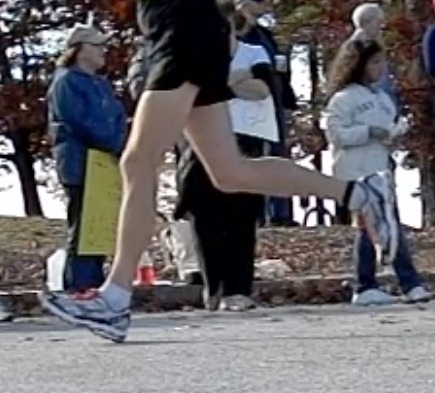 OK, first, the bit about 10 degrees of dorsiflexion. I’m no podiatrist, but I’ve watched slow motion video of a lot of runners (thousands), and almost every one wearing a typical shoe with a ~12mm heel lift and extensive cushion is a heel striker (this data is working its way through peer review as I write this). You can look at the photo in Bill’s post or the photo to the right and see that the sole of the shoe is virtually perpendicular to the lower leg just prior to contacting the ground. Assuming that shoe has a 12mm heel lift, it’s quite possible that the foot inside the shoe is actually plantarflexed at heel strike. Furthermore, the runner in the photo above could plantarflex the foot a heck of a lot more and still be landing on the heel – that’s what overstriding will allow you to do. So, I’m not quite sure where that 10 degree figure comes from. Perhaps I’m just misunderstanding what Bartold is saying, but then I’m just a lowly blogger.
Bartold then discusses that he believes some runners should forefoot strike, and I agree. Some people will naturally forefoot strike in any shoe you give them, just as some people will continue to heel strike even when you take their shoes off – see Daniel Lieberman’s 2010 Nature paper for evidence of this. However, both cases are rare – forefoot striking in lifted shoes is not common, just as heel striking barefoot is not common. I also agree that many runners do just fine heel striking, but anecdotal evidence (and I get a lot of it) suggests that others do not, and that moving to less shoe can be of great benefit. Does everyone need to go minimalist? No, absolutely not. If you are running pain free in ASICS 2100 series shoes, by all means, keep doing so. Being able to run is what is important after all, and why mess with what’s working. However, as Bartold points out, humans are variable, so why should we expect the 12mm lift, heel strike model to work for everyone? This is why I’m so perplexed at his willingness to fight the minimalist movement. If some people are benefiting it, why all of the resistance? Sure, ASICS makes racing flats that are similar to many minimalist shoes, but good luck to the recreational runner who wants to find a pair to try on and doesn’t have access to a specialty running store. It’s pretty darn unlikely that you’ll find the Piranha or Hyperspeed at your local Foot Locker or Dick’s Sporting Goods. Until recently, the average runner has had little choice but to go with the 12mm lift, heel striking model. Thankfully, progressive companies like Saucony, Merrell, Altra, Vibram, and New Balance are bringing alternative options to the running masses.
To be honest, I’m also quite skeptical that midfoot or forefoot striking in a 12mm lift shoe is a good thing. To accomplish a forefoot strike in a shoe with a big heel lift requires quite a bit of plantarflexion upon ground contact to clear the heel. Since evidence seems to be a popular word in this discussion, what evidence is there that this is safe? Shouldn’t the burden of proof be on the company making the product to show that it’s safe for the consumer? Isn’t this what drug companies have to do?
Moving along, Bartold next says this:
“Sorry Zero Drop.. you are misleading your bloggers.. you state “Most conventional running shoes have an average drop of 12 mm, which places too much impact and stress on the heel region”. Nonsense.. show me the proof.. published in a peer reviewed scientific journal.”
As I have written previously here on Runblogger, forefoot striking has been shown to reduce vertical impact peak (many studies, Squadrone and Gallozi, 2009 and Lieberman et al., 2010 are recent examples) and vertical impact loading rate (Oakley and Pratt, 1988; Williams et al., 2000) relative to heel striking. Data showing no difference between forefoot and rearfoot impact loading rate is out there (e.g., Laughton et al., 2003), but data are limited that involve people well acclimated to multiple landing types. Data on loading rates are sometimes difficult to interpret if runners are not acclimated to a barefoot running style – for example, De Wit et al., 2000 showed dramatically increased vertical loading rate in barefoot runners compared to shod runners, but their barefoot runners were heel striking. One would fully expect a barefoot heel strike to exhibit a higher loading rate since little cushion other than the heel fat pad is present to slow down force application. Lieberman et al., 2010 showed that habitually barefoot runners overwhelmingly land on the forefoot, which suggests caution when interpreting studies of barefoot heel strikers (who were probably unaccustomed to running barefoot). See this recent (2011) paper by Jenkins and Cauthon in the Journal of the American Podiatric Medical Association for more on this issue.
Why does any of this matter? Higher vertical impact loading rates (how fast impact is applied to the body – think punching a wall with your bare fist vs. a boxing glove) have been linked to injuries like lower extremity stress fractures (see this review paper by Zadpoor and Nikooyan, 2011). Conversely, Nigg, 1997 reports results of what appears to be an unpublished graduate thesis suggesting that impact force and loading rate are not linked to injury, and that increased loading rate was actually associated with fewer injuries. However, this analysis looked at short term injuries and did not look at injuries by specific type.
Next…
“You further state “The runner’s cushioned heel strikes the ground first instead of the shoe landing on the more biomechanically efficient midfoot or forefoot”.. again.. show me the evidence.. let me save you time.. you will not find it because it does not exist. “Excessive heel-striking marks an open-invitation for potential foot and leg injuries. But minimalist and barefoot running shoes have a much less drop. Which means you are now landing on the midfoot or forefoot– the way nature originally intended us to run.”.. balony.. absolutely zero evidence of a connection between heel striking and injury.. and there is no evidence whatsoever that “nature” intended us to run on the forefoot.”
Bartold goes on to cite a reference by researchers from the University of Massachusetts that reports “a 7% decrease in running efficiency in the barefoot group in a model predicting barefoot vs shod running.” I’m not sure exactly which paper he is referring to, but if it’s the one I think it is, it’s a conference abstract in which a computer model was developed based on measurements from a single individual. No oxygen consumption measures from living human beings were involved. So, the two-dimensional computer model based on one person referred to in an unpublished conference abstract ran better on its heels…not sure I consider that to be strong evidence. Jenkins and Cauthon (2011) summarize a number of studies which have shown reduced oxygen consumption in barefoot running compared to shod running. However, to be fair, it’s quite possible that this is simply a mass effect since removing shoes removes weight from the end of the limb. Squadrone and Gallozzi (2009) found oxygen consumption to be lower in in experienced barefoot runners running in Vibram Fivefingers vs. traditional shoes, and noted that running in traditional shoes resulted in significantly greater dorsiflexion of the foot on landing (i.e., they were heel striking, albeit mildly). Interestingly, barefoot was not significantly more efficient than either traditional or Vibram Fivefinger running (i.e., it was in between the two). The efficiency question might just be a wash, but I don’t think we can really say either way with any great degree of certainty at this point.
Studies of efficiency aside, from a performance standpoint (where it really matters), Hasegawa et al. (2007) looked at elite half marathoners and found an increased proportion of midfoot strikers among the faster runners in their sample. Furthermore, my friend Steve Magness reports some data from 800m and 1500m races showing that ground contact time is shorter in forefoot and midfoot strikers, and Hasegawa et al. (2007) showed a distinct relationship between ground contact time and speed (shorter GCT = faster runners).
Magness also makes this relevant point regarding why “nature” might intend for us to land on our forefoot (read his post, it’s well worth it):
“…the Achilles tendon and the arch of the foot store a large amount of energy upon footstrike and then that energy is subsequently used upon take off. A forefoot strike has shown that it potentially uses this mechanism much better. One reason is that upon initial contact the foot is in better position to store the energy from the ground strike. In heel running, a great deal of the initial strike energy is lost. On a similar note, it is possible that a forefoot strike utilizes the stretch reflex mechanism better due to the position of the foot upon contact. With a forefoot strike the whole calf complex is in better position to be stretched and subsequently respond than in a heel strike.”
Granted, this is not peer reviewed, published data, but Magness was recently hired to help coach the likes of Galen Rupp and Kara Goucher, so apparently Alberto Salazar and Nike think he’s pretty on the ball. What’s more, Lieberman’s nature study (2010) showed that barefoot individuals who have never worn shoes overwhelmingly run on their forefoot. Not all of them, but the vast majority. Does this mean that they will do so in every circumstance? No, probably not, but one need only take of their shoes and run down the road to see that your foot strike will change. I’m pretty well convinced that nature intended us to run most of the time on our forefoot.
Finally, I teach comparative anatomy, and this has some bearing on my thoughts about where footstrike should occur. When you look at cursorial (running) animals, what you often find is that over evolutionary time their “heels” have become raised up off the ground. Dogs run on their toes (digitigrade), and horses run on the tips of their toes in the form of a hoof (unguligrade). They do this because it allows them to essentially lengthen their legs, and they have slender distal limbs with many long tendons and ligaments. If one is to believe the theory that humans are/were on a path to becoming distance running specialists, would it not be a logical hypothesis that we were also moving in a direction quite similar to other running animals? We have long Achilles tendons compared to chimps, and an arched foot supported by the plantar fascia. As Magness states above, storage of elastic energy is more effective with a forefoot strike than a heel strike, and most of us will automatically convert to a forefoot strike after running barefoot for a time (sometimes instantly).
Onward…
“You see, you are completely missing the point.. every runner is different and has different requirements based on their biomechanics, their weight, their gender, their physiology etc. You are deliberately espousing a one size fits all approach and telling your readers that if they run barefoot or minimalist, they either will not get injured or will have injury rate grossly reduced.. are you kiding.. fact is, running is dangerous.. 65% of runners will get injured.”
Yes, every runner is different, and does have different requirements. ASICS has a lot of shoes to choose from, just not if your preference or requirement is one without a big heel and lots of cushion. See again my above comment about the likelihood of the everyday recreational runner finding a pair of ASICS racing flats in a typical shoe store. In terms of heel height, ASICS might as well be one size fits all.
And yes, runner’s will always get injured, and we will do so because we are often dumb and run more than we should and when we should not. However, in the absence of clinical trials, which ASICS has not published in a peer reviewed journal to show that their own shoes reduce injuries, we rely mostly on anecdote. Anecdotes suggest that some runners benefit from a barefoot or minimalist approach. Why ignore this? If you believe that humans are variable, why is the 12mm model so ubiquitous in the ASICS shoe lineup. Where’s the evidence?
“I challenge you to provide me with ONE single piece of evidence, published in a peer reviewed scientific journal to support the concept that there is a proven benefit to lowering heel gradient.
He asks for ONE piece of evidence, so here’s one. Again to Squadrone and Gallozzi, 2009. Running in zero drop Vibram Fivefingers compared to traditional shoes reduces oxygen consumption and reduces ground contact time (which has been shown to be associated with greater speed). Maybe it’s not a perfect example, but the claim that there is NO evidence is false. We can turn this around and ask for peer reviewed, published evidence of a benefit to running in ASICS shoes. What is the benefit of a 12mm lifted heel? You’ll typically hear about reduced Achilles problems, but has this been proven? Richards et al., 2008 state that “…the overall impact on injury rates of running in a shoe with an elevated heel remains untested in clinical trials.”
Fact is, this type of argument won’t get us far, because neither side has a whole lot of published evidence right now.
“Improved mechanics and muscle function? Nope.. Chockalingham et al 2011.. no change to gait kinematics or muscle function when changing from heel strike to forefoot strike.”
Last time I checked, a change in footstrike is itself a kinematic change. I was unable to find this reference anywhere, so hard to evaluate it, but kinematic changes have been shown many times between rearfoot and forefoot strikers. For example, consider this statement from a conference abstract by McClay and Williams, 1998 (published later in the Journal of Applied Biomechanics as Williams et al., 2000):
“Significant differences have been noted both in joint kinematics, kinetics and ground reaction forces in forefoot strikers (McClay and Manal, 1995, Cavanagh et al, 1980, Oakley et al, 1988, Harrison et al, 1988). These differences include greater rearfoot plantarflexion and inversion and knee flexion at footstrike and greater peak dorsiflexion and eversion velocities. In addition, larger peak vertical and anteroposterior GRF have been noted along with larger peak powers at the rearfoot and lower peak powers at the knee in the FFS group. Vertical loading rates are also lower in FFS. RFS that have injuries thought to be associated with the force transient present with heel contact may do well to adopt a forefoot strike pattern resulting in the elimination of the impact peak and reduction of the loading rate. However, it is not known whether simply instructing someone to “run on their toes” results in a biomechanical profile characteristic of a practiced or natural FFS.”
Moving along…
“Improved strength going minimalist or barefoot? sorry, not according to the published literature “Effect of Minimalist Footwear on Medial Arch Height Justin F. Shroyer et al and Effect of Minimalist Footwear on Arch Rigidity Index Cory E. Etheredge et al. Hey .. check it out.. it out there in the public domain for all to see.. I am not making this up.. we deal with facts, not opinion, folklaw and myth.”
Fact – these once again are conference abstracts, not peer reviewed publications. What’s more, my suspicion is that arch height is more related to ligament laxity and joint congruence than it is to muscle strength, so I’m not sure these studies can even answer the question of whether muscle strength increased as a result of wearing minimalist shoes. Better would be to actually look at MRIs and consider cross-section area before and after the intervention. You know what, this has been done! If we’re in the business of citing abstracts, how about Potthast et al. 2005 who showed that training in the Nike Free compared to a traditional shoe increased cross sectional area of the flexor hallucis longus, and improved toe flexion strength, plantarflexor strength, and dorsiflexor strength.
Furthermore, arch height or arch collapse measured statically are not good indicators of what the arch does dynamically in a person who is actually running. See Dicharry et al., 2009 for more on this. Basically, you can have a hypermobile foot while standing, but still have the same amount of arch collapse as a person with a normal or hypomobile foot while walking or running, presumably due to adequate internal stability mechanisms (i.e., strong feet and legs).
Finally, there’s a snide remark about minimalist shoes following the path of toning shoes. However, I have a big problem with this. Toning shoes are an aberration that deviate humans farther from the condition we are born with (barefoot). Minimalist shoes bring us closer to our natural condition (barefoot). I would argue that the Asics Kinsei or Kayano has a lot more in common with a Sketchers Shape-Up than the Vibram Fivefingers do. I, for one, was not born with a hunk of unstable cushioning under my foot (like the Sketchers provide), nor was I born with my heel lifted 12mm off the ground with a support element wedged below my arch.
I’ll finish by playing Bartold’s game a bit. Visit the ASICS shoe fit guide. It states this:
“Pronation is a normal, natural rolling motion that helps to attenuate shock. Some runners find that their foot does not roll all the way in, making the foot work harder to push off properly. This is known as underpronation (or supination). Conversely, a foot that rolls inward too much in known as overpronation. Runners who underpronate (or, supinate) would feel more comfortable with a Cushioning shoe. Overpronators do better with Maximum Support, and those with a more neutral stride would do well with Structured Cushioning.”
How do you know which category you belong to? What you’ll find next are instructions on how to determine your arch type based on the “wet footprint test.” Once you determine your arch type, you can translate it into a pronation category and choose a shoe from one of three categories: high arch gets cushioning, medium arch gets structure cushioning, low arch gets maximum support. These are basically different words for neutral, stability, and motion control. Since we’re in the business of asking for peer reviewed, published evidence, I’d ask what the evidence for using arch height to choose a shoe might be? I’d ask whether pronation has been reliably shown as a major cause of running injury that needs to be controlled by a shoe? I’d ask whether ASICS shoes or pronation control devices have been proven to prevent injuries?
Surely the folks at ASICS must be aware of the paper by Ryan et al., 2010. They showed that neutral runners did better in stability shoes, overpronators did better in neutral shoes, and all severe overpronators in motion control shoes got hurt. In other words, either the shoes don’t do what they are supposed to, or static measures of the foot are not a good basis for assigning shoes. And the study was supported by Nike.
How about the series of studies by the military (Knapik et al., 2009; Knapik et al., 2010a; Knapik et al., 2010b) which showed that when assigning shoes based upon arch type, recruits (thousands of them were included in these studies) were just as well off being assigned a stability shoe by default as they were being put in the correct type of shoe for their arch type. So much for that wet test ASICS!
How about Dicharry et al., 2009 who showed that static measures of arch collapse do yield distinct groups, but that those distinctions disappear when walking and are tiny at best when running? How about Nigg et al., 1993 who found that “arch height does not influence either maximal eversion movement or maximal internal leg rotation during running stance.”
When criticizing minimalist advocates for lacking evidence, it seems that the lack of evidence is not so glaring as it is made to seem when you do dig into the literature. Without a doubt, there is some amount of contradiction, which is why this debate gets so heated these days. What’s more, some of the evidence that is out there casts serious doubt on the very process that ASICS recommends when it comes to choosing one of their shoes – what could be more fundamental to what a shoe company needs to do than accurately advise its customers on how to choose a shoe?
I think I’ve said enough here. My position is and has been that each runner is an individual, and I agree with Bartold when he states that. Given this, different runners have different preferences and needs. Some may want a 12mm lifted shoe, but others don’t. Some of those who don’t might have made the switch to escape a long term injury, and it’s clear that in many cases switching to minimalist shoes has helped. Some (like me) switch simply because we enjoy running in minimalist shoes more than in big heavy clunkers (and yes, I have run in Asicsa Kayanos as well as the 2100 series). I was never injured seriously in bulky shoes, and I haven’t been injured seriously in minimalist shoes. I may or may not be faster now, it’s really hard to tell. But I will say that I am enjoying running more, and that’s all that really matters to me, and I really don’t care if that gets published in a peer reviewed journal.
Let’s finish with another quite from Bartold, this time from a 2002 radio interview:
“I think unquestionably Zola Budd got it right when she was running barefoot. I think the signs from all the laboratories around the world would support that the human foot is probably the perfect model, but of course it’s impractical for most people wanting to go out running barefoot, there are too many obstacles, and of course you know, you might get injured by a sharp object, and the surfaces we run on transmit too much shock. But in a perfect environment on a perfect surface, then an unshod foot is probably the best way to go.”
Head over to Zero Drop if you want to see more on this discussion.
You might also like:
 Podcast: Physiotherapist Blaise Dubois on Running Injuries, Form, Footwear, and Barefoot Running
 Criteria For a Safe Transition to Minimalist Shoes or Barefoot Running: Thoughts From Jay Dicharry, PT
 Can running in minimalist shoes strengthen your feet and legs?
 Shorter, Quicker Stride Reduces Impact on Knees and Hips: New Research From Dr. Bryan Heiderscheit of the University of Wisconsin
 Thoughts on Daniel Lieberman’s Barefoot Running Paper


 About Peter Larson










Perfect response! I wonder if this evidence will be enough for him. He is yet to show any actual peer-reviewed published evidence for his own claims…
Sorry Ioanna.. what claims! If you can highlight them, I will try try to reference them for you.. best.. SImon
Dude, are you serious? Ok, forget about claims. Let’s get down to the actual process of going to the store and buying running shoes. Why does the shoe industry feel that shoes with a 12mm (or greater) heel lift are the “gold standard?”
If there is no peer-reviewed evidence that these highly-cushioned shoes prevent injury or are more beneficial than zero drop shoes then why is there not more variety out there? If the studies are “still out” on either “minimal” or “maximal” (for lack of a better term) shoes then why isn’t there an even representation of both styles on shoe store shelves? It would make sense that since you’ve said yourself that all runners are different and will therefore require different styles of running shoes then there would be an even representation of both “minimal” and “maximal” shoes in stores. Instead, when I go to my local Fleet Feet running store there are about 60 highly-cushioned shoe choices and only about 6 “minimal” style shoes. I know you can’t speak for the shoe industry so just speak for Asics or what you’ve come to learn in your employment at Asics (if possible).
yep dude.. I am serious.. no one has called 12 mm the gold standard least o all me.. we do not even use 12 mm.. what is the question????
Let’s try this then (questions to follow the colon):
1) What is the average heel lift (defined as the height difference in millimeters between the heel and the forefoot) of the top 5 (by quantity) Asics running shoes sold at retail (both online & in stores) in 2010?
2) How many of those top 5 shoes have peer reviewed studies showing their effectiveness at preventing injury or increasing performance?
I swear, this whole thing is like a religion discussion where neither side budges because both sides feel they are right.
Anyhoo, I don’t have a peer reviewed medical journal article to back up what I’m about to write so SB may want to hit that little “x” in the top right corner.
For as long as I can remember every running shoe (for the most part) has always been a variation on the same theme: high-cushioned heel with much less cushion under the forefoot. Without fail there was always a huge amount of these types of shoes in the running shoe section of ______ store.
There may be some slight difference to make a few stand out from the others, such as gel pods, microchips, air pillows, whatever.
Essentially the modern running shoe has remained unchanged in the last 30 years if you don’t count the gimmicks (which I don’t). So, essentially the shoe industry, for the most part, is still selling the Model T. Different companies may give it a spoiler, Foose wheels, HID headlights, or a flashy paint job, but no matter what they do, it’s still a Model-T.
If the Asics of the world don’t start truly embracing a thing called innovation, then they WILL become the IBM of the shoe industry (as one astute reader stated previously).
Simon,
Let’s be fair here: “…I think that we’ve now pretty much established that
it’s good to have the heel raised in shoes. About 12mm is a good thing
biomechanically, because you’re in a more efficient position.” Your words
from an interview here:
link to sneakerfreaker.com… .
Do we have published, peer reviewed research showing that a 12mm heel lift
is more efficient than alternatives?
Granted, you go on to correctly state that it hasn’t been settled, but
forgive people for being confused:
*You mentioned before about a 12mm heel height being ideal? Why is that the
standard?
*Well, that’s a very interesting question because it hasn’t been settled on
at all. With ASICS we’ve always worked on a 10mm gradient. That’s the
difference between the height of the forefoot and the height of the rear
foot, so if you’ve got a cushion type shoe it might be 24mm and 14mm off the
ground. A racing flat might be slimmer at 10mm and 20mm. We’ve done a lot of
research on this and we understand that it actually puts your foot in a
mechanically better position, makes it more stable, takes a load off the
Achilles tendon… so there’s a lot of positives. There’s a lot of myths and
all that sort of crap and the problem is that every time you add a little
raise, people are going to say ‘oh but you’re removing the foot from the
ground therefore you’re going to make it more unstable and you’re more
likely to sprain an ankle’, which is complete nonsense. That’s
scientifically unsustainable. There’s no evidence to say that happens at
all.*
I’d love to see the research you mention, and it frustrates me that research
like this does not get published in peer reviewed journals.
And as for the 10mm gradient, the numbers published on the Running Warehouse
page show many popular Asics shoes to be 12mm differential:
Kinsei – 38mm, 26mm
Nimbus – 34mm, 22mm
Cumulus – 34mm, 22mm
Kayano – 32mm, 20mm
*Some are less – Speedstar, Hyperspeed, Piranha, etc.
I also happen to have two pairs of older 2100 series that my wife used to
wear (2120 and 2130), and measuring with C-calipers yields around 32mm, 18mm
(with insoles in).
Are these numbers incorrect?
For someone who wears shoes with differentials like these, going to a
flatter shoe is a big change, and does feel strange and carries risks for
sure. But as someone who has been wearing flatter running shoes for 2 years,
and who now wears mostly zero drop shoes to work (Vivobarefoot Aquas), I can
tell you that putting on my old pair of Saucony Guides makes me feel like
I’m standing on a steep downhill grade. My feet are now really good at
sensing small differences in heel height, because I have re-adapted them to
know what it’s like to be flat most of the time. I did this initially simply
out of curiosity to see what would happen, and I do still run in higher drop
shoes from time to time (rarely ever anything more than 9mm or so
differential). I’m an experiment of one, but I can attest that small
differences in midsole construction are noticeable.
Pete
*
*
Thank you Pete. You are the man. I guess I could’ve answered my own question by going to the RW site, but I was hoping Simon would own up to his intellectual lapse (pretty stupid of me).
Its interesting that these shoe company “execs” are so entrenched in the status quo (yes SB, it is a status quo as it hasn’t changed in 20+ years as you so eloquently stated previously) that they refuse to accept it may be even a little bit incorrect.
He insists on seeing peer-reviewed articles proving the benefits of minimalism and yet balks if the same evidence is requested for his position. We wouldn’t want to question over “20 + years of progressive development based on science.” How dare we even think such an outlandish thought!
If there is no proof then why the 12mm standard heel drop for the majority of recreational running shoes? It’s a question that requires an honest answer which I don’t think we’ll ever really get from Mr. SB.
I’m confused. Do you seriously believe that running in 12 mm drops is the way we were supposed to run? I really don’t care about peer-reviewed scientific journals. Take a look across the Atlantic to Africa.
link to youtube.com…
People like this adolescent do not run forefoot as a fun novelty. If they get injured then they will die, as they will be a liability to the community. This is better ‘proof’ than any MD writing up a paper. I’ve learned over my few years that doctors are rarely correct on more than you would think. Will they make money telling people to not buy their orthotics? I do not see why you would ever want to alter something as beautiful as the human stride.
Pete,
Amazingly well referenced and thoughful response. Here is my reply posted to Zero Drop.
Running colleagues,This is good thoughful discussion and glad we are having it. Lets keep it educational, scientifically skeptical (this is debate), and provide the BEST evidence we have when little exists. And as CR and JD suggest…design the study.
Here is a database of resources and articles on the topic from our website
link to trtreads.org…
Jason Robillard also has dug into the literature.
link to runnersworld.com…
For an experienced N or 1 take my story. Horrible injuries like most runners including multiple surguries in a competitive running career.
Now do almost all my running barefeet on pavement and grass surfaces. Use shoes for races and longer and quicker road work. i truly believe like Ken Bob does that it is almost impossible to hurt yourself running barefeet on hard surface if you use your brain. you self regulate in a way you cannot when in shoes. you land soft and if something shows even the slightest discomfort you stop. i’ve never seen a kid running around and playing voluntarily in summer in bare feet have an overuse injury. We are teaching the STYLE of bare foot running. I presented this video and some teaching techniques at the AMAA Sports Med Symposium at Boston Marathon this year. Dan Lieberman and Irene Davis had tons of science. Ran 2:37:00 at age 44 in shoes. Sweet bare foot one hour recovery on day after…amazing how i was post race sore before the barefoot run and afterwards this hit the reset button and felt great.
link to youtu.be
out for a morning bare foot run now after some coffee.
Respectfully,
Mark Cucuzzella MD
Mark,
Are you still racing in Newton shoes? Being that Newtons are a very unique design, do you feel your running gait similar to when you run barefoot…or in Vivobarefoots?
Fran
Fran,
yes, i race marathons in a “Naked Newton”…lots of material in upper removed , insole removed, and lugs reduced a little (i’m a small person). look forward to the new MV2 which will be more minimal. it is a progression though. The Newton is a really fast shoe when running on the roads on less than perfect texture surface….they do give back, esp with insole out and you feel the ground. pure barefoot running reinforces the proper gait and i do lots of training on roads barefoot .
Thanks for asking,
Mark
“To be honest, I’m also quite skeptical that midfoot or forefoot striking in a 12mm lift shoe is a good thing”
I completely agree. For a single run I switched from my Kinvara’s back to my Brooks Launch and by the end of the run the front of my feet were very sore after using my newly aquired midfoot strike.
Interesting observation Jonathan. Another N of 1 here, but I’ve spent
the majority of my running “career” as a forefoot striker in shoes with
the usual 12mm heel lift. In the last year I’ve very slowly been
introducing more minimal shoes. Even raced a 10 miler (1:04) on concrete in Trail Gloves
with no ill effects. More recently, I started putting all my miles on
a pair of New Balance Minimus in prep for a marathon, but developed some arch and calf pain.
Seems that with my “natural” (as in, that’s what I did in standard
shoes before I ever heard about this debate), forefoot strike, I put a lot of impact force on my arches. No big deal if I mixed up my shoe choice from day to day, but after a few weeks of continuous running in the Minimus, I found myself HEEL STRIKING and rolling my foot to minimize impact. So, in this one instance, minimal shoes were encouraging me to heel strike to minimize impact force.
Again, this only became a problem when I tried to run full-time in minimal
shoes. Now that
I’ve gone back to an 80/20 mix with my Brooks/NB, I find that all the pain has
dissappeared again, and that I run on my forefoot again in all my
shoes.
Not sure if all this is because my feet have been “corrupted” by heel-lifted running shoes, or if it is common to those of us who do intuitively forefoot run in heel-lift shoes. But I think it might also indicate that, for individual runners, the practical reality of proper shoe choice is unpredictable and has to be based on trial and error. In the right (or wrong) circumstances, a minimal shoe can encourage some odd mechanics, just as any other shoe might in someone else.
Just saying. P
I agree here – we are all indivdiuals with individual needs, which is why I
advocate for variety in shoe choice. I have no problem if people wear and do
well in more traditional shoes, as enjoyment of running is what is
important. My problem is the unwillingness to acknowledge and explore the
idea that some people (a lot?) seem to prefer and/or do better in something
else. Human variability needs to be met with variability in footwear
options, no 50 variants on the same common theme.
Pete
yep..that’s what I have been saying.. I am very adventurous and reccommned variability as well.. see previous posts
Pete.. I hope I am not playing a game! I certainly did not think thats what it was about..you know, the interesting thing is that in a crazy way we are both saying the same thing.. and please do not represent me as the ASICS mouthpiece. I entered this debate as an individual with 30 years in the world of biomechanics and sports medicine, and the views I am putting across.. in the spirit of asking questions and receiving answers, are my own. It seems a pity for the discussion to get personal. I have been trying to make only one point.. everyone is different.. some people do well running barefoot, some people do well running heel toe, some people do well forefoot srtiking. I have never.. ever, said do not do these things. What I have said is allow the athlete to make the choice. You will note that not at any point have I said everyone should run in an ASICS shoe.. of course not.. they have choice, and for some people, this product will.. for whatever reason not suit them, so they should and must look elsewhere.. but the key here is to allow choice.
The problem I have with this argument is the sense that the advice is that everyone will benefit from wearing a minimalist shoe, or at the very least, a shoe with zero raise gradient. Sorry, I do not agree, and that is taking the choice away frm the athlete. It also has the potential to injury them.. which is never good. Now I know you are immediately thinking hah! so do conventional shoes, but as you rightly point out, we have no proof either way. Many in these blogs have demanded a study proving conventional fotwear reduces injury rates. Well you sound like a guy with a scientific background, so maybe you can explain to the punters on this blog just how dificult it would be, if not impossible to design a meaningful study to ask that scientific question. If i put mY ASICS hat on, I would LOVE to do that study.. really, really interested in the answer, good or bad for the ASICS brand.. but how do i or you control all the variables this study would throw up. If you have an answer, i would genuinely like to know your thoughts.
I do not want this discussion to degenerate into a p*##ing match because it can and should be a healthy debate, no an us versus them argument. I have an opinion, so do you, both equaly valid. ASICS has a point of view, and we base this on the science that is available at this point in time. If that opinion does not match others, then that’s OK because other choices are available. Does that mean ASICS direction is wrong.. time will tell. It is, at times difficult to swallow the criticism, when we were the only brand to fly in the face of rigid, inflexible,heavy shoes all those years ago, and make changes no-one else would… based on the available science.. for what we believed was for the benefit of the athlete. Do you and the bloggers really believe that it is only about selling shoes? if that is the case my entire professional career has been a waste, and whatever small contribution I have made to footwear science has been worthless, because, i can say, hand on heart, everything I have ever done has been only with the wellfare of the athlete in view. Sure we hope whatever we do will sell shoes, but c’mon, do you really think we do not have the athletes best interests at heart? If that is really the case I find that really sad.
In relation to the references you quote..in the words of my good mate Craig Payne from Podiatry Arena, where this all started “There is no debate about if barefoot running is good or not. The debate is about the misuse, misrepresentation, misquoting and misinterpretation of the science”
An example of this is your reference “see this review paper by Zadpoor and Nikooyan, 2011”. to quote the actual paper..
results showed no significant differences between the ground reaction force of the lower-limb stress fracture and control groups (P>0.05). How does this support you argument? Furthermore, the Liebermann Nature article (which by the way is not a peer reviewed scientific publication), has been so badly misrepresented that Dan himself has posted a discalimer on the Harvard website saying the research has been misrepresented. People are reading what they want into it.. and by the way.. there were big holes in this.. like comparing a cohort of 19 year olds to a cohort of 40 year olds and also mixing genders.. hmm. I am sure you would agree when reading scientific papers, ‘critical appraisal’ is very imoprtant. A number of the papers you quote did not actually show what you are claiming they show. This does not mean you are wrong; you are just assuming you are right by using references that do not actually show what you claim they show.
Anyway.. thats my 2 cents worth.. interesting and hopefully healthy debate.. maybe one day we can meet and go at it face to face.. much more enjoyable than blogging, especially since I am such a crap typer! Can I once more emphasise that I do not claim to have all the answers, and that this discussion should be light and maybe even a little tongue in cheek, without getting personal.. to quote Fox Mulder, the truth is out there.. hopefully we find it sooner or later. best.. Simon
Simon,
I agree, the debate should be healthy and open minded, and I do agree with
you on the point that humans are variable and require variable options. My
point in writing this post is that your position seems to be dug in to the
same extent that you accuse the other side of. I am not a barefoot runner,
nor do I think everyone should/needs to run in barefoot shoes. I believe in
variability in shoe choice, and until recently my feeling is that most
running shoes available were simply variants on a common theme. Take a 12mm
raise model with lots of cushioning, vary a few stability elements, and then
tell runners they need one of those pronation control categories based on
scanty evidence, some of which openly questions whether any of these
elements are of benefit to runners. I am not a conspiracy theorist, but you
have to admit that marketing plays a big role in what gets put on store
shelves and in getting runners to choose a certain shoe. It is a business
after all, and marketing is expected, but I’d prefer to see science at the
forefront, not marketing. Maybe this is Ascis approach, but I have seen
enough shoe ads to know that it’s not the approach of many (most?) shoe
companies.
You ask for evidence, and then when citations are provided for each of your
points, you claim that I misrepresent the findings. It’s an all too common
response. Yes Zadpoor and Nikooyan did not find impact peak to be associated
with injury, they found that loading rate was. Irene Davis has a meeting
abstract essentially showing the same thing. Impact peak and loading rate
are different variables, as you know. Yes Lieberman had a small sample, but
my reference to his work was mainly related to the fact that he has data
about foot strike patterns in runners who have never worn shoes. Most were
forefoot strikers, but a few were not. Do you dispute this? I’m well aware
of Lieberman’s disclaimer, and I’m well aware that his paper never said
barefoot running is better or that it reduces injuries. I don’t believe I
have ever misrepresented his findings in any way. He looked at kinematic and
kinetic patterns, and foot strike data. He did not look at injuries.
You want a spirited and open debate, then refer to your friend Craig Payne,
who I have heard from numerous folks is the anonymous writer of the Barefoot
Running is Bad website which likes to denigrate the barefoot runners (I
suppose I’ll now be accused of misrepresenting what is on that site…).
Both sides could stand to be a bit more civil and open minded. I have read
Craig’s thoughtful post on the podiatry arena (I do lurk there from time to
time as I believe in learning from as many sources as I can). I agree with
most of what he says, contrary to his charges that I misrepresent study
results. The debate is not barefoot vs. traditional shoes. As Jay Dicharry
so eloquently wrote in response to the post on Zero Drop, the debate should
be about how best to find the optimal shoe for each runner. My belief is
that in order to do this, more options are needed. In a case where the
science is hard to do, anecdote has to play some role, and anecdote suggests
that some people do better in less shoe. Thankfully, more easily accessible
options are appearing in regular shoe stores, and runners are conducting
individual experiments on a daily basis. Heck, I have run in just about
every type of shoe imaginable, probably much to my own detriment, and only
recently have I come to determine my own personal preferences. Sometimes I
like a soft shoe like the Saucony Kinvara, other times I like an
ultraminimal shoe like a Vibram Fivefingers or Merrell Trail Glove. I don’t
like anything that has much more than a 6mm heel lift. That’s a personal
preference, and I am a n of 1. However, if I went by the advice of the shoe
store clerk when I first started running, I’d still be in typical stability
shoes. I feel that the shoe fitting process is flawed, and more research
needs to be done on how to fit runners to shoes. You say that Asics has long
tried to work to allow the natural movement of the foot, so why not start a
massive education program to educate shoe stores that pronation is not the
evil that it is made out to be, and is not the only factor to consider when
choosing a shoe. Why does ASICS persist in advocating arch type as a factor
in choosing a shoe when the best evidence we currently have suggest that
this is not a useful tool.
Both sides need to be more thoughtful and open minded. Bill over at zero
drop likes to take an extreme approach (much like Barefoot Running is Bad)
because sometimes taking that approach is necessary to get the other side to
come to the middle. A time honored practice in politics. I’d like to see us
arrive at a place where runners have more options, and store owners have
better criteria at their disposal to help them select a proper shoe. That
shoe might be an Asics Kayano, it might be a Saucony Kinvara, or it might be
a Vibram Fivefingers. I myself am not entirely sure what these criteria
should be, but I don’t have a fancy gait lab to do this kind of research
myself. I simply look at what runners do out on the road, read the
literature, and attempt to make sense of things. I probably make mistakes,
and that’s fine, I’m happy to admit that I’m not infallible. None of us are.
I appreciate your taking the time to respond here, and I agree – let’s keep
this thoughtful and civil. I’m sick of the polarized debate and the constant
screaming for evidence supporting the extremes. But lets also admit that the
status quo in shoe stores might just be flawed in some ways, and my hope is
that research in the coming years will lead us to a broader, more open path
forward.
Pete
actually.. I agree with you.. there are many gaps at many levels.. and that is what I have been trying to say. I cannot tell you how many discussions I have had with the powers that be bout educating.. on the facts at a grass root level about this stuff. it is very frustrating. There are 330 million people in the USa.. where to start?.. i wish I had the power.. but, i have been erroneously viewed as the “head of research” for ASICS.. just wish I had that power. Between you and me.. and the whole world on this blog.. the shoe fitting process.. the foot type categorisation process.. is stuffed and needs a major overhaul.. but I am tired.. and hope one day we can actually come together for the benefoit of the athlete.. the most important person. Pete.. reread my posts.. i agree with you.. it is a time of greta change.. of useful self appraisal.. no one has the answers.. I am more than happy to listen and learn.. just as long as it makes sense
Simon,
Based on your comments, I think we do agree more than we disagree. My
position would be that when it comes to the production of products that have
the potential to alter biomechanics, either for the better or the worse (or
maybe not at all), biomechanists should be at the forefront of all design
decisions. I have heard stories from many that this is not the case at most
major shoe companies. I have heard that good designs from a biomechanical
standpoint can get sunk because they can’t be marketed or because they don’t
meet aesthetic considerations. I have heard that marketing budgets vastly
outstrip those for actual biomechanics research. I have heard that many good
designers who are biomechanically oriented have left the business because
they get frustrated by marketing departments. I don’t know the situation at
ASICS, so I can’t speculate on your situation, but I believe this process is
backward. Biomechanics and science should be forefront – build the best
product for the runner based on sound science as you suggest. I do realize
that products have to sell, but sometimes maybe taking a risk on a novel
product is worth it because it’s the right thing to do. Maybe make concept
shoes on limited release to selected individuals – see how they work in
practice before releasing to the broader public. If you do truly believe in
variability, despite your comment that minimalism is “nonsense” like toning
shoes, then I wish you had a lot more power to push ASICS in new directions.
I also agree that the shoe fitting process is stuffed, but as Kevin points
out in another comment, it’s not easy to offer alternatives, and I realize
this. But, because alternatives are hard does not mean we should be content
with the status quo when studies do suggest that basing shoe type almost
exclusively off of things like arch height and pronation does not seem to be
of any benefit to the runner. ASICS may not use the terms neutral,
stability, and motion control, but I can assure you that shoe stores still
use these categories, and runners are still fit to Asics shoes based upon
them (my wife was).
There are many runners who would happily serve as guinea pigs for novel shoe
designs, and I count myself as one of them. I test more shoes than I should,
and probably am messing myself up in the process as I don’t acclimate to any
of them. But, if I can provide some at least subjective and maybe a bit of
objective detail on what makes then different, then I hope that I have
helped in some way. If Asics should decide to expand their selection of
shoes that might be similar to the Piranha, send me a pair, I’ll be happy to
give some feedback.
Pete
Pete.. where do I start? Lots odf questions so I will try. There seems to be a lot of animosity toward ASICS, but not a lot of understanding of what the company does.. other than sell shoes..let me start here
biomechanics, either for the better or the worse (or maybe not at all), biomechanists should be at the forefront of all design decisions.. at ASICS.. they are.. to the extent, that we outsource our research to about 6 diffrent universities, as well as using our own facility in Kobe Japan. the reason we do this.. which is quite unique, is that we want t eliminate any bias i our research and make sure we really do get an answer to our research question. I am very confident we get fear no favour answers, because if we are gonna publish this in the public domain, it is the reputaion of the key researchers at stake.
“I have heard that good designs from a biomechanical standpoint can get sunk because they can’t be marketed or because they don’t meet aesthetic considerations” I am sure this is the case with some companies, but not with ASICS.. the only reason a project gets sunk is if we can not establish beyond doubt that it works.. or, that it has the potential to injury the athlete. Let me give you a recent example. For almost 4 years, I have been working on a project aimed at individuals with late stage overpronation, that is those pronating from midstance on, which is very stressful. Let me emphasise that contact phase pronation is not in my sites and has not been for 20 years. The shoe we have been working on provides a stimulus to the plantar mechanoreceptor t send a signal to the brain that the foot is “off’ the line of progression and alway it to dictate a change. After 4 years looking at the kinetics and kinematics and many prototypes, we know this works. What’s more, we can demonstrate a refractory effect.. ie, once the shoe has been removed, the effect lingers. So we are good to go. Only problem is, after all that work, and several million dollars, a full 1/3 of the most recent cohort (24 athletes, completed April 2011), report one injury or another.. and.. we don’t know why. We believe it is not the proprioception butrather the execution of the shoe (which coincidentally works off a very low platform). So.. the shoe cannot be marketed, and we must either abort what is a great idea, or.. push forward with the project.. which is what I intend to do. The only product that I am aware of, in the whole time I have been involved with this company, that got stymied by the marketers was a shoe with an oblique last. Let me point out that the shoe went to market, and we persevered with it for 2 years. the reason the marketers pulled the pin, is not because of the product or the company, but because the consumer just would not acept the look of it.. it looked funny, and although like the Nike footscape, it was ahead of it’s time, the marketplace was not ready for it or accepting of it.. so it did not sell. The marketers then had to ake a commercial decision, which is a reality of business.
“I have heard that many good designers who are biomechanically oriented have left the business because they get frustrated by marketing departments. I don’t know the situation at ASICS, so I can’t speculate on your situation” I have been at ASICS for 30 years this year… the head biomechnist, Nishiwaki-san.. also head of research, not me.. has been there as long as I can remember. In my time as someone very involved.. 12years.. there has not been one single loss of a key design or research staff member. Remarkable.. I am sure will now scoff that maybe this is ASiCS “problem”. I know the guys at Nike and adidas pretty well. Mario LaFortune, Gordon Valient and Jeff Piscotti.. have all been at Nike longer than I have been at ASICS.. all three are the key biomechnists.. can speak for design team sorry, do not know. Adi.. the same.
” Biomechanics and science should be forefront – build the best product for the runner based on sound science as you suggest”
that really IS what we do.. it is the only way it can work.
“I do realize that products have to sell, but sometimes maybe taking a risk on a novel product is worth it because it’s the right thing to do”
Pete.. a part of my job is to try to identify injury trends in the community, and then see if I can design a research project to understand why that is happening. Sometimes it results in shoe technology that helps, sometime is has nothing to do with shoes. Let me give you an example of this and the risks we take. In 2005 I identified a group of athletes who had an extraordinary divergence of injury rate and type in the sports community. in particular this group was suffering ruptures of their ACL’s at a rate 8 times more often than their peer group. This group? Women. I wanted to try to understand why this was happening, and what we might be able to do to help, given that, at the time, all women’s shoes were downsized versions of mens shoes, making zero recognition of the diffrences in anatomy, physiology biomechanics, etc. So.. we embarked on a fascinating journey. We set aside a budget of several million dollars, and went to the Univerity of Melbourne to meet with Professor Kim Bennell (a woman), the head of the Centre for Health, Exercise and Sports Medicine. There, we mapped out a research project that was to take 4 years, and headed up by the extraordinary mind of Dr. Adam Bryant, a biomechanist at CHESM. I will not bore you with the details, but the research yielded 3 papers, all published, and if you are interested, I will send them to you. The study looked at the effect of circulating oestragen on tendon complance and neuromotor control, with the premise that high concentrations of oestragen if female athletes would increase tendon compliance (make them stretchier) and also impair motorskilss.. a double whammy for a female athlete. What we were able to discover was that high concentrations of oestragen increased tendon compliance at about day 14 of the menstrual cycle, and low levels reduced motor skills. So.. women (who are not on the pill” have a window of opportunity for injury at about day1 and again at day 14. Bigo.. if we know this we can do something to protect this. The research has now won several international awards, and had the rare distinction of attracting editorail comment from the Journal of Applied Physiology, calling it one of the most important studies i nto gender reseach i a decade.. ASICS research mate.. that has nothing to really do with footwear. Dowe deserve credit? Your call. What I can tell you is that armed with what we now knew, we did introduce new design elements into the Kayano 16 for women, which, based on the science, we believed would help the female runner. We did not expect a huge spike in sales!! Interestingly, we added 3mm to the heel gradient, because we were aware that the achilles tendon was susceptible! The rward we got from Chris MDougall for 4years of hard work and many many dollars wa for him to publically mock the shoe and call it thE ASICs Gel Menses. He never bothered to read the research or understand what it was about. Sometimes the crap flows the other way Pete!
“it’s not easy to offer alternatives, and I realize this. But, because alternatives are hard does not mean we should be content with the status quo when studies content with the status quo do suggest that basing shoe type almost exclusively off of things like arch height and pronation does not seem to be of any benefit to the runner” As we speak I am working on exactly this. I can tell you I am personally very embarrassed that there is any mention of a wet foot print test on any ASICS website. I will have it removed or die trying.
Simon,
As a scientist myself, I understand the desire to always look for studies
peer reviewed data before making any decisions – it’s our nature as
scientists. I don’t know what the details regsarding the late-stage
pronation shoe that you are working on, but let me offer a different
perspective. As you said, 1/3 of individuals experienced an injury, and you
don’t know why. My question would be what happened to the other 2/3? Did
they experience fewer problems or even dramatic improvement? Such is the
nature of variation in a population – some will benefit from a given
intervention, others might not. However, if you have a product that is going
to improve quality of running (and life for that matter if it allows them to
exercise) for 2/3 of the population that need it, it would be a shame for
that product not to come to market.
This is the problem with studies. Studies look a groups of variable
individuals and assess the effects of a given intervention (say one type of
shoe vs. another). A study might show no difference in the mean response
between the two shoe conditions. One could then conclude that there is no
difference between the shoes, and that you’d be just as good choosing one or
the other – it’s a wash. However, on an individual level, some people might
have been better in one shoe, others might have been better in the other. In
other words, the results are non-systematic. There is enough variability in
response that there is no difference when comparing means. But, on an
individual, n =1 level, the shoe chosen can make a huge difference. This is
an issue with many of the running studies I have read. Non-systematic
results are extremely common. One runner does better in one shoe, another
does better in the other, and the stats wind up showing no difference. One
runner has a higher loading rate while heel striking in a given shoe, one
has a higher loading rate while forefoot striking, so we conclude there is
no difference when looking at the means. But again, it matters to the
individual. This reminds me of Irene Davis’ study that was presented at ACSM
and reported on by Amby Burfoot. In gait retraining some runners adopted a
forefoot strike to reduce impact, others adopted a more extreme heel strike.
Presumably, though, they did what was best for their individual condition.
This is why I’d view it as a shame if a product that has the potential to
help a segment of the running population doesn’t get brought to market
because there are concerns that it might hurt some others. This is why I I
think education is such a critical component when it comes to selling new
and different products. This is why so many of us preach a slow progression
when converting to a shoe like a Vibram. This is why I like that companies
like Merrell are really putting an emphasis on education when it comes to
using their new barefoot line. Some people will benefit from these shoes,
and yes, some might get hurt in them. This is why n=1 matters.
I really do appreciate you taking the time to respond here – there are not
many folks from running companies who would do so, and it is to your credit
that you did in so open a forum. I think more discussions like this would go
a long way to helping the average runner understand what it is that you do,
and might help you understand why people get angry when you make comments
like the one that set this whole discussion off in the first place.
Minimalist running has helped many people. It has hurt others. What we now
need to know is why some benefit, and others might not. And we need more
shoe options so that we can continue to experiment.
PS. As for my feelings about marketing, and so you know that I’m not
singling out Asics, these are my feelings about how Brooks launched their
Pure Project:
link to runblogger.com…
Pete
Ok. I’ve been thinking that I may be unfairly judging you (and Asics). So I’d like to try out a pair of Asics to try out. I went on the web-site to the shoe fit chart, but I couldn’t really get past that page. Step 3 asks the consumer to select our “Category Type” but the only options available are “Structured,” “Cushioning,” “Maximum,” and “Trail.” If my foot requires a minimally supportive and minimally cushioned shoe because my foot arch is extremely strong as are the supportive muscles in my foot and leg, then which Asics shoe would you recommend? I am unconvinced that there is anything wrong with my running gait as evidenced by absolutely no foot, leg, or joint pain during short or long runs. Therefore I do not require any “correcting” or extra support devices in the shoe. All I really want is a little cushion and protection from abrasion and puncture.
Also, I don’t really want a “driving” or “casual” style shoe such as the Tiger. Since I’ve already adjusted to little to no heel lift I’d like a shoe with a 0-4mm heel lift, and that eliminates the Pirahna. It has been stated earlier (by Scott Abenoki Brown) that Asics may market more minimal style shoes in Japan. If true, do those include models beside the Tiger or Pirrhana? Are they geared toward recreational runners (I don’t want racing flats either)? If so, is there any way to get those other models in the States?
Thank you for your help.
Jeff,
Since Asics has apparently abandoned the concepts of motion control and
pronation control, maybe this is the shoe for you from their 2011 lineup!
link to youtu.be
Pete
The Gel Evolution 6? Its listed as a motion control on RW.
Here’s the description:
“The Asics Evolution 6 has become a revolution for the motion control category. While the shoe continues to provide maximum pronation control, the Evolution has never felt so good. With top shelf upper materials and enhancements to fit details, the Evolution 6 has a luxurious feel around the foot. A broader base continues to deliver a stable ride, but now feels ultra smooth. For a great running experience, it is time to get out of those clunky motion control shoes of the past and get into the Evolution 6.”
And according to RW it has a 12mm lift [Heel (33mm), Forefoot (21mm)]. This appears to be a classic Model-T running shoe with some weight removed. Although its still much heavier than my Kinvaras and Trail Gloves (obviously).
I suppose there isn’t an Asics shoe to fit the bill. I’ll just buy the Kinvara 2’s or maybe the Hattori’s. Thanks for trying Pete. ;-)
Sample of the offerings from Asics Japan:
link to asics.co.jp…
Sorry Pete. I knew you were being sarcastic. I was attempting it myself, but obviously I’m not good at it. Thanks again.
I got your point, no worries.
see this is the problem I have with a blog instead of a face to face. You will find, on more occasions than I can mention, including today to an audience of 150 people that I have been saying there are maybe one in 1000 shoe sales that can benefit from this shoe.
Simon,
Just having a little fun. If there are people who do benefit from a shoe
like that, by all means keep it on the market, even if it’s just a small
number. It’s just that you made the statement that Asics has abandoned the
concept of motion control shoes, but all it looks like to me is that the
name has been changed to “maximum support.” Still targeting the same
audience from a marketing standpoint as a shoe like the Brooks Beast based
on what is said in that video.
And contrary to what you might believe, blogging is not just about making
stuff up. I started this blog with an audience of 0. I wrote about my
family, then got interested in running, so I started writing about shoes I
had worn, books I had read, races I ha run, and science that I was
interested in. People found my writing because they were looking for
information about shoes, running, and yes, the minimalist approach that I
had embarked upon myself out of an interest to experiment with something
different. I was not a minimalist when I started this blog. I now get nearly
100,000 visitors and 175,000 pageviews a month, so your estimate of the size
of the audience reading this may be just a tad low. There is a lot of
written material out there that is worthwhile, and not all of it is written
in a peer reviewed journal.
Pete
pete.. I meant the audience of 150 that I presented to today face to face at a running symposium…. not yours.. I know you have greater pull than me! This si the problem with a blog.. everyhting gets misrepresented!
Simon,
My apologies, I misunderstood your statement (I did think you were taking a
shot), and my response was reactionary. Things do get lost in the written
word from time to time. And speaking of audience, if I were to give a talk
on my primary area of research expertise (tadpole anatomy), I’d be lucky to
get an audience at all! Not a whole lot of interest in that stuff.
Anyway, I’m sure we’d have a much better time having this discussion over a
beer. But, I think one of the benefits of blogging is that a broader
audience gets to read and learn from exchanges like this. As I expressed in
another comment, I appreciate and respect your willingness to mix it up in a
public forum like this. In fact, seems a number of commenters don’t believe
you are the real Simon Bartold!
Pete
whoever the “real Simon Bartold’ is.. alas, it is I!
I wish people would stop calling me the ASICS head honcho.. I am not. Nor am I an ASICS executive.
mate.. you need to relax.. I have not once had a shot at you.. not once.. and I never have disrepected the value of the written word.. jumping to conclusions that I am belittling your pull power of an audience of 150, when in fact that was my pathetic crowd is a great example of why we all just need to relax and understand that we are all i this together
whoops, I did not mean to like it. Simon and his Aussie ‘mates’ seem a little defensive.
Jeff.. i do not know what is available in Japan. I am not at all involved in sales and I really do not know.. sorry (PS Scott Abernoki Brown.. I go to Japan often, and have been to the headquarters in Kobe dozens of times.. I will ask the question for you when i am there next week.. but i am not a product guy remember.. I am a researcher). I am in Orlando right now, and one of the discussions I am having is about shoe categorisation… ie stuctured, cushioning etc. i have stated many times, and I do so now in writing that i think this system is meaningless, out moded and useless and needs to be completely overhauled immediately.Bit the wheels sometimes turn slowly, and if it frutrates you.. imagine what it is like for me. believe it or not, I am into change and innovation. it will be top of the agenda for my meetings in Japan next week. if you let me know hoW I can get a pair of shoes to you, and sizing in Us sizing, i will deliver. They will be the new Gel Neo 33.. and they will be a production sample, if, hopefully we can fit you. The shoe is not for general release until February, so you will be of the first in the world to try it. It is not minimalist.. but a lightweight (9 oz), unstructured trainer with quite a bit of tech. It is on a 10 mm paltform, but at 18/8.
cheers
S
It sounds like a decent shoe (though the heel seems a little high for a “minimal” offering). I’d definitely be open to giving them an honest shot, but I’m not sure how to get you my info without putting it out there for everyone (not that I don’t trust Pete or the readers of his awesome blog).
Thanks for bringing this topic to the forefront of your upcoming meetings. I hope that Asics will truly consider bringing a minimal shoe lineup to shoe store shelves soon. Maybe the success of other minimalist shoes such as Vibram’s Fivefingers line, Saucony’s Kinvaras, and the Merrell Barefoot shoes (just to name a few) will encourage the executives at Asics to green light more minimalist shoe development.
I think we’ve all agreed that there is definitely room for improvement in the shoe industry starting with education and honest/open discussion (which we appear to be doing here).
It would be great to have lots of variety offered by EVERY manufacturer, but I understand that there is a substantial cost and risk involved in such a venture. In my opinion though it is well worth the cost & effort for every shoe company to have innovative shoes that span the most “minimal” to the utter “maximal” shoe choices.
After all, if everyone with their differing biomechanics and personal preferences can find their own “perfect” shoe offered by their favorite manufacturer (we all have favorites), then the shoe industry will make their money while helping runners stay healthy and happy. Then maybe we can decrease the injury rate of runners, get more and more people running, reverse the obesity epidemic, and achieve world peace! I went a little too far there, but you guys know what I mean.
“but I can assure you that shoe stores still use these categories, and runners are still fit to Asics shoes based upon them (my wife was).”
I share your frustration.. and I wish I could personally educate retail.. actually that is exactly what I am doing right now in Orlando. It’s tough Pete.. retail is retail and I cannot control what is said and done out there even if we both know it is wrong. It is the same with some of the medical community.. things being said and done that are nonsense.. maybe years out of date and not accurate. What do you do?
“There are many runners who would happily serve as guinea pigs for novel shoe designs, and I count myself as one of them”
We have a very sophistcated shoe tester program that basically involves all continents so we do not get any enthnic bias.. literally thousands of runners. No product ever gets to market without this.
If you let me know where you live and how to get shoes to you, I would be more than happy to receive your feedback.. there is some new stuff coming through that you might find very interesting.
I hope this has answered some of your questions. I hope it has helped some of the other bloggers out there to understand that we are not the great evil, and we put a huge amount of time effort and money into trying to make running a safer sport for everyone. That is my one and only goal. Farnkly. I really never go into any project thinking “how many pairs of shoes will this sell”.. you might not believe that but it really is true.. sales just ‘aint my bag
regards
Simon
“Once more the ether is thick with unsupportable nonsense. pose, chi, toning, barefoot, minimalist….when will it end?”
“everyone is different.. some people do well running barefoot, some
people do well running heel toe, some people do well forefoot striking.”
The first statement suggests rather strongly that barefoot/minimalist runners are deluded (lost in the ether) but the second statement explicitly admits that runners are individuals and at least some can benefit from barefoot running. These statements were not made in succession and have been taken out of
context but they do seem to demonstrate that Mr. Bartold has conflicting thoughts regarding current trends in running footwear which is reasonable, considering that there isn’t any credible evidence to support the traditional running shoe paradigm that is followed by his company. Mr. Bartold, I respectfully challenge you to provide us with one single piece of evidence,
published in a peer reviewed scientific journal to support the concept
that there is a proven benefit from a raised heel gradient. I’d like to learn why all the big companies do what they do. I actually dislike using the word challenge because it’s kind of confrontational, but you used it first.
there is not one.. nor is there one to support the concept of a lowered gradient.. the only evidence is 20+ years of progressive development based on science that has worked well for the athlete.. it ‘aint broken Kevin
Where is your evidence that “it” isn’t broken? Show me a study that show running injuries decreasing because of “20+ years of progressive development.”
You can’t.
“This is how it has always been so we shouldn’t change” is another way of saying your company is not interested in innovation.
They used to think that blood letting helped get rid of disease. They continued the practice until someone came up with a safer and more effective way.
I know why you continue to insist that the way it’s always been done is the best way because that’s the way it’s always been done, but do you think that maybe, just maybe, there may be something worth exploring in this minimalist movement you continue to demand proof from? Does it bother you at all that you don’t have “proof” for your “side” either?
I would submit that the current state of the running shoe market is “broken,” if for no other reason that there is not enough variety. Luckily there are companies such as Merrell, Saucony, New Balance, and Nike (sort of) who are trying to “fix” it by offering more and more “minimalist” shoe choices. Will Asics follow suit (a couple of old shoe styles don’t really count)? For your livelihoods sake I hope so.
That’s funny! My fault. I made it sound like Asics used to be into blood letting. That’s kinda funny. Sorry Asics!
First I’d like to thank you for your work in this field. I do believe that you genuinely want to help athletes perform their best. I appreciate the idea of progressive development to benefit athletes but I’m still confused about your repeated assertion that “it ain’t broken”. How do we know it ain’t broken if there isn’t evidence one way or another?
Maybe this debate comes down to each individual or company’s definition of “progressive”. You may feel that Asics is progressive because the running shoe line is “updated” regularly. It seems to me that the updates are driven more by marketing than science. That is my opinion as a consumer. I won’t buy Asics shoes because I feel that Asics is maintaining the status quo (e.g., lots of cushioning, pronation control devices) and, in my opinion, maintaining the status quo seems to be directly at odds with the idea of progressive development.
This debate led me to think about the following quote: “It seems that perfection is reached not when there is nothing left to add, but when there is nothing left to take away”
– Antoine de Saint Exupéry
Simon- you are very right about a study not being out there. We who coined the term ‘Zero Drop’ (Altra Footwear) feel like more research should be done on this. I totally agree with you that this is nearly impossible though. Like you said:
“Many in these blogs have demanded a study proving conventional fotwear
reduces injury rates. Well you sound like a guy with a scientific
background, so maybe you can explain to the punters on this blog just
how dificult it would be, if not impossible to design a meaningful study
to ask that scientific question. If i put mY ASICS hat on, I would LOVE
to do that study.. really, really interested in the answer, good or bad
for the ASICS brand.. but how do i or you control all the variables
this study would throw up.”
I don’t have the best answer aside from A LOT of objective studies. So I think we will probably take Craigs challenge and see how Altra’s Zero Drop shoes compare to Asics, Brooks, Nike, etc.
Time will tell as I have no study to show yet, but I personally believe that a 1-to-1 (Zero Drop) ratio shoe allows for better running technique and fewer injuries than a 2-to-1 that nearly every running shoe promotes. (Most racing shoes are even on 2-to-1!)
Having worked for many years at a running store and sold hundreds if not thousands of Asics shoes, worn through and loved a dozen or so myself, I would love to see how our newly design Altra Zero Drop shoes compare in a clinical peer reviewed study. Is Asics in? Based on what you said above, you are in. Just need to convince the next guy up the ladder…
Brian @ Altra
http://www.altrafootwear.com
Why is proprioception never isolated as a variable in this specific argument (heel drop affecting strike pattern). People adjust their gait and land midfoot/forefoot in “minimalist” shoes because it is uncomfortable to do otherwise; and they often revert back to a heel strike when fatigued and/or they stop paying attention. When the midsole heights remain relatively beefy, is there any change in landing pattern? I’d love to see research that shows that heel strike changes when the only variable is heel height (ie, the same basic shoe type/midsole where the heel heights are manipulated to, ie, 14/14 from 24/14), and the study is done blind so runners don’t know what shoe they are running in. I suspect the answer to any such study would be heel height does not independently change strike pattern, based on the following:
a) I work in a running store that does rearfoot stop-motion video analysis on all customers trying on shoes. Runners who try on the Saucony Kinvara (4mm drop) do not adjust their gait if they are unaware that the shoe is different (this is based on informal observation of hundreds, if not thousands of runners)
b) watch any race. Near the end, you will see many, many fatigued runners heelstriking (and overstriding) in shoes designed to promote/force a forefoot strike (ie Newton/reduced drop shoes).
c) we collect worn shoes for donation. Most of the donated Kinvara/Newtons we receive show significant heel wear.
That’s a well put together discussion. We might even be able to ignore some of the science for a moment think about the business aspect of all this. The fact of the matter is there is a market for minimal shoes. Why would a running shoe company want to avoid making money from this market? If ASICS isn’t careful, they might become the IBM of running shoes.
This is an excellent debate and it is very nice to see some reasonable opinions being expressed on such an important topic and in a civil manner. As a disclaimer, my friend and podiatric colleague, Simon Bartold, has not asked me to come on here to help support him or to support his ideas. I am entering into this discussion only because I feel that a few important points need to be made from my 40 years of being a competitive long distance runner and my 28 years of being a sports podiatrist.
First of all, I do think that the “minimalist shoe trend” is a good thing for runners overall. Allowing runners to have more shoe choices can only be a good thing since, by trial and error, many runners may be able to find a shoe that allows improved performance, decreased injury rate and greater enjoyment to our wonderful sport of long distance running. My frustration comes from when runners expect these “minimalist shoes” to cure or prevent all running injuries, which is far from the truth.
Different shoe designs will cause different structural components of the foot and lower extremity of the runner to be subjected to different magnitudes and temporal patterns of stresses which, for some runners, may be good, but for other runners, may cause injury. I am in support of different shoe options to allow the runner to have the greatest variety of shoes to choose from for their running workouts and races. However, it frustrates me, as a medical professional that spends a good part of my day trying to get runners back on the road to recovery from their injuries, to see the “minimalist shoe advocates” making statements that suggests that there is only one best type of running shoe for every runner, when, in fact, that is very far from the truth.
In regards to the name “minimalist shoes”, back in the 1970s, when I was a high school and college distance runner doing 60-100 miles per week, often times in double workouts, we had these shoes we called “racing flats” with thin soles, that had light weight nylon uppers and that we often ran in during interval workouts on the track, over grassy fields, during fartlek workouts over varied terrains and during cross-country and road races. Today, these same shoes would likely be called, by many, “minimalist shoes”. For me, and many of the “older runners” from my generation who I have discussions with about this subject, we don’t see a whole lot of difference between what we previously called “racing flats”, which have been continuosly been available for 30+ years and what we now call “minimalist shoes”. To me, “minimalist shoes” are not a new thing…. it is just a renaming of an older shoe idea that has been in existence for the last 30+ years.
In addition, barefoot running is certainly nothing new. We ran barefoot during my college days in the late 1970s while I was an Aggie at UC Davis running mile intervals on the grass. In fact, many coaches have been using barefoot running drills for their competitive distance runners for decades. They use barefoot running as a good way to change the stresses acting on their runner’s legs and to possibly improve their athlete’s running form. However, in todays shod society, it may be very difficult for someone to transition completely to barefoot running since their skin and musculoskeletal structure is simply not strong enough to run barefoot 100% of the time without causing injury. Barefoot running also introduces the possibility of lacerating, puncturing, abrading, burning or freezing the skin of the foot which can cause serious and permanent foot deformity and disability. Therefore, for most podiatrists who have seen these types of injuries cause serious damage to the foot, we are very cautious about recommending barefoot running due to our medical responsibility to “do no harm”.
Finally, I would like to encourage others on this thread to keep things civil in our discussions so that these discussions can be a positive source of information on this interesting subject. In the end, I believe we are all searching for the same goal…to find truth in what will allow ourselves, our runner-friends and our runner-patients to continue to enjoy the great sport of long distance running free of injury, free of pain and with maximum enjoyment. Let us not let negative comments get in the way of our meaningful discussions.
Cheers,
Kevin
Kevin A. Kirby, DPM
Adjunct Associate Professor
Department of Applied Biomechanics
California School of Podiatric Medicine
Kevin,
Thanks for your thoughtful response, I agree with most of what you say here.
One point I would make is that I view racing flats as one subcategory of
what many refer to now as minimalist shoes. Yes, racing flats have been
around for a long time, but for most of that time the average runner would
never see them in a typical shoe store. For example, in April of this year I
went to my local Dick’s Sporting Goods store and counted 90+ pairs of
running shoes on the wall (men’s and women’s). Not a single pair of racing
flats, not even a cross country shoe. Every single pair was what we might
refer to as a PECH shoe to use RIchards et al., 1998 terminiology. So,
though racing flats have been around the average runner would rarely if ever
have been exposed to them. Furthermore, most shoe companies and specialty
stores would typicaly only recommend them to what they call “efficient
runners” and only for racing or short distances. Some stores would refuse to
sell them to recreational runners. What we are now seeing is broader use of
shoes similar to racing flats (or even less), with some runners using them
for all of their training with seemingly positive results. We are also
seeing broader usage of barefoot running as a training tool, much as it has
been used by competitive runners for many years. I don’t run barefoot much
at all, but on occasion will do so to cool down after a track workout or on
a treadmill to work on form and strengthening.
In my opinion, racing flats have a limitation in the they are often narrow
and often stiff in the sole. These features might be positive on race day,
but I’m not so sure they are positive in an everyday trainer (maybe they
are, I don’t know). There are some exceptions – the Mizuno Universe comes to
mind, but there are some flats that I could barely even squeeze my foot into
(e.g., the Nike Waffle Racer). What is different now is we are seeing more
shoes with features like a wide toebox, greater flexibility, anatomical
lasts, etc. There are many features that can be varied in a minimalist shoe
beyond just sole thickness and heel height.
I view variability in choice to be what we should all be aiming for, and
like you, I advocate variability in shoe use if you can handle it. As you
have said, different shoes stress the body in different ways, and mixing
things up might help to avoid stressing tissues in the same way on every
run. I’d be quite happy with 3-4 shoes – a cushioned shoe like a Saucony
Kinvara, a racing flat, a barefoot-style shoe like a Vibram for form work
and strengthening workouts, and a trail shoe. You might be interested in
this post I wrote on overuse injuries and rotating shoes as I think we think
very similarly on this topic:
link to runblogger.com…
Again, thanks for chiming in.
Cheers,
Pete
Pete:
Nice response. It is true that racing flats could now be considered a subcategory of “minimalist shoes”. However, the point I was trying to make was that racing flats have been around for many years (at least since the early 1970s) and the idea of a thin soled shoe that would be lighter and faster is not a new idea.
In my experience, I have always seen racing flats on sale at running specialty stores here in Sacramento, where the original Fleet Feet Runing Shoe Store was founded by Sally Edwards and Liz Jansen in 1975 during my senior year in high school. The original Fleet Feet store, even in its early days in the late 1970s, devoted some of its shelf space to racing flats, since this is what the local runners demanded. Therefore, I can’t see that the runners here in Sacramento have been somehow unaware that racing flats existed for the past 35 years, even though this may have been the case in other communities that were not so running-oriented. In addition, I have never seen or heard of any running shoe store somehow “refusing to sell a runner a shoe” in my four decades of being a runner. Does this actually happen in other communities??
In addition, knew of many wide-footed runners in my days as an Aggie Running Club member and running for UC Davis XC and track teams that had no probem finding racing flats to race in. Many of us, during those days, raced without socks in our racing shoes so that, of course, improved shoe fit for those with wider feet. I clearly remember toeing the line at one of our XC races at UC Davis in about 1977 and seeing 3/4 of the runners with the blue and gold Nike Elites with waffle soles on their feet, what would now, I guess, be considered a “minimalist shoe”. These flats (and there were also many others from Onitsuka Tiger and Adidas available at the time) were light, flexilbe soled and were a great racing and training flat. We often ran our intervals in these shoes also. So, perhaps, I’m too much of an “old dog” to get too excited about a new name for shoes that I ran and raced in around the time that the Apple I computer was considered “state-of-the-art computing”.
Many of us also, during my UC Davis days in the late 1970’s, were using the concept of running in multiple varieties of shoes to try and lessen the risk of injury and “keep our legs fresher”. Those of us who were competing in marathons during the late 1970s often would try to rotate two to three types of running shoes of different makes, different shoe midsole qualities and different heel height differential during our training runs because, subjectively, we simply avoided injury more and our legs felt less tired in doing that many miles every week. This makes complete sense now, with more education and clinical experience on the biomechanics and treatment of running injuries under my belt, in that the rotation of different types of shoes will prevent the same structural components of the foot and lower extremity from having the same stresses on every run and on every day. Certainly, this is where I see the minimalist shoe or even barefoot running being quite helpful for the higher mileage and experienced runner at possibly helping prevent injury.
Great discussion.
Cheers,
Kevin
Kevin,
To answer your question, yes, some stores do refuse to sell certain shoes to
their customers. I have no idea how frequently it happens, but it does
happen. In fact, was just having a conversation with a PT who does gait
analysis. He did a full eval of a patient and then sent them to a store with
a tailored list of shoes to try. Store refused to sell the patient any of
the shoes, presumably because they did not sync with their fitting policy.
Maybe this is rare, maybe it’s not, but when stores will even ignore advice
from expert medical professionals because they are so tied to a certain
fitting protocol, there is a problem. Like it or not, fitting based on
degree of pronation and the belief that prnoation is evil is still the norm
rather than the exception. I was told that I needed stability shoes solely
on the basis of a clerk watching me run across a store in my socks – I
suppose they must have had a bionic eyeball. Even more sadly, once told by a
store that they need a certain type of shoe, many runners are terrified to
ever try somthing else, even when what they are using isn’t working. It took
a long time before I worked up the guts to try a racing flat – I was told I
needed stability, and that’s what I always bought. At that time, I didn’t
know any of the literature – I was ignorant, and believed everything the
college kid at the store told me. In addition to increased variety of shoe
choice, research on best practices for shoe fitting, and better education of
store owners are very much needed.
As for flats, I don’t dispute that specialty running stores carry them –
they do. My point was that the beginnning or recreational runner often goes
to their local sporting goods store or a mall to buy their shoes. They’re
not going to find flats at those places. Some specialty running stores are
very open minded, and do a great job working with their customers. Others
are locked into a rigid fitting protocol and don’t deviate. What’s more,
customers get wowed by having their gait filmed, or when they step on those
fancy pressure mats and get a colorful photo of their foot. Is the average
runner going to argue when they are told by a computer analysis of arch type
that X shoe is perfect for their foot? Most don’t even know about
biomechanics, and just want to be able to run.
My take would be that you are lucky to have a good store in Sacramento,
others may not be so lucky. I hear from them all of the time.
Pete
Pete:
Since I have been consulting with the owners and shoe sales people at Fleet Feet Sacramento for the past 20+ years on how to perform gait evaluations and on their running shoe fit philosophy, then I am sure my opinions of how this store fit shoes is somewhat biased. When I do my monthly free screenings at their store, from what I observe, the advice given to the runners on the proper shoe is generally very good, especially when you consider these people are not medical professionals and do not have PhDs in biomechanics.
However, on the subject of shoe fitting by shoe stores, many podiatrists also have problems with how shoes are fit and about the shoe recommendations given by some shoe stores. The problem of finding the right shoe for the runner in a shoe store setting is that the process is not necessarily based on scientific fact but rather is based on the personal experience of the shoe salesperson, the fitting philolosophy of the shoe store, the type of running and terrain the runner will be training in, the fitness level and weight of the runner, the injury history and personal preferences of the runner, and the subjective “feel” of the shoe on the customer’s foot in the shoe store. This is a bewildering process for most inexperienced runners and also for the less knowledgeable sales people. Certainly, from what I have seen, many running shoe stores do a fairly good job of putting these runners into a shoe that should help them run with a minimum of problems, but no store or sales person is perfect.
Having been a shoe salesman for one of the most popular running shoe stores in San Francisco during my summer breaks from Podiatry School, I can state with certainty that the process of picking the perfect shoe for the runner is not an easy process. Until the individual complaining about how terrible the shoe stores are at fitting shoes actually start trying to perform this processs on a daily basis, they will not understand how difficult and subjective the process is, especially when dealing with the less experienced runner who basically wants to know, “what will be the best shoe for me?”
Further complicating matters in today’s world is the fact that now runners are needing to decide on not only the brand and motion control/stability/neutral options, but they must also decide whether they should be choosing a traditional thicker heeled running shoe or a “minimalist shoe”. And, with running shoes being a significant financial cost for most individuals, the shoe selection process becomes even more difficult, not only for the runner but also for the running shoe salesperson that truly wants to “get it right the first time” for the runner.
I would be interested, Pete, in what you would consider the ideal fitting process for a running shoe store sales person? Should they perform visual or video gait evaluations? If they perform gait evaluations should they use a treadmill or not? What questions should they ask the runners? Would you recommend heel-striking, midfoot striking or forefoot striking running patterns, and why? How would you recommend different running shoes based on weight, sex, running style, foot kinematics, training surfaces and training styles for the runner that only can afford to purchase one running shoe every 4-6 months for their running? Having been involved in helping the shoe sales people at the largest running shoe store in Sacramento for the past 20+ years with their shoe fitting/selection process as a sports podiatrist that specializes in treating runners, my opinion is that it is much easier to criticize the process and the people performing the process than it is to do it well.
Kevin,
I wish I had the answers to all of your questions, I really do. If I or any
one else did, we wouldn’t be having this discussion in the first place. To
me, this entire debate is about trying to answer questions like those that
you pose so that we can best be sure that runners are being given what they
need. That’s why debates like this are valuable, because we can all benefit
from hearing the opinions of others, and we can all be corrected when we say
something that is dumb or out of line. I’m sure I’ve said more than my share
of dumb things in my time.
As you say correctly, it is easier to criticize than it is to do things well
– point taken. But, does that mean that one should not express criticism
when it is warranted? Should I not be concerned that I was “diagnosed”
solely on the basis of trotting once or twice across a small shoe store? It
turned out ok for me, but my wife was with me that day and also got fitted
in stability shoe using the same process. She has had chronic hip pain for
years in heel lifted stability shoes and then in Nike Free 5.0’s (which have
a healthy dose of cushion and a pretty big heel lift), and was ready to quit
running altogether last Fall. My reaction was that we had nothing to lose,
let’s try something drastic. I filmed her out on the road, saw that she was
overstriding dramatically. No idea if there was a causal relation between
this and her pain, but figured what the heck, the alternative to trying
something different seemed to be not running at all. I bought her a pair of
Vibram Fivefingers and she started running on the treadmill, just 5 minutes,
3 times a week. If she could handle 3 consecutive runs, we upped it by 5
minutes. By the end of the winter she was running without pain for 30
minutes. She’s now running 3 times a week outside in Newton Distance Racers,
with occasional runs in the Vibrams or Merrell barefoot shoes, and the old
hip pain seems to be gone. She is a n of 1, and who knows if what worked for
her might work for someone else. I don’t even know if her success will
continue, but I sure hope that it does because she loves to run just as much
as I do. All I know is that by changing shoes to something very different,
things seem to have improved dramatically for her. I hear stories like hers
from readers all the time, and that’s what motivates me to write what I do
here. I’m not a podiatrist or PT, I don’t even claim to be a gait expert. I
just like to probe the science, watch runners run, ask questions, and see
what answers might be out there. I might not always be right, but I do my
best to be open minded, and I’m always trying to learn.
In a perfect world, every runner would be seen by an expert in biomechanics
and foot anatomy like yourself and would be assigned a shoe from a multitude
of different options. I have a friend who is a doctor and runner who once
made the analogy to eye glasses. When we need glasses, we see a specialist
who can properly determine our exact needs and we have a pair of glasses
made for us. His opinion was that given that shoes are sold under the
assumption that they will help a runner avoid getting hurt and maximize
performance, and that ill fitting shoes have the potential to injure, then
maybe anyone who intends to run regularly should see a trained professional
who could prescribe an appropriate shoe. Now, this is a pipe dream, I know.
I don’t foresee a day when shoe stores get staffed by medical professionals
or biomechanical experts, nor do I see a day when each runner will get a
custom shoe. But I think an approach like the one you use with your local
store is very positive. Have experts get involved with shoe stores, educate
the staff, and make sure everyone know what type of things to look for. I’m
a teacher, so naturally I think education is critical. I also respect any
store that develops individual relationships with runners. Long term service
allows them to see what works and what doesn’t, and over time needs can be
fine tuned. Honestly, I’d love to learn what you look for when fitting shoes
– I’d be happy to put up a guest post if you ever so desire to write
something up, let me know. The more perspectives that get shared to the
larger community of runners, the better.
I posted the final quote by Simon because I actually think it is quite
eloquent. We were all born with feet that are products of millions of years
of evolution. In a perfect world most of us would not need any intervention,
but that perfect world is also a pipe dream. We have to deal with people who
have been largely sedentary their entire lives. We have to deal with a
modern environment, and people who have acclimated to wearing shoes of all
different types for their entire lives. We are at a point in time where most
runners have been in shoes with heel lifts, lots of cushion, and stability
elements for most of their lives because other options were either not
available or they did not know that other options existed. So, we start with
a biased sample to begin with. As you indicate, this makes the process of
finding the right shoe very difficult, and that’s why I hesitate to say that
my personal preference for minimalist shoes should be adopted by all.
Ideally, I am an advocate for a more minimalist approach – put each runner
in the least amount of shoe they can handle. For some people that might be
no shoe at all, but the number of barefoot runners is always going to be
very small, and for good reasons (environmental, social, etc.). Some people
can do just fine running in a racing flat, others clearly cannot. Some
people need a shoe to take care of impact absorption and stability for them,
either because they have anatomical issues, they lack the strength, or
whatever other of what I’m sure are many reasons. I’m also a realist, and
know that saying everyone should go minimalist tomorrow would be unwise.
Some people who attempt to go into minimalist shoes from traditional shoes
get hurt, and some might not be able to handle minimalist shoes. However,
some also overcome injuries. Why one result and not the other? I’d love to
have the answer to that question. Some of it might be too rapid a
transition, but is this always the case? I don’t know. We don’t even have
any solid data on how many people who try minimalist shoes have problems,
and how many have positive results. Clearly they both happen as evidenced by
runners you probably see in your clinic, and me by emails of thanks I get
for letting people know that other options are out there.
All of these factors make blanket prescriptions about shoes, form, etc. very
hard to suggest. Thus, my general feeling is that if a runner is running
well with minimal issues, keep doing what you’re doing, even if it’s in a
shoe that I might not choose to wear myself. However, if a runner is
experiencing a chronic problem, why not try something different? I get
emails all the time asking me which shoe a runner should buy. I try to be
honest and say that I really can’t answer that question, so I limit what I
say to my own experience, and maybe suggest a few shoes that I like that
match their preferences. I test a lot of shoes, with the goal being to
provide some perspective of how they differ from one another that goes into
more depth than you might find in Runner’s World or other publications. The
new runner with limited money is the hardest case, just as you say. Would I
tell them to run out and buy a pair of Fivefingers? No, probably not,
because I know some people have problems with them. I also get emails all
the time from people who have injuries. I’m honest and tell them they’re
better off seeing a medical professional than asking me questions via email.
I’m not qualified to treat injuries, so that’s not something I want to get
into (unless it’s my wife, and that might be even riskier since I have to
suffer the consequences if I injure her even more by putting her in pink toe
shoes).
I’d again finish by emphasizing education. Scientists are good at doing
science and publishing in journals, but many are not so good at bringing the
science to the public. That’s one of the reasons I write this blog – to take
some of the science that’s out there and let people know about it. I try to
educate people about minimalist shoes – what they are, how they differ, what
the potential risks and rewards are. All too often I see people railing
against “the bloggers,” but I view blogging as a tool that I wish more
scientists and medical professionals would take advantage of. It allows for
great discussions like this to occur, and hopefully discussions like this
are a positive for everyone involved.
Pete
Pete:
I would be happy at some point to answer questions from you for your readers on any aspect of what I do as a sports podiatrist….time allowing. A question/answer type of column may be the best way to do this since I am not sure exactly what you or your readers want to know.
In regards to your wife and her experience with injury with thicker soled shoes and more comfort with the Vibrams, it sounds like she is on one of the right tracks that will hopefully allow her to continue running injury-free. As an aside, one of the world’s leading PhD researchers on running, who also happens to be a good friend of mine (we have lectured together numerous times both nationally and internationally), had a similar experience as your wife of having knee pain when trying to run in any running shoe. Now my friend runs all miles barefoot and this has been a very positive and influential experience in my friend’s perspective on running injuries.
As far as what the I do with my shoe recommendations, I have always tended to recommend the running shoe with the least mass, when at all possible. Shoe mass is definitely a factor that affects the metabolic efficiency of running and also the subjective enjoyment of running. The lower the shoe mass, the less is the moment of inertia for the leg during the forward recovery phase, and the less the metabolic work required to accelerate the lower limb forward during the forward recovery phase.
However, in my patient population, I am often treating runners that are over 200 pounds in weight. In a runner of this mass, their increased impact forces during running will normally cause them to rapidly compression-set the midsole of a shoe with a low durometer midsole in a few weeks. For this reason, these runners often seem to do best in a beefier shoe, for example, of the motion control variety, especially if their foot has a “medially deviated subtalar joint axis” which leads to increased magnitudes of subtalar joint pronation moments during running. This subject of subtalar joint axis spatial location has been the focus of my research into foot and lower extremity biomechanics over the past quarter century. I use this assessment of subtalar joint axis location as one of the many factors which determines the shoe recommendations that I give to runners.
I agree that runners with chronic problems need to try something different. Maybe they need a different shoe, maybe they need to try a different running style, maybe they need to run a different time of day, maybe they need to run on a different surface, or maybe they need to stretch, strengthen or get foot orthoses to improve their running mechanics. This is what I do every day as a sports podiatrist. I treat many of the high school, college, competetive adult and recreational adult runners of the greater Sacramento area. I am treating ultra-marathoners and those that are trying to run their first 5 K race. I am treating triathletes both for their running and cycling injuries in addition to athletes that play basketball, tennis, soccer, baseball, skateboarding, ultimate Frisbee, Alpine and XC skiing, and football, to name a few. And I also treat non-athletes who simply want to be able to walk and work without pain and disability every day. The job of trying to get the injured athlete back to training and racing without pain is not always an easy one, and certainly shoe selection is one factor, but, from my perspective, it is only one of the many factors I must take into consideration in order to get my athlete-patients back on the road to recovery. But this is what I love doing since, as an athlete myself, there is nothing better than getting the athete back to their sport with a big smile on their face.
Pete, you do a great job with your blog and I think it is very valuable resource. Thanks for the great dialogue and keep up the good work!
Cheers,
Kevin
Last time I checked, a major running store here in north east florida, First Place Sports (owned by long time runner and “shoes expert” Doug Alred), fits into that category of completely refusing to sell or recommend “minimalist” running shoes. I havent been in the store since last year, so maybe theyve changed there position, but its doubtful. They sponsor nearly every major race in the area, including the Gate River Run which is used every year as the 15k National Championship, so there influence is far reaching. In the program/magazine that is sent out every year for the GRR they included and article on the barefoot running debate (if youd like I can scan it and email it to you. I’d be interested to get your thoughts). In that article it became obvious that some store owners, Doug in particular, have not taken the time to do any sort of research, completely dismissing barefoot running outright when he stated that running barefoot does not in any way account for the impact forces the way running in a cushioned shoe does.
Fantastic blog. I”m reading this and Sweat Science regularly now, and learning quite a bit along the way.
One word comes to mind regarding stores that refuse to sell shoes based upon dogma: suicidal. Brick-and-mortar retailers already have exceptional trouble competing against online competitors. While shoes aren’t the most suitable things for buying online, you’d better believe I would take my business elsewhere if I encountered one of these headstrong holdouts.
Educating consumers is fine. Providing them with one’s opinion on controversial subjects is OK with me, too. But treating me like a child who can’t be trusted with “special” products? See ya — have fun at the going-out-of-business sale.
So, after reading the comments of Simon Bartold I am adding this brand to the increasing list of shoe brands I will never buy.
Thanks for the awesome post Pete. Once again you have put forth a well thought out and supported rebuttal to an extremely biased comment made by another “the world is square!” shoe company leader. It continues to amaze me that a shoe company would allow an employee of theirs to alienate an entire group of consumers. Wow.
By the way Simon, since you’re calling for evidence, where is your evidence that the high-heeled, high-cushioned, highly “supportive” shoes you are pushing prevent injury or even help the runner in any way? And the argument that “if it ain’t broke…” doesn’t hold any weight since there aren’t any studies that today’s platformed heel running shoe prevent injuries in any way. I’m thinking that the only thing those shoes are good for is to help prevent heel fractures when heel-striking. Just one runners opinion. Not that consumer opinion counts, right Simon?
Oh, and even if you weren’t supposedly speaking for Asics, if you represent yourself as an Asics researcher then, to the minds of the audience, you are speaking for Asics. Sorry, but its true.
Hi Pete,
Great article again. Very well thought and researched. I just wanted to comment on the changes that might occur in the rate of loading with forefoot and barefoot running. I think I have a different take on the research. You cite the research suggesting that it is the rate of loading that is the important variable that is linked with injury. From my take on the literature (which may be wrong) both Lieberman and Squadrone found no difference in the RATE of loading when running barefoot with a forefoot strike and when running in shoes with a heel strike. The only difference that occurs is when you run barefoot and continue to heel strike. It is in this subgroup of people who have a higher rate of loading. Running in shoes while heel striking appears to attentuate this high rate of loading similar to running barefoot with a heel strike. The impact transient is still there with the shoes but the rate is comparable with a forefoot barefoot strike. This is well illustrated in the Lieberman paper. I wrote a quick article here about this exact topic (link to thebodymechanic.ca… ).
As for the Williams and McClay (2000) study that you cite that suggests that a converted forefoot strike reduces impact loading when compared with a rearfoot strike the authors of this paper never compared these two groups. They only did a stats analysis on forefoot strikers and converted forefoot strikers. They just had old data and graphs from rearfoot strikers that they put in the paper for visual comparison. I can send the paper if you like.
I hope I am not coming off as an ass here. I’m just being a little picky. This by no means takes away from your post – I just wanted to comment on the rate of loading but still support everything else you wrote.
Thanks,
Greg
http://www.thebodymechanic.ca
Greg,
Yes, I’m aware of the distinctions you mention, which is why I didn’t
include Lieberman or Squadrone when discussing loading rate, just impact
peak. My point was that there is conflicting data out there, which I have
openly discussed in previous posts. I do have the Williams paper as well,
and they used a comparison with the rearfoot strike group to generate their
hypotheses. It was not a part of the paper per se, but the differences were
discussed and were a basis for the study design.
The data on loading rate and injury are muddy to be sure, and there are
papers pointing both ways. My point again is that it is not so cut and dry
as some make it seem.
Pete
Incidentally, I should have included this recent paper from Hamill et al.
2011 which showed a significant reduction in vertical loading rate in
barefoot versus shod conditions:
link to informaworld.com…
.
They attributed the reduced loading rate in the barefoot condition to a more
midfoot/forefoot landing pattern.
Pete
Thanks Pete,
I have been trying to get that paper. Hamill, did not respond to a reprint request.
Thanks for the response.
All the best and good luck with your running this season,
Greg
Pete:
And, by the way, I love your slow motion videos of running. These have been a very helpful resource for me and for the podiatry students/residents that I teach on the biomechanics of running. Excellent!!
Cheers,
Kevin
Great post Pete. I can’t help but be annoyed at the belligerence of Bartold. Whenever I approach debates like that I always like to look back at history. It provides great insights into how and why we developed our unique physiology. To scoff at that is a bit insensitive to the motto of ASICS (Anima Sana In Copore Sano).
I read a very good book on brain plasticity entitled “The Brain that changes itself” by Norman Doidge. It is a very revealing book about the changes the brain undergoes and its resiliency. A passage that can be brought to bear on this discussion is this:
“Finally, they are working on ‘gross motor control,’ a function that
declines as we age, leading to loss of balance, the tendency to fall,
and difficulties with mobility. Aside from the failure of vestibular
processing, this decline is caused by the decrease in sensory feedback
from our feet. According to Merzenich, shoes, worn for decades, limit
the sensory feedback from our feet to our brain. If we went barefoot,
our brains would receive many different kinds of input as we went over
uneven surfaces. Shoes are a relatively flat platform that spreads out
the stimuli, and the surfaces we walk on are increasingly artificial and
perfectly flat. This leads us to dedifferentiate the maps for the soles
of our feet and limit how touch guides our foot control. Then we may
start to use canes, walkers, or crutches or rely on other senses to
steady ourselves. By resorting to these compensations instead of
exercising our failing brain systems, we hasten their decline. “
I used to wear Asics shoes. I was told I needed a support shoe. I subsequently developed a bad pes anserine bursitis.
Contrary to the advice of my physio I went more minimal with the other
brands and worked on my gait. My only complaints these days are a sore
calf. No regrets here.
I feel compelled to weigh in with my personal anecdotal evidence:
When I started running a year and a half ago, I was seen at a running
specialty shop near where I live and was told that I was an over
pronator and given several motion control options. The top two being
Brooks Adrenalines and ASICS 2150s. I ran in these two shoes (owning one
pair of each) and alternating between them as I learned to run and
train. I replaced them diligently at 400 miles each and went through 4
sets of each over the course of a year. During that year, I found
runblogger.com, zero-drop.com, scienceofrunning.com, etc. and found that
the content therein spoke to me as if It were the answer to a question I
had not yet known to ask.
See, three months into my short running career, I came up with ITBS.
Bad. I nearly missed my first half marathon because I could barely stand
to walk up a flight of stairs, much less run. I was fortunate to find a
way to run comfortably enough to at least participate in my race. Three
or four months after that race, I started to learn about minimalist
running. It seemed apparent to me that there might be something I could
do about running injuries- so the idea held my interest. After my first
year of running, I had experienced the ITBS, a stress fracture in the
metatarsals of my right foot, tendonitis around my ankle, and some hip
pain that I didn’t bother trying to figure out. I decided that something
had to change because I loved running and I wanted to be able to run
efficiently, comfortably, and for a really long time (read: over years,
not necessarily miles).
I bought a pair of Saucony Kinvaras and took to backing off my mileage
and speed and focused on my gait and foot strike. I’d never thought of
myself as an inefficient runner, but my race photos might attest to an
abysmal running form. I really look ridiculous. Before I get too
terribly long winded, I immediately felt comfortable in the Kinvaras
(this is NOT a product comparison between Saucony, Brooks, and ASICS). I
also felt an almost immediate change in my gait and foot strike- from
being a heel striker to becoming a midfoot/forefoot striker. I still
would alternate between the Brooks Adrenalines and ASICS 2150’s for my
longer runs (anything over 8 miles). In March, I felt some of the worst
pain I’ve ever felt from running- worse than my bought of ITBS. I felt
like my my fibula near the ankle of my right leg was destroyed. I
remember thinking, “I’ve over done it Maybe I really do need the
support and stability,” so I closeted the Kinvaras. I took some time
off, about a week, and went back out in the Brooks. The pain was still
there, but totally manageable. I took a couple days, and went out in the
ASICS. 1.5 miles later, I was sure- positive that I’d developed a
stress fracture (not going to address fibular stress fracture incidence
here…).
I saw my doctor, who agreed that it was possible that I’d had a stress
fracture but that it was more likely tendonitis. Either way- I took two
months off of running (that killed me) and when I finally did dare run,
on went the ASICS. I’d comfortable run a marathon in 2150’s last
September, so they were my go-to’s. 0.75 miles and I was done. The pain
was still there and I was miffed to high heaven. furious even. I could
feel that something in the shoe was changing my gait and foot strike in a
way that my body didn’t want to move. So I closeted my Brooks and ASICS
and dusted off my Kinvaras. Another week off and I went out for a
comfortable (but slow) 12 mile run on even terrain. No pain. That was 15
days ago. I’ve since run some 51 miles and while some runs have been
uncomfortable, my last- yesterday, was a 13.1 miler that was completely
pain free in any area that had previously bothered me.
While correlation does not equal causation, I feel relatively
comfortable in stating that I wish I’d tried to run in my Kinvaras
sooner. I might have been able to continue training and not have had to
defer a half marathon and a full marathon. For now, Saucony is getting
my money.
Thanks for posting this Trevor!
Wow, Pete…. Little did you know when you posted your blog today that you’d be mediating such a discussion… heated, here and there, but all good. You’re to be commended for putting the time and effort that you have into this one – a really great post.
In regards to the 10 degrees dorsiflexion “requirement” noted, yes, that is what Novacheck notes in his review article on running biomechanics, (likely describing heelstrikers). In the running assessments I perform in our clinic, certainly this is all over the map, sometimes closer to neutral as you noted in your summary. Mid and late stance dorsiflexion and triplanar motion is really more interesting, as it doesn’t always reflect the same amount of limited passive dorsiflexion that was measured passively – yes, I know that some of this is due to triplanar motion at the subtalar articulations, but not all of that is explaining the increases in dorsiflexion during loading. This is true of those runners whether barefoot or shod during video analysis.
I really take with a grain of salt the measurements of heel-toe drop – given the varying densities of midsole components and the distribution of forces during loading throughout stance, a runner may well be compressing portions of their midsole to a greater depth than others – the breakdown patterns evident in a worn training shoe evidence this. Add in outsole wear over the life of a shoe, and any accurate representation of this after the first 100 or sole miles is probably wishful thinking. I do think that as a generalization, that a runner functions better with less rather than more heel lift and with less rather than more midsole. Certainly, the information from looking at balance dysfunctions in older adults suggest that the risk for falls is higher in those with thick, cushioned midsole shoes (without taking into consideration the issues we see with neuropathy in some of those individuals).
You did well to note the problems of assessing foot strength via arch height vs. MR – we really don’t have very accurate ways to assess foot “strength” nor do we measure rearfoot motion well (with the rather primitive tool of trying to bisect the calcaneus as a reference point). These measures of motion become more complicated when one is shod, even with slow motion video analysis – its very difficult to assess forefoot/rearfoot motion that occurs inside of a shoe when running. Its more laughable that a clerk in a running shoe store believes that they have a handle on assessing foot mechanics with a few-second observation of running gait (whether filmed or eyeballed) – there’s so much that happens during a running stance that isn’t apparent until one has the ability to control the variables and get a proper slow motion video, and that’s not also taking into consideration the combined mechanics at the hip/pelvis, trunk and knee. In my situation of assessing runners, performing video and assessing the other issues (strength/flexibility/foot mechanics/posture and trunk stability), the video assessment that takes probably 10-15 minutes to film (treadmill and road, training and race pace, barefoot and shod) takes anywhere from 2-4 hours to break down and summarize in a way that’s meaningful and understandable for the runner involved – thank goodness for Dartfish.
Anyway, thanks again – keep up the good work!
Kent Kurfman, PT,DPT,OCS,MTC
Great post Peter,
Simon is really making you work!! Remember that these are public posts and that he has to keep “on message”… as you said it’s an old political tackic… polarize the debate. Th more he gets the “minimalist” side reved-up, the more his base will rise-up… and to him that means they will buy shoes. Isn’t it the Joker who told batman: “You need me… you can’t exist without me!”
Actually, I think all he’s doing, along with every other shoe company representative that belittles minimalist runners/advocates/converts, is alienate a rapidly growing segment of the running population. Will this group of runners be more or less likely to purchase a pair of Asics running shoes after reading his polarizing comments? I’m not trying to be a jerk, I’m just asking an honest question.
What a historic weekend its been- the first time that disparately divided parties have come together for open and critical debate.
Thankyou Simon for crossing the fence to take on us barefooters and minimalists on our own turf. Thankyou Kevin for being kind enough to do the same.
I am enjoying running my current RCT (Newton trainer vs Mizuno Wave Nexus) measuring distance running performance and injury rates and look forward to commencing another two RCTs later this year.
My message to the footwear industry is simple- if you truly want to know if your design philosophies are correct or incorrect then we have the research expertise to provide those answers. These studies are time consuming, but they are not difficult and they provide the highest level of evidence possible from a single study. Their design is specifically tailored to account for not only the confounders you are aware of but also those that you have not yet even begun to understand.
Given that the footwear industry could answer these questions should they so choose, then merely to provide choice as some are suggesting is grossly inadequate. Why should runners have to work out for themselves by painful trial and error which running shoe is right for them when we could so easily develop the evidence that would allow us to recommend the shoe most likely to serve them well?
Craig:
You wrote:
“What a historic weekend its been- the first time that disparately divided parties have come together for open and critical debate.”
This isn’t exactly the case. I debated Barefoot Ken Bob Saxton on barefoot running in the February 2010 issue of Runner’s World on Amby Burfoot’s request. Here is the link:
link to runnersworld.com…
Cheers,
Kevin
Hmmmm…. academic podiatrist vs lay runner. He can’t debate the evidence and you can’t challenge his experiment of n=1.
Craig:
This is about as much as you will see in a popular running magazine format, I’m afraid. What I will say about my debate with Ken Bob was that I liked his approach very much, he is honest and truly believes that barefoot running helped him.
What is interesting about Ken Bob is that he recommends not using minimalist shoes but rather he advocates running barefoot since he believes minimalist shoes such as the Vibram don’t allow proper proprioception with the running surface. I told him in a recent e-mail that if I was ever in his neighborhood that I would run barefoot with him…..as long as it was on the beach for my tender feet.
Cheers,
Kevin
I agree with Ken Bob’s approach but of course have no data to know whether or not it is true. Add it to the long list of unanswered questions I would really like to know the answer to.
A key question is whether biomechanical efficiency measured by performance is linearly related to biomechanical efficiency measured by injury risk or whether the optimum for one comes at the cost of the other. Cushioning in shoes plays similarly in my mind- does it improve performance but increase injuries?
Craig:
Excellent point. Is there a correlation between biomechanical efficiency, as measured by oxygen uptake at a steady state running speed, and biomechanical efficiency, as measured by a decreased injury risk for a given running speed? This is a very important question for those of us who are currently debating these topics in academic forums.
At initial glance, we might assume that the kinematic pattern that is adopted by the runner that is the most metabolically efficient (i.e. the least O2 consumption) may also be the same kinematic pattern that is the least injurious to the runner. However, we have no evidence of that being the case. Certainly, when we look at Tom McMahon’s research on tuned tracks, such as the one he had constructed at Harvard decades ago, we can see that running speed can be altered by surface stiffness alterations and more recent research has also indicated that leg stiffness may be altered within a step of the runner encountering an alteration of surface stiffness.
Does this mean that the runner is altering their leg stiffness to optimize metabolic efficiency or altering their leg stiffness to optimize the tissue stress in their feet and lower extremities so that their injury rate is minimized? I tend to think that metabolic efficiency is the primary driving force in initially determining the runner’s kinematic patterns at any given running speed but that this kinematic pattern may be altered by training of the central nervous system to accomplish the running task with greater coordination of the muscular firing patterns as the runner becomes more “experienced” with the motor task. However, if a painful stimulus is applied from tissue injury during running, then the central nervous system will likely override the most metabolic efficient pattern for the uninjured runner to produce the most metabolically efficient kinematic pattern that also produces the least painful afferent stimulus to the central nervous system.
Coming from a competetive distance running background long before I became a podiatrist, I know I am somewhat biased toward the more elite runner and how they achieve their great running performances since these individuals are highly skilled at what they do and we may use them as models of efficiency both mechanically and metabolically. However, as a clinician, I must always consider the injury side of the running performance equation in my patients to allow them to be as fast as possible, but without getting themselves injured in the process.
Very interesting discussion. Thanks for introducing it.
Cheers,
Kevin
The flip side of course is how do shoes interfere with this balance? Do they damp the sensory input that drives self-protection in a different manner to the drives required for metabolic efficiency?
I don’t see how shoes would interfere with the sensory input required to maintain metabolic efficiency during running. Certainly Robbins was big on the diminished sensory input from shoes being the culprit for injury and Chris McDougall rode that train in “Born to Run”, but Robbin’s hypothesis is just that, a hypothesis. As far as I can see, people who run in shoes can feel pain just as well as people who run barefoot and the ability to sense pain doesn’t seem to suddenly change once someone wears a thinner-heeled shoe. However, certainly the sensory input is damped by shoes since the main purpose of shoes is to protect our plantar feet from the three fold magnitude of body weight ground reaction forces acting hundreds of times per mile. Personally, I prefer diminished sensory input when I am running over hot asphalt.;-)
Cheers,
Kevin
Craig,
Agreed, the discussion has been fun and productive. Ultimately, I think we
are all interested int he same thing – how to help runners bea bale to run
injury free. I think most of us agree that exclusive barefoot running is not
the answer. I tried running barefoot once in early March here in NH, and it
didn’t work out too well… Most runners are always going to wear shoes, and
ultimately the question is how do we find the best shoe for each runner. I’m
doubtful that there is one ideal shoe type that will suit all, and thus my
main goal right now is to promote variability in the marketplace so that
each runner can independently conduct their own experiment of one –
hopefully with better guidance than they currently get in many stores..
Pete
“To be honest, I’m also quite skeptical that midfoot or forefoot striking in a 12mm lift shoe is a good thing”
I’ve been running in ASICS GT 2150 since about Jan 1. In that time I’ve gone from running 30 seconds and then walking, to running 13-15 miles comfortably. To be honest, I bought the 2150s because the sporting goods store had them in a EEEE width, and knowing that my forefoot tends to splay and expand a lot on impact, I always go with a shoe wider than my foot measures. (Never one blister for me in the 2150).
I did develop some pretty painful tendinitis below my knee, and some knee pain. I attributed this to being 45 years old, a new runner, and running WAY more than was recommended. I was fitted for a pair of Orange Superfeet inserts by the local running store, and that has seemed to help quite a bit.
I found this blog while researching knee pain, and I’ve been trying to consciously avoid heel striking ever since. Sometimes I feel like I’m succeeding, and other times I don’t. I think I tend to get better after 6 miles or so, and I think I get better when I pick up my speed a lot. Sometimes when I’m sprinting to the finish line (even if that finish line is just my car, or my front porch) I feel like my foot hits the ground with no impact at all. It’s during those sprints of 1/4 mile at a 5:25 pace that I feel that, “this is the right foot strike for me.”
My question I have now: Should I even be trying to avoid heel striking in my 2150’s?” The quote at the top of this reply has me wondering. I am still getting shin and knee pains, but I just call them “growing pains” as I up my mileage every week. The shoes do have a lot of miles on them and are due to be replaced soon. I might go to a slightly flatter shoe (I have access to a bunch of running specialty stores here on Boston’s North Shore), but I doubt that my next pair will be truly “minimalist.” (I’m assuming that if I do decide to head in that direction, a transition shoe would be my next step)
EDIT: I bought a pair of Saucony Kinvara 2 today.
John,
Honest answer is I have no idea, my statement was merely speculation, and
I’m not aware of any research that has looked at safety of forefoot striking
in shoes with a substantial heel lift.
Your comment about feeling better when you run fast is an interesting one.
There was a study that came out recently by a group from Wisconsin that was
spurred because they were often told by patients that they seemingly
counter-intuitively feel better when running faster. Their hypothesis was
that this is because runners might increase stride rate when running faster.
May not have anything to do with foot strike, but rather cadence and stride
length. Read this article by Amby Burfoot for a nice summary of the
research:
http://peakperformance.runners…
Pete
My speculation is that there is no danger in forefoot striking with heel-lifted shoes. But if you do, why have heel-lifted shoes? Heel-lift is there for you to heelstrike on hard surfaces, and support that. With forefoot or midfoot strike there is no need to pad the heel, so you’re just shuffling along unnecessary dead weight. But I see people do it, and the main reason is that there are not zero drop running shoes or even racing flats to buy, you need special interest and travel to the major cities to get a minimalist running shoe.
Indeed there will be a transitional injury risk when moving to zero drop, since if forefoot striking in heel-lifted shoes plantar flex will be exaggerated, and as always with heel-lift your achilles tendon and calf will not be ready for high volumes of zero drop right away.
I did one mile in the Kenvaras yesterday. I’ve noticed that we naturally forefoot strike when running up stairs, so I’m thinking that the stair machine at the health club might strengthen the appropriate muscles (It uses actual moving stairs, not levers).
I actually find myself walking around on my forefoot, trying to work my calf muscles. I watch my daughter walk around and jump in her pointe shoes while conditioning for ballet, if she can do that, I can do this. (Although I’d never want my feet to look like hers look after a week of ballet workouts. *shudder* The bruising makes it look like her feet have been run over by a car.)
Interesting. As a child, my stride length was so short when running that the kids all called me “penguin.” Every gym teacher, baseball coach, etc. always told me to lengthen my stride.
I bought a pair of Saucony Kenvara 2 in size 11 yesterday (that’s about a half size bigger than I normally wear). They don’t come in wide widths, none of the minimalist shoes they had seemed to (I’m wearing a EEEE in my Asics). The guy at the running store said that I do pronate a bit, but that doesn’t mean it’s a problem and it doesn’t mean I’m benifiting from the support shoes. He advised me to keep an open mind while transitioning and perhaps even try using my superfeet inserts in the Kenvaras during the transition. The thing he seemed to stress the most was to only run no more that 10% of my weekly miles in the Kenvaras at first.
Excellent advice to progress slowly if you are anxious to experiment. If
width is a problem, the Altra Instinct and NB Minimus Road are both wider
than the Kinvara. The former is completely flat, so would be a more dramatic
change. The Minimus is much firmer than the Kinvara, but I find the fit to
be a bit more roomy.
Pete
Even though this discussion seems to be mostly about the biomechanical effects of running shoe design, as a sports podiatrist, I am also concerned about many other factors that may have produced the injury in my runner-patients. I wrote a paper in 1982 (when I was a junior student in podiatry school) that was published in the Journal of the American Podiatry Association that includes a list of questions that might be used by the sports podiatrist when taking the injury history of the runner-patient (Kirby KA, Valmassy RL: The runner-patient history: what to ask and why. JAPA, 73: 39-43, 1983). Hopefully this list of questions will give those of you following along a more broad perspective of the multitude of factors that medical professionals should consider when trying to determine the cause injury in runners……in addition to their running shoe choices.
++++++++++++++++++++++++++++++++++++++++++++++++++++++
Runner-Patient History
Training History
1. How long have you been running (in years)?
2. How many miles/day do you average?
3. How many days/week do you run?
4. What’s your longest run during the week?
5. What pace (in min/mile) do you average in your workouts?
6. Do you do intervals, fartlek, long slow distance and/or long fast distance in your workouts?
7. On what type of terrain do you usually run (grass, dirt, concrete, asphalt, sand, hilly, flat, etc.)?
8. Do you run on any canted surfaces (ie, on one side of the road, on beaches, or always around the track in the same direction)?
9. What time of day do you normally run (morning, afternoon, night)?
Racing History
10. How often do you race?
11. What distances do you normally race?
Running Shoe History
12. What model(s) of running shoes do you train in and/or race in?
13. How long have you had your present pair(s) of shoes?
14. Do you wear any orthotic devices, special arch supports, etc in your shoes?
15. Do any of your shoes make the problem better or worse?
16. Do you “build up” your running shoes to keep the outsoles from wearing out too quickly?
17. Where does the most outsole wear occur on your running shoes’?
18. How do your shoes fit (too long, short, narrow, wide)?
19. Do you wear socks when you run; how many pairs?
Pre-/Post-run Activities
20. Do you stretch before and/or after you run, and for how long?
21. What type of stretching exercises do you do?
22. Do you warm up and/or warm down for your runs and for how long?
23. Do you do any muscle strengthening exercises?
24. Do you participate in any other sports or any other physical activities?
Injury-related History
25. Did you modify your training/racing schedule prior to your injury?
26. Did you run a particularly hard race or have a hard workout immediately prior to your injury?
27. Did you switch to another pair of running shoes prior to your injury?
28. Did you modify your shoes prior to your injury?
29. Was there any direct trauma associated with your injury?
30. Did you have another injury or any discomfort in your feet or legs prior to your injury that you tried to train through?
31. Have you cut back in your mileage or pace since your injury, and has it produced any results?
Cheers,
Kevin
All good questions but how do they help you recommend a shoe?
Sorry, ignore that, your post made perfect sense. I didn’t read the final line properly and misunderstood what you were saying.
Thanks for posting this Kevin, it’s a useful reminder that shoes are just
one part of a large equation that can impact injury. Personally, I think
training volume and lack of necessary rest are probably the biggest causes
of running injury, and making a change without a slow progression to the new
condition may be number 2. That change could be training type (e.g.,
starting speedwork), training surface, shoes, rapid volume increase, etc.
Pete
OK, Bartold, I’ll race you and wipe your heel striking ass all over the pavement. ( barefoot, of course ).
I’d rather have a few nicks on my naturally moving bare feet than put casts on them.
david ( no injuries since running zero drop )
The main problem I have with all this is that people defending the traditional heel-strike design (and indeed many in the minimalist movement) think they know what they are talking about, when we are in fact all just speculating. Yes we have studies to look at, but they are limited in number, often contradicting and hard to draw conclusions from.
The most irresponsible thing to do is to fool the customer into believing that we *know* what is best for him/her. Shoe manufacturers do not know, podiatrists do not know, and even bloggers don’t. Very few are humble and honest around these issues, you are one of the few and I truly appriciate this.
My own experience from shoe salesmen and podiatrists here in Sweden is that they kind of force choice upon the customer/patient. The typical argument goes like this “your biomechanics is too poor to deal with anything less than high levels of support”, which you of course can say to anyone since noone is perfect, not even Gebrselassie. There are a few open-minded out there though, and the number seems to be growing. A key factor in this I think is that minimalist shoe products are becoming mainstream, running shoe stores still don’t have them (can’t even get racing flats, only exists in speciality stores in the largest cities), but merrell and fivefingers exist in outdoor shops all over the country. People start using them and will in time force podiatrists to learn what pros and cons there is with minimalist footwear.
That many podiatrists still seriously claim that barefoot (and minimalist) activity does not strengthen the foot is just outrageously dumb (it is totally obvious to anyone trying out minimalism on their own, that the foot/lower leg grows stronger and needs to get stronger is probably the main reason why it is high risk to get injured during transition), and to me is the ultimate proof that their minds are closed, refusing to learn new things in fear of that their current practices may not be the best.
Very well stated Anders! Are Merrells and Fivefingers popular in Sweden?
Pete
I don’t have any numbers on sales, but I do know that large mainstream outdoor companies have them distributed to all their stores. The Swedish edition of Outside magazine has written about minimalist/barefoot running many times, and I’ve heard about it on the mainstream radio so it is about to become mainstream, but as usual with trends we’re behind the US.
Among the general public there’s still the association that minimalism = vibram fivefingers, which is great for vibram but puts many runners off just because many think they’re plain ugly :-). It’s great that there’s one new easy-to-get alterantive which is the merrell. Nearly all other alternatives are hard to get, often you need to order from abroad.
I’ve seen people run both barefoot and in vibram fivefingers in the small city I live (about 70,000 citizens), but I recognize them all :-), so I guess there’s about 4 – 6 minimalist runners in this town. There’s definitely something happening though. I guess one can say that the trend is about the same as in the US but one year behind.
As a shoe salesperson (from your eastern neighbour country) I’m always really careful in claiming something like “this one is the right shoe for you” or “you should have this and this properties in your shoes to avoid injury”. The problem is, that the customer often thinks that the salesperson will KNOW what the optimal shoe for his/her is by just looking at the customers feet. They think there’s some good quality science behind running shoes, which there isn’t.
Often I feel like saying that “I don’t know which type of shoes will be best for you, you just have to try them all”, but the customer would probably just think that I’m an idiot who doesn’t care to do her job well. :)
As a minimalist runner myself, I feel sometimes almost bad about selling heavily cushioned motion control shoes for lightweight people with only slight overpronation, but if someone comes to store and says “My doctor/physiotherapist told me to get a shoe with a lot of cushion and pronation support”, who am I to tell that he’s wrong? Maybe he is, maybe he isn’t. Then I just sell the Asics Kayanos or Mizuno Nirvanas and hope for the best. And mention, that we also sell Vibram FiveFingers, which may help strengthen the feet. (They are becoming really popular in Finland, actually they are our best selling product at the moment.)
For me, it’s obvious that a minimalist shoe helps to prevent injury. I had a chronic hip pain in two years until I tried running only in low-heel racers. If I just once take my old 12 mm heel drop shoes for a longer run, the pain comes back, but when running in FiveFingers, Feelmaxes, track spikes or racers I’ve never had the pain. Also my shin splints are gone. I have some overpronation and have been recommended to run in motion control shoes (years ago, when I started running), but I’ve been less injured in neutral shoes, even when I used to run in more cushioned shoes.
Just one more thing – do you have any idea why there is this seemingly fierce resistance in acknowledging that midfoot/forefoot strike may be the natural way to run?
The argument goes that there is no 100% evidence that midfoot/forefoot is the body’s preferred way to run, and therefore we should only make shoes that are made for heel-striking. By some reason that I do not understand they seem to think that evidence is required for midfoot/forefoot (i e zero drop) but no evidence is required for heel-strike (i e built-up cushioned heels). On top of that there seems to be little if any interest in finding out the answer, that is try to gather this evidence.
Bartold seems to stand for this view, and Benno Nigg is another. I was most surprised of Nigg’s view who is a scientist with great integrity (he does not blink an eye when saying motion control shoes don’t work and criticize orthotics heavily etc, based on decades of scientific research), but seems to drop all logic around this issue.
I *could* be the case that the body will heel strike if the situation allows, i e very soft ground, but otherwise forefoot strike. This is the way with barefoot walking, (light) heel strike if ground is fair, careful forefoot foot placemoet on sharp gravel etc. But if this is the case (which we do not know), there still is no evidence that the best thing would be to artificially provide “soft ground” through cushined heel so we can always heel strike.
So why are not people more open-minded about this?
The strongest argument for heel-buildup and cushioning as I see it is that western shoe tradition has weakened feet and shortened achilles/calf so that only runners with true interest and continuity will be able to go the minimalist way. Those jogging shoes are for don’t-care-runners who maybe wear high heels and other disasterous shoes in daily life. I don’t see anyone use this argument much though.
Old habits are hard to break. If you look back at a lot of the running
mechanics literature from the past 30 years, many studies specifically
exclude non heel strikers or require that runners heel strike. We have
a lot of great literature looking at the effects of all kinds of
things on heel striking, much less on mid foot or forefoot. Why?
Because for a long time people have thought that heel striking is what
most people do. And they’re right, but now the question is have we
been doing this because of the shoes we have been wearing? Even Irene
Davis has openly stated that she thought that heel striking was what
everyone should be doing for most of her career, and only recently has
she changed that opinion based on her personal experience and
research.
Pete
“ASICS makes racing flats that are similar to many minimalist shoes, but good luck to the recreational runner who wants to find a pair to try on and doesn’t have access to a specialty running store.”
The above may be true in Western countries but here in Japan you’d be hard pressed finding an ASICS shoe at a running store that isn’t “Minimalist” ! So a representative of that company saying they, the company, rejects the value in minimalist shoes is just silly. He should come to the head office in Kobe and try to sell his Japanese counterparts on his ideas!
Sure he doesn’t speak for the company at all!
I have been told by a former Mizuno rep the exact same thing. Mizuno markets all the highly cushioned shoes here in the US but in Japan they mostly sell flats. He told me almost everyone wears flats for all of their training.
Christ, I’m getting tired just skimming this thread (and the related Zero Drop one too). You guys are going to wear out your keyboards.
Rather than jump into the fray, I think everyone involved can agree that everyone is different, and one size doesn’t fit all when it comes to finding a shoe. In my case however, my size is 14-15, and there is not a single racing flat made that will fit me (please correct me if I’m wrong). The industry has apparently deemed me a foot-marshmallow-type.
Merrell Trail Gloves are and exception, though these are much better offroad. Some choice would be great though.
Dave,
I feel your pain. I am in search of some shoes that are more lower profile and just finding a size 14 is enough of an accomplishment. But add in the fact that I am a EE and it doesn’t help. I will say that New Balance MT101s (one of Pete’s favorite shoes) have a great fit and a wider than normal toe box. Oh I have them in size 14 also. They are more geared for trail running, but I have on occasion used them on the road. you may want to give them a try (they are also pretty cheap).
Nope, all NB 14s fit too small. 14 in Vivobarefoot Neo is too small too, as are all but the 48/KSO in the VFF line. Barefoot Ted happily made me some custom huaraches a while back, and I’m thinking of checking out SoftStar RunAmoc (I think they make custom). Simon – Any chance you could whip me up a pair of custom Piranha’s?
Am I the only one skeptical of the poster “sbartold” actually being the exec with Asics? I can’t imagine any corporate exec engaging in a blog debate without their company’s PR folks heads exploding.
Billy B:
Yes, this is the real Simon Bartold you are all having a discussion with. Simon is one of the smartest sports podiatrists that I know. We have lectured together here in the US and internationally on numerous occasions at biomechanics seminars and I consider him one of my closest podiatric colleagues (Oz translation – good mate). From what I have seen over the 20 years we have known each other, Simon is a true academic, more interested in research and wanting to know how the foot and shoe interact biomechanically, than in making money for the company he works for. Like me, Simon loves to debate and discuss topics that he is interested in and that he is passionate about. Simon is the real deal and, as far as I’m concerned, Asics is very fortunate to have him on board.
Cheers,
Kevin
I’m enjoying the incredible debate in all the comments following this post, especially the cordial (mostly) comments from several medical professionals as well as Mr. Bartold himself. Gotta give the guy credit for standing behind his comments or at least owning up to them. Data is what it is, and is what you make of it. There truly is very little definitive evidence that running in minimalist shoes, or running in motion control shoes is the answer. Although there are several articles I’ve read that motion control is NOT the way to go. We do deal with a great deal of subjective data from many runners, myself being another n=1 type having made the shift from motion control to neutral, more minimalist shoes. From heel strike to midfoot. This was a long and slow process. I dealt with the early soreness in the calf muscles and eventually learned to build slowly. My old injuries: shin splints and viscous posterior tibial tendonitis are gone with the neutral shoe and modified midfoot strike. I feel so much better now that I just finished my second half marathon and am looking forward to my first marathon in NYC this fall. I will not go back to those clunky motion control shoes or high heel drop. My wife is my N=2, barely being able to run 5 minutes without severe proximal tibiofibular pain. I got her out of her old orthotics and “traditional” running shoes and into a pair of saucony kinvaras. After about 8 weeks of training her to midfoot plant and shorten her stride she now runs 20minutes at a time pain free. I thank Pete for providing a forum were people like myself can find information about these issues and tips on how to do it. I just hope that ascics and brooks and nike/reebox/saucony etc will give us options. I’m convinced that “minimalist” running is the way to go for me and for my wife. We won’t be running any races barefoot soon but we’ll stick with our kinvaras and merells for now. Thanks for the debate!
Thanks for sharing Andrew, and so good to hear that things are going well
for your wife! My wife is now running 4-5 miles per run, 2-3 times per week
outside on the roads (mostly in Newtons, but sometimes in Vibrams or Merrell
Pace Glove). Her old hip pain seems to have resolved. We are a long way from
where she was last Fall!
Pete
Hi Pete,
Having also read the debate over at your friend’s blog, there seems a genuine desire to provide scientific evidence for both sides. Over in the UK our leading “minimalist”/transitionist” shoe manufacturer Inov-8 discuss this objectively…It makes for very interesting reading…
link to inov-8.com…
Now that the comment volume has tapered a bit, I’d like to throw in my own story and observations, which come from a different perspective relative to the bulk of the comments.
I had stopped running for 20 years due to severe pain associated with running. I was an “aggressive” (nearly straight-legged) heel-striker. An overstrider in current parlance. I’m also extremely flat-footed, and mildly bow-legged. I had frequent shin splints, and all my joints ached after any run longer than 10K.
Three years ago I returned to running as part of becoming a triathlete. The state of shoe-art had advanced significantly, and I knew I wanted to keep my heels as far from the road as possible if I was going to have any hope of returning to running. At the time, the Mizuno Wave Creation 10 was the shoe that did that job best.
Soon enough, I had pain once again, which became chondromalacia in my left knee that was ultimately caused by severe ITBS. I was still unaware of the minimalist/barefoot community, and I didn’t even know the right terms to Google to learn more. “Running Pain” didn’t do the job.
My primary resource was my own local running community, so I looked there to see who had to deal with the most discomfort and pain issues, and what they did about it. It turned out there was an entire community of active runners in this category: The obese (women over 250 lb, men over 300 lb) and the aged (over 80 or so). And, remarkably, nearly all of them had a running gait with two common characteristics: A short stride and a high cadence.
While I was uncertain why I had experienced running pain for all of my adult life, I figured if I was going to be any kind of a runner, I should incorporate those characteristics in my own stride. As an engineer, my rationale was simply that many small steps would be less stressful that fewer big ones. After my ITBS subsided, this proved to be correct in practice. I became an “incidental” heel-striker: Yes, my heel still touched first, but most of the impact was borne by my midfoot.
The most notable difference was the complete cessation of shin splints. I associate this with my forefoot no longer slapping down onto the ground.
Soon enough, my distances were growing and my times were shrinking. Then, two years ago, my lowest (and largest) disc, the L5-S1, decided to finish its degeneration, and I was suddenly crippled by leg and foot numbness and distributed agonizing pain from muscle spasms and neurological issues such as sciatica.
Fortunately, I was in that blessed 10% of folks whose L5 didn’t subluxate (I had no spondylolisthesis), so a spinal fusion was not needed, and I was soon undergoing three months of intense physical therapy to increase my pelvic and leg strength to better support my shrinking and under-cushioned spine. the pain and numbness were reduced to a somewhat tolerable state (drug-free).
At the mid-point of PT, I started wondering how (not if) I would return to running. It was at this point I finally stumbled across the natural/minimalist/barefoot communities, as well as POSE and Chi running. My take-away from my research was simple: I needed to add more cushioning if I was going to run, and I had already reached the limit of what shoes alone could provide. Previous stride modifications had produced some progress, and it soon became clear that I had no other options than to become a forefoot runner, to let my calves supply the cushioning that my discs could no longer provide.
When I started using a forefoot strike, it immediately became clear that my heel was hitting the ground way too soon and sending painful shocks up my spine. I switched to “minimalist” shoes primarily to give my calves more time to absorb the impact before my heel touched down.
My long, skinny, flat foot fit none of the shoes then available (such as the Brooks Green Silence and the Nike Free), so I wound up getting racing flats. And though I had switched to a forefoot strike, I was still overstriding, and last October I broke the 2nd metatarsal in my left foot. That taught me why they are called “racing” flats and not “training” flats. When my foot healed, I went shopping again, and after two months of shopping I finally found my “running slippers” the Adidas Chill M.
My return to running was ultimately successful, though it’s been a slower return than I’d like. What I resent most was that there was NO local expertise to help me along my path, and the online discussions had little to say about adapting the running gait to allow for various forms of disability and degeneration. I’m presently on a mission to address this, by designing a running clinic for miserable runners, ex-runners, and non-runners.
What is my take-away from all this? Quite simply, I believe most of the arguments in this thread lack a crucial perspective: We are all getting older. Our bodies are breaking down. This happens sooner for some of us, but it is certain to happen eventually for all of us. When we reach our eighth decade, assuming we continue to run, we’ll all likely run just like all the other little old people out there! Minimal heel-strike (if any) with a fast cadence and short stride.
If that’s where we’re going to wind up anyway, why not run that way today?
Sure, many can tolerate more aggressive gaits, and such gaits may help many with their maximum possible running speeds. But for endurance running, anything 10K and longer, a more conservative stride is generally warranted.
Now, once you have your stride, what shoe makes the most sense for that stride? My own observations, having worked with 6 “problem” runners so far (including myself) with a wide variety of issues, and ages ranging from 15 to 68, indicate a surprising conclusion: All kinds of shoes are needed! The ONLY thing that matters, the ONLY predictor of shoe success I’ve found so far, is how the shoes FEEL when running in them!
Which presents a chicken-and-egg problem: You need compatible shoes to develop your personally ideal stride, yet you need to run with your personal stride in order to know when you’ve found the right shoes.
The solution is simply to start running gradually with a “flat” shoe on forgiving surfaces (turf or a rubber track). Oddly enough, Converse All-Stars and Vans sneakers are surprisingly appropriate. As the runner’s comfort, distance and speed increase to being able to cover about 2 miles in about 22 minutes, then it is time to go shoe shopping (on fresh legs!).
The shoe technology just doesn’t matter once the best feeling shoe has finally been identified. I tell folks to run in at least 10 different shoes before buying anything, and to visit as many stores as possible.
What matters most is having a wide variety of shoe types available to try. My observations indicate there is NO WAY to predict in advance what specific shoe will feel best to any particular runner. So I don’t even try: I simply have them try everything.
Bottom line, I think it is great that the shoe makers each have their own philosophies, and produce shoes according to those philosophies. I’m absolutely certain each of their shoes will prove to be “best” for one of my present or future “problem” runners.
-BobC
http://BobIsATriNewbie.blogspo…
Bob,
Missed this comment when it was originally posted – excellent thoughts and I’ve reached many of the same conclusions. I think stride length is a key factor, and shoes are very individual, and the best pair is most likely to be found through experimentation.
Hey Pete,
Did you hear about this new study reported by Men’s Health (and other places I’m sure)?
link to blogs.menshealth.com…
I’d like to hear your opinion on the science of it as it seems to prove that a running gait with shorter strides and higher turnover is more efficient than an overstriding (and therefore heel-striking) running gait.
Pete and my other more minimal brethren: The most eye opening part about this whole discussion for me is not the debate itself. Asics must be concerned about the minimalist movement if they send their big chief Bartold to argue with people who do not need proof about their running style. Why else would Bartold be looking at websites called ‘Zero Drop’? I run minimal because it works for me. We do not need to sell a product like Asics does. I do not believe that the water shoe manufacturer thought about my 15 mile jaunts while designing them. Therefore, Bartold’s presence on this site and ‘Zero Drop’ should be taken as a compliment my minimal runners that the major shoe manufacturers take us a serious threat to their philosophy: a clear win. A reader on ‘Zero Drop’ asks Bartold why he can run barefoot with his double axes neurological vertigo but cannot take a step in Asics without falling over. Bartold replies that there is no proven science behind the barefoot advantage. Maybe so. I really couldn’t care less. It works great for me and the inspiring man who wrote that comment. That being said, I’m sure the heel pounding jelly moon shoes work for Simon. I realize that in the professional stride destruction( footwear ) industry , they need proof to legitimize their facts. Evolution is what got us here, so why distrust it now? Nothing compares to the feeling of running in the dark barefoot with no music on. Our ancestors ran that way, and so should we. The tender-feet just don’t understand because their feet are not conditioned. After all, it can take years to reverse what the foot casts called running shoes have done. Some of us feel that it is worth it to put in the initial pain to run how we were born to.
MDs, don’t feel the need to let us know of your education title. I went to several MD’s when I had shin splints. They gave me some expensive orthotics and told me I should not run hard ever again; I just wasn’t ‘built for it’. Remember, we were all born to run.
Less is More,
David
Hi Pete
Thanks, first and foremost, for putting out an excellent blog. I’ve enjoyed reading your updates and reviews tremendously. I typically do not post comments but after reading this particular update, I knew I had to share some of my experiences. In running two .5 marathons and one full marathon (I only started “running” about a year and a few months ago…but have been a basketball and soccer player all my life), I’ve always worn stability shoes from the Asics Kayano to Adidas SuperNova to the pair I wore to all three races: the Nike Equalon 4. I am a shoe freak and often buy multiple pairs so that I can try them all out.
It was only recently that I switched to a pair of Mizuno Musha 3 (admittedly because of how great it looked in the store) but ever since I started running in them, I noticed that my form improved, my knee and foot pain have almost disappeared, and I’ve been recording faster times.
My gait has changed from a slight heel strike to midfoot. In fact, I put my Equalons back on today to see if this is all in my head and i found it difficult to run midfoot and maintain my form in them. I am now sitting in front of my computer with the familiar foot and knee pain associated with my previous runs in these shoes.
Now I am not a podiatrist either but I did spend 8 years in university on degrees in Physical Therapy and Nursing and I really don’t know if minimalism is better than maximalism or vice versa. One thing I do know is that the medical community never really agrees on anything and it doesn’t really matter how many journal or studies each side produces because the side that funds the studies will “usually” interpret the results the way they want it to conclude (I know it’s a cynical point of view but that’s just how I feel).
The other thing i do know is that I have never felt better during and after a run when I put on the Mizuno’s.
And here’s the last thing I know, the worst pair of soes I have for running? Asics Kayano. The last time I ran 6k on them, I had to stay of my feet for two days.
So to Bartold I say, you can keep your Asics and your studies, I’d rather be running ignorantly yet pain-free in my minimal Musha’s.
As some have pointed out, there’s a huge difference between Asics standard products in the USA and Asics standard products in Japan:
link to asicsamerica.com…
link to asics.co.jp…
The Japanese products are clearly more minimal. Howcome? Is minimalism only dangerous to Americans (and Swedes too apparently, Asics products are about the same here)?
As an American of Swedish descent, I must really be at risk!
I’ll take a pair of the Sortie Supermagic 3’s in black. Those look pretty sweet! Nice and low with a minimal sole and upper (at least as far as I can tell from the pic).
Good question.
It seems that the major companies like ASICS are more marketing and sells driven than straight. If your main focus in western markets is for 20 years cushioning and support, then it is really hard to change your “philosophy”. On the other hand:
I don’t believe that runners in different markets have fundamental different needs. ASICS and the other big players respectively their country departments obviously think and act so. It’s strange.
Maybe they get overrun by reality (or maybe not), in that markets where they told their stories about technology and biomechanical-correct driven High-Tech-Shoes.
Great discussion, guys.
Thanks a lot Pete for this great blog. Keep up the good work.
Dear asics,
I’m afraid your Nimbus ended up in the bin after I went minimalist. I was always being injured in them, and shoes like them. Since then I have waved goodbye to such inconveniences after I took off my shoes.
While this discussion gets repetitive, let me make a couple of points. There really is not much “science” here, so asking for scientific proof is more of an argumentative position than an intellectual one. But as it happens I am a scientist, and the thing I find convincing about the advantage of a fore-or-mid foot strike is simple mechanics. If the foot comes down in front of the center of mass, then there will be a backwards force. This simply cannot be a good from a biomechanical perspective. Also, the barefoot argument is also pretty convincing. When I was a heel striker, I could not run without shoes. That said, having tried to switch from heel to forefoot striking in my late fifties, I have found it difficult and painful. First I tore a calf muscle, and now I have an Achilles problem. So it is a mixed bag. Young runners should probably try to develop good forefoot form and maintain it for life.