
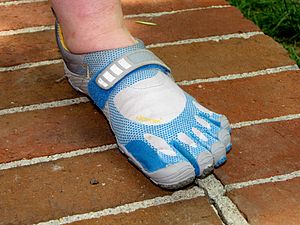
Image via Wikipedia
One of the most common claims made by minimalist and barefoot runners (myself included) is that running in minimalist shoes (or barefoot) can be an effective tool for strengthening the muscles of the feet and legs. The idea is that constrictive, stiff, and overly cushioned modern footwear brace the foot, alter our natural biomechanics, and limit the ability of the foot and leg muscles to function naturally. As a result, these muscles get weak.
One of the first things I noticed when I began my own journey into minimalist running about two years ago was that my feet felt different. My first minimalist shoe was the Nike Free 3.0, and I can distinctly remember how I felt that the shoes were working my legs differently, and I had a sensation of “fullness” in my feet that I had never felt before (I can’t think of proper words to describe the feeling…). I knew something was happening, but I really wasn’t sure what it was. Jump ahead two years and I’m now quite certain that my feet have changed shape. I have no “before” pictures that I can compare to, but I find that shoes that used to fit me comfortably are now constricting and narrow, and if I had measurements, I’d guess that my forefoot is now wider than it used to be. No proof, but I believe this to be the case. I also feel like my big toe has migrated a bit medially, as if it were trying to create some additional space between itself and its smaller brethren.
All of this led me to begin doing some research to see just what we know about whether running in minimalist shoes can actually strengthen our feet and legs. It makes perfect sense, but the scientist in me wanted to see some data.
It’s fairly well established that living a shod life can alter the anatomy and function of our feet. For example, earlier today I read a fascinating study by a group of European researchers (D’Aout et al., 2009) in which they traveled to southern India and made anatomical measurements of the feet of habitually shod and habitually unshod individuals. They also took measurements from a group of Belgians for comparative purposes, since even the typically shod Indians wear mostly non-constrictive shoes like sandals (they also typically go barefoot as children). In addition to the foot examination, they had each individual walk over a pressure mat to examine how pressure is applied to the sole of the foot during normal walking.
What the researchers found was that the habitually unshod group had the widest feet, and both groups of Indians had longer feet when corrected for overall body size than the Belgians. In other words, the Belgians had short, scrawny feet compared to the Indians (take a look at Figure 3 from the D’Aout paper if you want to see what normal human feet that have not been deformed by footwear should look like). When they looked at plantar pressure distributions during walking, they found that the habitually barefoot group used more of the foot surface to disperse pressure (particularly in the region of the midfoot), whereas the Belgians tended to exhibit stronger and more localized pressure peaks under the heel and under the 2nd and 3rd metatarsal heads. The authors conclude their abstract with the following:
“The evolutionary history of humans shows that barefoot walking is the biologically natural situation. The use of footwear remains necessary, especially on unnatural substrates, in athletics, and in some pathologies, but current data suggests that footwear that fails to respect natural foot shape and function will ultimately alter the morphology and the biomechanical behaviour of the foot.”
They go on to state in the following in the Discussion section:
“…we suggest that walking and training barefoot or (if the substrate does not allow) using shoes that allow the foot to function as closely as possible as in the barefoot condition, could lead to performance benefits for athletes. Such performance benefits can be achieved, for instance, by increased muscular performance (as found by Potthast et al. 2005 when wearing minimal shoes) or as a result of potentially lower injury rates due to smaller peak pressures.”
The citation in this latter paragraph (Potthast et al. 2005) piqued my interest, so I hopped onto Google Scholar and found the reference, as well as a few others by the same authors. Turns out they are not journal articles, but rather are extended abstracts from a series of scientific meetings. Interestingly enough, Potthast and colleagues had conducted a study to see if training in the Nike Free shoes might actually lead to strengthening of muscles in the feet and legs when compared to training in a more typical shoe. Here’s their description of the study in “scientist-speak:”
“…it can be hypothesized that an especially designed training shoe with a multiple segmented outsole, mimicking barefoot movements and allowing barefoot-like exercises on hard surfaces, could induce different mechanical stimuli on foot and shank muscles. A biopositive adaptation should be advantageous in terms of injury prevention or performance enhancement. The purpose of this study was to identify an eventual training and adaptation effect in morphology and function on foot and lower leg muscles when wearing such a specifically designed training shoe.”
The scientists took 100 individuals, split them into two equally sized groups, and had them perform a series of exercises on a weekly basis in either Nike Free shoes or a conventional running shoe (for a duration of 6 months). The exercises included running, aerobics, skipping, and a variety of other things. They were also allowed to wear the shoes in everyday life if they so chose. They took a variety of measurements before the initiation of the study, including toe flexor strength (toe flexion is downward bending of the toes), range of motion of the 1st metatarsophalangeal joint (i.e., the joint at the base of the big toe/hallux), and the active path of motion of the same joint. They also took a subset of 25 individuals assigned to wear the Nike Frees and took MRI’s of the lower leg and foot to obtain information about muscle cross-sectional area (think of this as muscle belly size for simplicty’s sake).
What they found was that individuals in the conventional shoe group saw no change in toe flexor strength, whereas the Nike Free group saw a significant 20% increase in toe flexor strength. The experimental group also saw a reduced path of motion of the 1st metatarsophalangeal joint, which they suggested could be related to the higher strength of the toe flexors – stronger flexion of the toes would lead to less dorsiflexion (upward tow movement) during gait. With regard to MRI results, they found that the flexor hallucis longus (the muscle that flexes the big toe) was significantly larger after the experiment in those assigned the Nike Free. Although not significantly larger (very close), they found that both the abductor hallucis (the muscle that pulls the big toe away from the second toe) and tibialis posterior (a muscle the supports the arch and resists pronation) showed a trend toward size increase after the experiment for the Nike Free group.
In a second Abstract from the 2005 American Society of Biomechanics meeting, the same group reports additional data showing that plantar flexor strength (calf muscles) and dorsiflexor strength (tibialis anterior I presume) also increased in the Nike Free group.
I haven’t been able to find either of these studies published in full in a peer reviewed scientific journal, so they need to be taken for what they are as conference abstracts. However, they do suggest that a period of training in Nike Frees can increase muscle size and strength when compared to training in a more conventional shoe, at least for some muscles. What I find particularly compelling is that the subjects weren’t even necessarily running in the shoes very much – aerobics, skipping, side stepping, etc. were also included in the training plan. If doing these types of things can increase toe flexion strength, foot plantar flexion strength, foot dorsiflexion strength, and so on, one wonders what would happen if a more intensive running program were employed? Furthermore, the Nike Free isn’t even all that minimal of a shoe – it’s pretty cushy and retains a fairly sizable heel lift. I’d love to see a similar study that compares a group of runners using traditional shoes to a group that transitions from traditional shoes to something like the Vibram Fivefingers for six months.
After reading these studies, I recalled a light moment at the Running Injury Conference in Shepherdstown, WV that I attended back in January. Podiatrist Ray McClanahan was giving a presentation and he took off a shoe to show off the bulging belly of his abductor hallucis – he had “guns” in his feet! The abductor hallucis, as I mentioned, is the muscle that pulls the big toe medially away from the other toes. Make this muscle stronger, and this could provide the explanation for why many minimalist and barefoot runners claim that their big toe begins to migrate away from the others (into a position like that of the habitually unshod Indians discussed above, I might add…). I also begin to wonder if increasing the strength of the big toe flexor allows the big toe to take some load off of the metatarsal heads during stance phase, and whether this might also explain some of the difference between the unshod and shod plantar pressure differences shown in the D’Aout paper. Going further, perhaps weakness of this muscle combined with poorly adapted foot bones might contribute to some of the metatarsal stress fracture issues people occasionbally run into when transitioning into minimalist/barefoot running. Total speculation here, but interesting to put some pieces together and ponder.
At the end of this, my feeling is that the answer to the question posed in the title of this post is a definite “yes.” I’m left to conclude that my initial feelings after running in the Nike Frees way back in 2009 were probably correct – I think I was strengthening my feet and legs in ways that I previously had not.
What’s your sense – have your feet and legs changed in any noticeable way as a result of going minimalist or barefoot?

You might also like:
 Study: Running Economy Improves After a 4 Week Simulated Barefoot Running Program
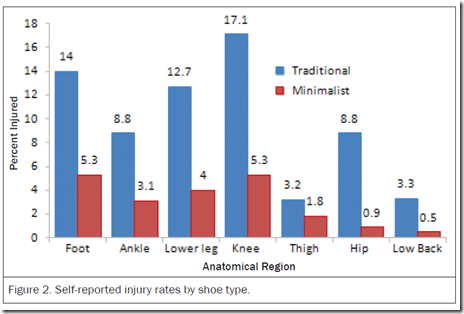 Minimalist Running Results in Fewer Injuries?: Survey Suggests that Traditionally Shod Runners are 3.41 Times More Likely to Get Hurt
 Are you ready for minimalist running?–Self-Assessment video from Jay Dicharry and Running Times
 Irene Davis Lecture on Running Shoes, Form, and Injuries: A Must Watch for Anyone Interested in the Minimalist/Barefoot Running Debate
 The Barefoot & Minimalist Running Debate – A Plea for Moderation


 About Peter Larson










Great posting.
Short answer to your question. Heck yah.
At age 55 Free’s helped me beat Achilles Tendinitis….I run with them for all my <10 mile runs to keep things strong. For marathons I run in Kinvaras which are a bit easier to take on long races..but to keep the AT at bay I have to run in the Frees (and in stay zero drop shoes or barefoot knocking about at work and home, etc)
I also stopped stretching recently and found I didn’t need it anymore after using the Frees for so long. I personally think maximum mojo is from strengthening the feet with minimalist techniques but still using some cushioning for races and long runs.i.e running marathons barefoot…not optimal.
-paul
http://50-is-the-new-30.blogsp…
Hey Pete, I’d have to agree. I ran in Nike 5.0 for 5 years and in Feb. of this year dropped down to the 3.0 and ran a marathon in them a couple of weeks ago. I wear Vibrams or am barefoot 3-4 hours a day. For trails I was wearing Montrails but my feet seem to have had enough of them so last week I wore the Merrell Trail Glove for a 2.5 hour mountain run and they felt great. I’d have to say my feet feel different than a few years ago. Like you I don’t have any anatomical measurements to compare but my feet feel stronger and seem to be more sensitive (they feel the ground better).
One thing I’ll add – my toes are definitely feeling better. #2 – 5 used to all be squished together even barefoot but now they’ve got space between them!
Pete,
great post as always and thanks for applying data and science to what you feel . i have run over half my miles barefeet, mostly road, since the spring thaw in march and my feet are thicker for sure. i can deal with tougher texture now too.
Mark Cucuzzella
Pete – Great analysis, very detailed as always. I totally agree with you about the sensation of “fullness” in the feet. Even on back-to-back rest days I feel my feet “working” all the time. And my town shoes (which fit perfectly until early 2010 before I started running minimalist) now apply significant constriction around my forefoot, which appears to have “spread”. Unfortunately I don’t have before and after pictures either, but I can definitely confirm a change in the physiology of my feet as well as greater strength in my lower leg & plantar area.
I think the answer is yes. I was in motion control shoes, rigid orthotics and a heel lift for my shorter let. I since have got rid of all of it. I now run in Altra’s and qualified for Boston on my first try at the marathon distance. My calves have grown leaps and bounds and just like you mention, my big toe is looking a little strange because it is so seperated from my other toes. I can also say that my ability to balance on one leg has increased too.
I have definitely noticed differences in my feet and legs since switched to minimalist shoes at the start of this year, even though I only cover 10-15 miles per week with jogging and walking intervals. My feet somehow feel like they have more “structure” to them. I’m flat footed and used to suffer shin pain, ITB friction syndrome and frequent ankle sprains when I did sport which completely put me off exercising. But now, not only are all those problems gone, I’m even starting to get a hint of an arch on my feet. They also feel much more springy and agile (I love that feeling). So all in all, I do think that barefoot/minimalism made a big difference physiologically for me. I’ve actually been taking photos of my feet every few weeks since I started on my minimalist running journey. It’s only been ~4 months and not much difference is visible yet. I’m curious what they will look like in a year.
From various anecdotes I’ve read on minimalist forums my current belief is that changing of foot shape is happening to some, even drastically, but not all. Some have been minimalists for a few years without any considerable change in foot shape.
That feet gets strengthened is however 100% self-evident for anyone that try to transition to barefoot. If there were no difference (like I’ve heard some podiatrists say!) we wouldn’t be able to train the feet to handle more barefoot/minimalist walking than the first time, but obviously you can.
It is odd that things that are considered obvious with other body parts are not with feet. For example, would anyone think that bracing your back or neck would not weaken the muscles? Don’t think so.
For me personally, I have not seen any significant change in foot shape after about 1 year with much minimalism, however I do not yet run much, just walk. However, I could handle only very little minimalist walking in the beginning, and it is getting much better so obviously the feet has got stronger. Still I experience limits, that is I cannot walk as much as I would want to, so I’m in an adaptation phase still.
I remember standing at the start line of an ocean swim in Noosa, Australia this time last year, looking across at a fit young guy who had the most developed foot musculature I’d ever seen. His big toe was well distanced from the second toe, and standing barefoot on the hard sand he had a significant splay of all toes providing a serious platform and grip of the surface below. Turns out this was his only contact with the ground as he was an above knee amputee. Just shows how the body adapts when it has to.
I’m fascinated to observe and feel the changes in my own feet and gastroc/soleus complex which have come about following a switch to more barefoot and minimalist running over the past 12 months.
It’s like these structures are waking up from a deep sleep…
Great post…I can see a big difference in my feet since ditching orthotics, traditional shoes, and spending big portions of my day barefoot. Love to read some evidence behind it. Thanks for digging this up.
I’m slowly getting to the point where I can run in Minimalist shoes. I think I’m two pairs of running shoes away from that. That said, over the last two years I’ve been wearing less and less constructed shoes or am barefoot around the house. I’ve worn Crocs with very little structure. I wear those Converse sneakers (I’m the poster on FB), and I wear my Vibram FFs for boot camp 3x/wk which include various kind of foot work including short sprints such as suicides on gym floors. And yes my feet feel cramped in regular shoes. A few months ago I had to go on a business trip (I usually work at home) and dawn ‘regular’ black leather ‘business shoes.’ Wow, did they feel cramped–hadn’t worn them in over a year. So, yes, I do believe, without measuring, that my foot structure has indeed change–for the better.
This article was amazing! I loved it! I have been going barefoot since I was very young( about 6) and I had always wondered why my big toe was so much farther from my foot than everyone else’s big toes. I can’t stand normal shoes to run, walk, or even just stand around in. They feel to big, cramped, and clunky. Thank you for the great post!
Thanks for helping me confirm something I had noticed just yesterday! Before heading to ortho for 6 week check on stress fractured 2nd metatarsal, I noticed a gap between big toes and the rest. Before the stress fracture in early April I had been running at least once a week in VFF (Bikila & TrekSport – no more than 5 miles), and had been putting in longer miles in Adidas Attune (wide toe box, very light shoe). I have noticed a considerable difference in the way the rest of my shoes feel. Note: stress fracture was a result of two things, 1. shampoo bottle hitting for in shower, and 2. running half marathon a week after the shampoo bottle incident.
As always, great post packed with very useful information.
Ah…the old shampoo bottle injury :) Maybe that’s the secret to this rash
of stress fractures.
Absolutely. I have more meat to my feet, and muscle definition in my legs that I’ve never seen before and I’ve been a runner for 24 years.
Pete, I have been running in the Brooks Launch for several months and am ready to try a more minimalist shoe. I was thinking about the VFF Bikila but am also considering the WT10, WT101, or Trail Glove. I see that you love your MT101s. Do you think they’re ideal for road running? I almost never run off-road. I was sort of excited to try a shoe with the Vibram sole, but I’m guessing the WT10 will have similar problems to the MT10. I would love any advice you could offer me since you have so much experience with minimalist running shoes. THanks!
If you try on the WT10 in store and they feel good, they work fine for
on-road running. I’ve run up to 20 miles on roads in mine.
Pete
What are your favorite minimalist shoes for road running? I know you like the MT101s a lot. Would you buy something like exclusively for road running, or should I be looking elsewhere?
Thanks for the advice and sorry to veer a little off-topic. There are just so many choices, and sometimes only one or two are carried at a given store, so it is hard to compare. (I also wear women’s 11, which means that it’s hard to find shoes to try on!)
I don’t know if I’m “stronger”, because I’ve always had very strong calves. But I know that since I’ve moved to more minimulist shoes and running on my forefoot that I’m about a minute/mile faster on roads, my crippling shin splints have gone away, and I’m just enjoying running more.
My six year old daughter has the most amazing toes. Her big toes are quite separated naturally (when we buy shoes I try to get them wide so she won’t loose this). [ As an aside, she can also flip her pinkie toe over the fourth toe without touching it – there’s a muscle there that most of us have lost ;)] Anyway, great post – I have noticed changes in my feet and love the soreness in my calves after running minimalist (my barefoot miles are negligible). One interesting thing is that one of the people you would most likely see widespread toes on is Barefoot Ted, but when he displayed his feet for us at the New York Barefoot run – they were not. He has other adaptations that are quite amazing including the thickest (but still soft and supple) foot pads…like a bear.
Definitely! I noticed in just a couple of months after incorporating VFFs that my calf muscles were not only stronger but larger and a few months after that I had the same moment where I noticed that my feet were definitely “meatier” than I could ever remember them having been before.
My legs (especially my calves) and feet are definitely stronger since I started training in minimalist shoes. I could tell this from day 1. Converting from a shoe with a 12mm+ heel lift to one with a minimal (0-4mm) lift encouraged me to run in a more natural manner: landing on the fore-mid foot instead of the heel. This change made my feet and legs work in ways they haven’t in a very long long time.
After getting over this initial adjustment period I started getting significantly stronger foot, calf, quad, and hamstring muscles. I have no data to back this up. I only have 35 years of experience with my body. I am so very glad I did try this “new” style of running because it has made ALL the difference in the world.
I’ve always enjoyed running since I was a toddler, but I never really understood the joy it could bring until I stopped beating up my body by heel-striking and started running like a human is supposed to run.
I find it sad that many people are so hard-headed that they need data to show them the truth when they could just find out for themselves. I truly believe that if everyone would try this more “natural” running style in minimalist shoes (or no shoes at all), and allow their bodies to adjust to it before making any judgments, then there would be many more happier runners out there and a whole lot less injury. We’d have the whole running community converted!
Sorry for the soapbox rant. I just feel very strongly about this subject. :-)
Great post! Recently begun my journey into minimalistic running. Have battled Morton’s neuroma in the past, but this time around, since paying more attention to my form and shoes, it has not come to haunt me. Optimistic that I can keep on and stay injury free :)
Definitely. I started running consistently about 9 months ago in the Nike Free 7.0. I currently run in the Nike Free Run +. In my soccer playing years in college, I consistently battled ankle injuries. Running in the Frees has allowed for a wider range of motion in the lower extremities, especially my ankles, breaking up scar tissue and making them stronger. My feet and calves have bulked up a bit too. I’m a big fan and a happier athlete.
Great post. I’m into improving performance per se (and not focussed entirely on reducing injuries as many are) and for those athletes (triathletes) with rather poor pronation and proprioreception to start with, running in minimal shoes really hasn’t appeared to improve those aspects. Would you care to speculate on these observations…
A couple of things here. First, I’m not even sure there is really a good
definition of what constitutes overpronation, or at what point, if any,
overpronation is really much of a problem. I suspect that at times
overpronation may not even be related to a problem with the feet, but
possibly somewhere higher up in the kinetic chain. Personally, I think the
whole concept of overpronation needs to be reevaluated, and the entire
pronation control shoe paradigm hasn’t held up well to scientific study so
far (e.g., studies by Ryan, Knapik, etc.).
Second, how do you measure proprioreception? I’d essentially think that you
get maximal proprioreception when barefoot, and the moment you put shoes on
you lose some of that. The question is how much shoe can you wear and still
maintain an adequate amount of proprioreception.
Form and shoes are intertwined, and my sense is that changing shoes doesn’t
necessarily change form unless you go really minimal. Otherwise, you really
need to work at it. For example, the Nike Frees worked me in a different
way, but I don’t think my form changed dramatically until I started rotating
the Vibram Fivefingers into my training. The Frees are too cushioned and
have a heel lift – both of these decrease proprioreception and interfere
with the ability to assume barefoot-like form.
All of this being said, I’m not sure whether barefoot like form will offer
any major performance increase over any other form for elites (maybe it
will, maybe it won’t, hard to say). The question is still open in my mind,
and the anecdotes I hear more often focus on benefits in terms of injury
reduction for those with chronic problems, particularly above the ankle.
As you know, you’re not alone thinking that the overpronation paradigm should be dropped. Benno Nigg, one of the major biomechanics researchers that are regularly hired by shoe companies, focus a lot of effort in his latest book to falsify it. And this is a man that is certainly no minimalist. I’d say that the overpronation paradigm is strong among the general public, but nearly dead among researchers.
My current view on this is that if you have got direct overload of muscles involved in the pronation movement (i e tibialis posterior) you should not use shoes that *increase* pronation (like unstable cushioned shoes can do), but otherwise there’s no worry. There’s no value of reducing pronation that is within natural range, if you still get injured there’s probably some other thing to blame, weak feet, too high training dose etc.
Concerning barefoot running style and performance I think it has a significant performance increase in middle distance running at elite speeds, but the body may need several years to adapt and optimize if an athlete radically changes technique so it is really hard to test. At long distance running speeds, even elite speeds, I think the difference is very small. Also this will be really hard to test.
But put it this way – we don’t know of any advantages of running with the shoe-requiring unnatural heavy-heelstrike style, so there is no reason why beginning young athletes should learn running that way. There’s lot of questioning floating around if minimalism and natural running style is really better, but we forget that we don’t have any evidence that we should use built up shoes and walk and run unnaturally. If you deviate from the natural I think one should have a good reason, and we don’t have that.
I’ve been running minimal for just over a year now and I have noticed some changes as well, especially very recently.
I started with a pair of Nike Free Run shoes in April 2010 and were so light that I swore I would never go back to a heavier shoe. I had some ITB problems last spring and that’s when I changed to a mid-foot strike. I have never regretted this decision as I have had virtually no knee or ITB-related injuries since. I spent most of last Summer in my VFF bikilas, but running no more than 5 miles at a time in them. When fall came and I committed to running a full marathon this Spring, I bought my first pair of Kinvaras and wore them out by January. My second pair of Kinvaras were my marathon shoe. I also bought a pair of MT101’s as my casual wear shoe in January and the wide toe box became the norm for me almost daily. Also have been barefoot around the house whenever possible.
The revelation on my foot changes have only come recently however. My Kinvaras, which have been my go-to shoe for runs over 5 miles since Fall, are now too narrow. I developed a callus on the outside of my right big toe, and sometimes get one on the outside of the ball of my foot too. By marathon day on May 1, I could tell that my foot was just too wide for them. After some inspection, I also notice a definite gap between my big toe and the next (whatever it is) toe. On my right foot, there’s even a gap between toes 3 and 4 . On the good side is the fact that, aside from the Kinvara blisters, I have had no foot-related problems to speak of, no matter which shoe or a lack thereof that I’m wearing.
Regardless, it is making my shoe shopping more difficult. I had my eye on a pair of Kinvara 2’s, but I’m not sure the toe box will be wide enough for me. I love my MT101’s, but they’re not really a road or race shoe for me. My current thought is a pair of Hattoris…
Thanks for sharing your story! The Altra Instinct and Netwon Distance Racer
are good choices for wider road shoes.
I’ve been running in minimalist footwear for a little over a year, and my feet feel better than ever. In the past my running has been sidelined by ITB problems, but that hasn’t been an issue in the past year as I’ve increased mileage. I’ve had a couple of adjustment issues trying to do too much too soon, but right now things are good.
I run about 30 miles a week in zero drop shoes and for the most part wear such shoes all the time when I’m not barefoot. I’ve worn the Feelmax Osma shoe for about a year and love it and sometimes run barefoot at the local track. The Feelmax Osma is as light as the Vibrams and has about the same thickness on the sole, but it looks more like a shoe. It has a wide toe box, snug around the heel, and no support.
I believe my feet have adapted well and gotten stronger. I’m certainly loving to run more than ever before. I think my feet may have changed and wish I had a good picture and measurements to prove it. I think my big toe might have widened out a bit and my hammertoes have become more relaxed.
Pete, I just came a cross your blog last week and have enjoyed reading it. Thanks for the research on this recent post!
Thanks for sharing, and thanks for the feedback!
Agreed with Dan. The volume of my feet has increased as has development of the lower leg systems. Interestingly much of my training voume wise has stayed consistent over the past few years. The variables have been footwear, form specific drills and a conscious effort to engage those systems while running.
As I have gone to less and less shoe, my body has adapted to the workload accordingly. I think we are seeing a lot more athletes shift the role of stability and cushioning away from their shoes, to developing it on their own accord. In my experience, this where the genius of running is. Develop the things you can control (form, cadence, posture, etc.) and use those as primary tools to improve your running experience.Pete, this is another great one. Keep up the good work and keep raising the bar.
Clearly the answer to your inability to access all the data is that you need to up your conference attendance, Pete.
Great stuff here – I’m not sure if my feet have changed at all, but I have noticed that my ankles and lower shins feel stronger since I’ve gone towards more minimal shoes. Anecdotal as can be, but I’ve had a number of instances where I’ve been on the precipice of turning my ankle and have had the foot/ankle strength to correct without spraining or straining.
ha! I hate academic conferences. Too much egotism and preening, though
it is nice to sometimes see grad school buddies.
yep, in less than 10 months, my feet have become buff!! and getting better every day!
during my last track season in the last couple months, i have a pair of track spikes that are my normal spike size…but i noticed my feet were over the sides a little bit…and it felt tighter, then it hit me, “my feet are buff! thank you natural running!”
^that, and the fact that my legs are stronger…and running is so much better now, running is so much more comfortable
Just WOW, look at the response Pete, I think you hit a resonate frequency on the topic :-)
Over the last year I too have migrated to more minimal and wider shoes and barefoot around the house, and like practically everyone else chiming in here now have stronger, and for me even broader feet. I also have stronger calves, though there are still adapting so DOMS in the calves is still a regular occurance.
I’ve also encouraged my children to stay barefoot when they want to, and to stick to minimal footware when possible. My wife still comments on the dirty feet at bathtime though! One of my daughters went barefoot out in the rain last week and splashed around in all the puddles she could find, the delight on her face was magical. There is real sensual pleasure in just going as nature intended ;-)
The research you’ve noted in this post, and the response in the comments really stands out as an emphatic contridiction of the points made by Simon Barthold in the interview that you highlighted in the your recent “What is Good Running Form?” post. I just hope the likes of Simon and others entranched shoe “professionals” pick up on blogs like yours and commentary seen here.
Thanks for the references. All of this makes perfect sense as it did when Robbins observed this type of stuff back in the 80″s and when the Canadian company Barefoot Science started it’s product development around the same time. Both have looked at either the use of proprioception and/or barefoot exercise as a catalyst for changes in foot morphology, as a method to observe benefits such as injury prevention, injury rehabilitation and increased performance. Over such short periods of time the only logical way you will see a morphological change is through soft tissue adaptation and most notably the increased strength and flexibility of associated muscles. Although bone is capable of shape change as a response to strain/stress it would have to be observed over a much longer period of time. Therefore you simply need to imagine an igloo with a bunch of loose blocks – that is the weakened foot – now take and tighten/secure these blocks into place ie secure them, with increased muscle contribution – the shape of the igloo has changed. Now imagine that you want those blocks to move out of place if necessary, maybe to react to the ground surface or dissipate to type of impact energy, but return back to place. You might to it with a buggy cord – but a single bungee cord (weak muscle and poor muscle spring properties) would be less effective than say 4 bungee cords used in parallel (stronger muscle and improved spring properties) Now you get the morphological change + increased functionality. That is what I believe is what is happening as you introduce increased ROM (or rather remove the restrictiveness and bracing of modern footwear), introduce a strain/stress component to the muscle to illicit a strengthening response, and add proprioception (ie an insole like Barefoot Science if you are in a minimal shoe, or simply the uneven contours of the natural support surface.). The end result would be a morphological change to the foot as a result of the 26 bones interacting with each other in a more naturally efficient manner, increase natural cushioning and support through improved eccentric control by the supporting musculature and more efficient use of the muscles throughout the body in controlling the other gait characteristics.
It is refreshing to see all of the excitement over something that has been introduced 20 years ago but poo-pooed by them running giants and the podiatric industry. Finally social media has given these people an effective means to communicate to the masses.
Thanks Dick, well put. I like the igloo analogy!
I believe so. I started running again about a year and a half ago. This coincided with the minimal/barefoot movement heating up. After a lot of research, I bought a pair of Kinvaras and began walking the dog barefoot. My right leg is a half inch longer than the left and my left arch is lower and weaker. My feet are stronger now and I don’t have arch issues like before. I don’t run high mileage, but I can see space between my toes. I wear Birks the majority of the time, so I did not have any real muscle issues running in a lesser shoe, but there was some adaptation. The Kinvaras are even starting to feel tight, and my feet are not wide. I’m starting to look for new shoes that are wider.
My wife, who is not a runner, wears flip flops 95% of the time. The spread of her toes is impressive.
here’s something interesting;
keith olbermann on letterman saying youre not supposed to run in vibram ff’s if youre 170 lbs plus. he must have been running incorrectly: link to youtube.com…
I completely agree about less is best in terms of enhancing foot and leg strength. I actually think the point is sound without much defending of it being necessary. I think its fair to compare it to say wearing glasses all of time, even when not needed and having one’s eyesight weaken or even say, living the very sedentary lifestyle of today’s modern world and how it makes us weaker, heavier and less mobile. Thus the invention of the indoor gym. However, the gym, like the super cushioned shoe, cannot replicate all of the natural movement our bodies would be engaged in in some previous period of human history.
The more all of the natural body parts are engaged in movement of the body, then the more the entire body will be stronger. The point seems simple and rather easy to grasp, all on its own. What is interesting to me is that there is even a debate. Shoe companies will always have a customer who wants fashion and comfort over say proper foot health. I do not think there is anyone out there who would say hi heels are good for the foot and yet they are still selling strong.
I suppose my only comment of significance to add is that with the broader minimal shoe movement in full swing, it seems as if people somehow think that the shoe alone will fix whatever injury they have or get. I do not think this is the case. Though I have no evidence to support this, my guess is that there are just as many injuries and biomechanical abnormalities caused by poor training and other body issues than the wrong shoe. So, I always caution people to think about the whole picture when addressing their running. Yes, the the right shoe is essential but its also very important to eat the right foods, drink the right amount of water, get a good night’s sleep, do some cross training, etc.
I’d go a step further and say that most running injuries are caused by poor
training decisions.
My shoe size increased from 8.5 to 9, and as a 28 year old, I’m not sure what else to blame but my minimal running sneakers! My previously narrow feet seem slightly wider and I completely changed my view on what constitutes a comfortable shoe.
This is very exciting since I’m also a cyclist who has experienced extreme pain in the ball of my foot (hot foot) on only one side. Obviously, there is a mechanical or structural issue with that foot. I delayed going to a podiatrist due to cost but am transitioning to minimalist shoes, currently running in New Balance Minimus. I’m thinking the changes this may bring to my feet may actually allow the nerve in my left foot to stop being squeezed or whatever. I already like the quicker foot turnover and landing more midfoot instead of on the heel as the thick soled shoes encourage you to do. Oh to be able to climb big hills on my bike and not have tears of pain running down my face! Thanks for looking into this; I will definitely pursue the transition and let you know if it “solves” my hot foot on the bike!
Thanks for sharing your experience – let me know how it goes!
Pete