 Update 4/2013: This is a discontinued model, read my Saucony Fastwitch 6 review here.
Over the past few months I’ve been putting miles on several new reduced-heel shoe offerings from Saucony. Among these are the Fastwitch 5, Mirage, Peregrine, and most recently the Hattori. The Fastwitch 5 is unique among these in that it is the only one that is not an entirely new shoe – it’s the 5th incarnation of a popular lightweight trainer/racing shoe. I actually have a personal history with the Fastwitch as the Fastwitch 2 was my first racing shoe, and it was the shoe I wore for 2 of my first 4 marathons. I was therefore rather excited when I first heard that Saucony would be reducing the heel height of the Fastwitch in this newest model (making it a 5mm drop shoe). Saucony has been a bit of a trend setter in this sense – they have a wider variety of reduced heel options than most of their major competitors, and for this I give them a lot of credit.
On with the review:
Appearance
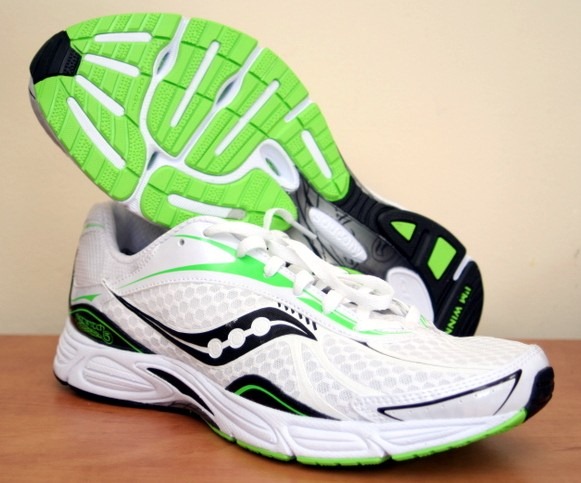
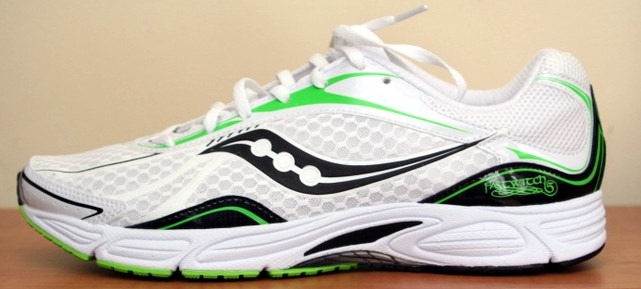
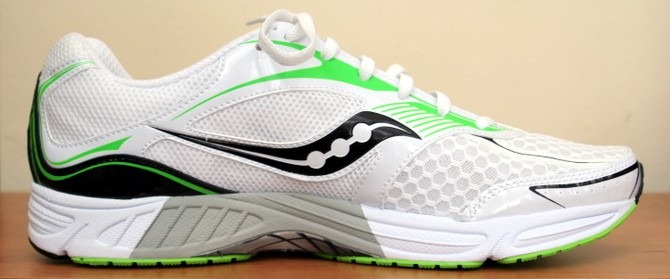
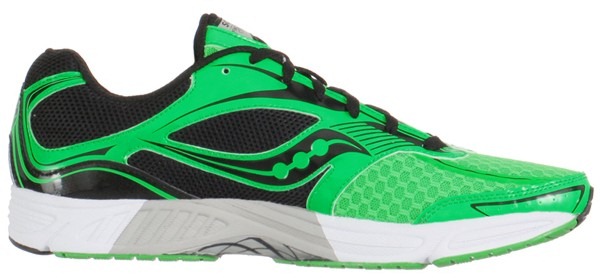
The initial release of the Fastwitch 5 included to colorways – a fairly conservative white version with black and green overlays, and a flashier green version with black overlays. Unfortunately, the media sample that Saucony sent me was the white version (disclaimer: this shoe was provided free of charge by Saucony), and though it is certainly not an ugly shoe, I’m not a huge fan of excessively white shoes. The green version is pretty slick (see photo below), and much better suits my taste. In most respects, the Fastwtich 5 is a pretty standard looking running shoe – not much more to say than that.
Construction
Though it shares a similar heel-forefoot-drop to the Saucony Kinvara (see my Kinvara review here), the Fastwitch 5 is a very different shoe. First and foremost, whereas the Kinvara is a neutral cushioned shoe, the Fastwitch is a stability shoe with a medial post (see gray area on the midsole in the photo above). Thus, the Fastwitch 5 will appeal to those who might be afraid to try a neutral shoe like the Kinvara. Personally, I’m not a big believer that pronation control should be a major criterion in shoe selection, but I know some people fear deviating from their assigned category, so this is a low drop shoe that might strike a bit less fear into the stability crowd.
In addition to the medial post, the Fastwitch also has a very firm midsole – much firmer than the Kinvara. The reported specs are 18mm lift in the heel, 13 mm in the forefoot (I measure 14 mm – close enough I guess), and the included insole adds 2 mm to the heel lift (as is the case with most of the other Saucony shoes I have). I have taken to using my Nike Free insoles in all of my Saucony shoes since they are flat and thus don’t add additional heel height. There is also noticeable arch support built into the shoe, so swapping insoles doesn’t correct for that.
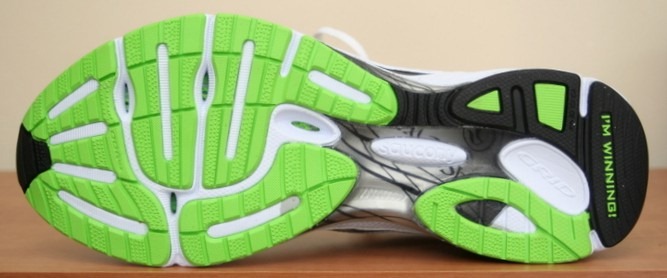
One of the biggest complaints that I’ve heard about the Kinvara is that it lacks durability due to its minimal outsole. The Fastwtich 5 has a much more prominent outsole that covers the entire bottom of the shoe. As such, I expect that it will be a lot more durable for those who have had issues with the Kinvara (my one and only pair of Kinvaras has held up quite well even after having run two marathons in them). The tradeoff to the added rubber on the sole is that it’s a bit heavier than the Kinvara – it’s listed at 8 oz in size 9.
Finally, in terms of fit, these shoes run true to size for me and the forefoot is snug but comfortable. It’s by no means a wide shoe – very similar to the Kinvara actually, which works OK for my foot (though I’d prefer a bit more width).
Performance
I’ve come to the realization over the past few months that I don’t like firm shoes unless they sit extremely close to the ground (e.g., an XC flat or less). This is a problem I had with the New Balance Minimus Road, and I’m having similar feelings about the Fastwitch. While running in the Fastwitch 5, I find that the firmness seems to cause me to rapidly pronate upon initial ground impact, but then stop rapidly once the medial border of the shoe hits the ground. It feels kind of like a jerky motion as opposed to the more fluid landing I feel in a softer shoe or one that hugs the ground. This is probably just a personal thing, but because of it, this shoe will not likely earn a regular spot in my rotation. For those who dislike the Kinvara because of its slightly squishy sole, the Fastwitch might be a better choice.
Aside from the firmness of the sole, this is a pretty solid shoe. Because of the low heel, I’m capable of running comfortably in them and can easily find my midfoot (easier once I’m warmed up a bit). They are quite comfortable on the run, and I haven’t experienced any abrasion or hotspots.
Conclusions
The Fastwitch 5 is a decent addition to Saucony’s crop of lightweight training/racing shoes. I’m personally not a big fan of the firmness of the midsole, but if you don’t like the Kinvara because of its softness, this shoe might be a better option. Furthermore, if you’ve been hesitant to try a low drop shoe because most lack stability features, the Fastwitch 5 might be a “safer” option (as is the Mirage, which I will be reviewing soon).
For an alternative viewpoint, check out this review of the Saucony Fastwitch 5 by my buddy Thomas Neuberger over at the Believe in the Run blog.
The Saucony Fastwitch 5 is currently available at Running Warehouse.
You might also like:
 Saucony Virrata Review and Comparison to the Saucony Kinvara 3: Guest Post by Alex Raggers
 Saucony Grid Type A5 Running Shoe Review: A Phenomenal Racing Flat!
 Saucony Hattori LC Lace-Up Review – A Massively Improved Update to Saucony’s First Zero Drop Shoe
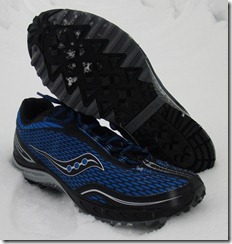 Saucony Peregrine Review: A Rugged, Low-Drop Trail Running Shoe
 Saucony Kinvara 2: Comparative Photos and Update Summary


 About Peter Larson










Great review Peter. Interesting how your review compares it to the super popular Kinvara. I saw them in a different class before reading this. There are some similarities in the shoes. Thanks for link.
Thanks for the review, Pete. I added the Fastwitch to my rotation about 100 miles ago and like them a lot. Initially enamored with the softness of the Kinvara sole, I found I eventually longed for something a bit stiffer, like the Addidas AdiZero line. As you mentioned, the Fastwitch does this well, and I also like the added upper support.
If I had a complaint with this shoe it would be pronation. I noticed the same behavior you described. When I first started wearing them I’d notice my feet clipping my calves sometimes. The longer I wear them, however, I do it less and less.
I won’t be abandoning the Kinvara, but am looking forward to v2. The Fastwitch will hold me over nicely at least until then.
Thanks for the review. A question for you:
I normally use the Kinvara as a trainer, and race in the Fasttwitch 3 — I like the greater cushion of the Kinvara for easy runs, but prefer a bit more stability (helps with form breakdown near the end) and better “feel for the road” of the Fasttwitch for races and workouts.
However, the Fastwitch 5 seems to be a bit heavier now, and no longer is really a racing flat. Any idea what might be a good replacement for it as my racing shoe? (criteria: slight stability, low heel height, not too padded, equal to or lighter than Kinvara). I would prefer to stick with Saucony, as I have a very narrow heel, and Saucony tends to fit me better than other brands.
Check out the Saucony Grid Type A4. Should meet most of those criteria.
Pete
Thanks so much!
Hi Pete,
Great review, as always; thank you. I know you’ve been busy, but any chance we’ll be seeing that New Balance MT101 review sometime soon? You’ve alluded to a forthcoming one before. If you don’t hurry the 110 will be out by the time you review the 101!
Sorry, been hard finding the time to write as many reviews as I’d
like. The 101 is a great shoe – it probably fits my foot better than
any shoe I own. My only complaint would be that the heel is a bit
higher than I like, but other than that it’s near perfection.
Pete
I am in love with my Kinvara’s and haved wondered some about these other styles, good review!
I’ve been running minimalist for a month or two now in nike frees, but after a gait analysis I found I overpronate on my right foot slightly, while my left is pretty much neutral. This I think has turned into a bit of metatarsalgia/Morton’s neuroma (can never tell the difference) only on my right foot, so I’m looking for some stability. Torn between the Saucony Mirage and the Fastwitch 5–have gathered that the fastwitch has a bit more stability and a firmer ride. Is this correct? Thanks in advance!
Yes, that’s how I’d characterize the difference.
As a Fastwitch 5 fan I found your review on a web search. You mentioned the pronation effect, and I noticed it too when I first ran with the FT5s. In comparison, the Kinvara and Mirage essentially have full contact outsoles while the FT5 replaces the outsole under the arch with the support bridge. Perhaps the lack of contact under the arch is allowing for overpronation at certain paces.
However, at faster paces, I don’t notice any overpronation and the firm tuning of the midsole really comes into its own. I also find that the lower overall midsole height of the FT5 compared to Mirage (which I have also worn) really is a benefit.
I previously wore the Fastwitch 3, and while they performed fine, the outsole durability was really poor and the shoes simply felt too “tall.” Saucony has addressed these issues with the FT5.
I prefer a bit of beef built into shoes, and for me the Fastwitch 5 are close to the prefect balance between too much and too little structure.
I asked for a pair of the Fastwitch 5’s (Red/White/Black) as part of my Christmas wish list. I was looking forward to this new pair as I have worn the previous model Fastwitch in several half marathons. I even planned on wearing the new 5’s during the Disney half marathon this past weekend. My first run in the new 5’s was an 6 mile tempo run. I had been wearing Kinvara 2’s for the past 200+ miles. As soon as I put the 5’s on, I immediately felt a very stiff sole and restrictive top area of the shoe. I tried on a previous model of the Fastwitch and noticed a significant difference in feel. The new 5’s felt heavier also. I was obviously very dissapointed and decided to go out for an easy 4-miler. The arch of my foot started hurting after about a mile. I guess after wearing Kinvara 2’s for a while now, I just can’t get used to the new 5’s. This is definitely a different feeling shoe compared to previous models. I raced they Disney half in the Kinvara 2’s and have placed the new Fastwitch 5’s on ebay. Very dissapointed with this shoe. I will try the new A4 which just came out.
I had the same experience with the Fastwitch 5 – too firm and stiff for my taste.
I agree that this shoe is too stiff to run comfortably at least with a forefoot/midfoot strike.
So after my first run in these, I took a knive and cut deep flex grooves, lengthwise and across, in the sole following the existing lines in the outsole. Same design as Nike Free etc. has. I also cut about 5 mm off of the lateral flare both at the heel and the forefoot. This surgery made the forefoot a LOT more flexible and it feels like a totally different shoe. Now it feels pretty soft and controllable, not hard and slapping as before.
Does this technique really work because I wore these shoes in a half marathon and lost it after mile 9. My right arch started hurting really bad. I figured the insole switch would work.
The virrata seems to soft for me. I was wondering if the F5 or the F6 would be a good choice
F6 is much firmer than the Virrata, and fit in the forefoot is a bit wider. A6 is also a great shoe from Saucony for a firmer ride.
—-
Pete Larson’s Web Links:
-My book: Tread Lightly: link to ow.ly
-Blog: https://runblogger.com
-Twitter: link to twitter.com
-Facebook Page: link to facebook.com…
-Discussion Forum: https://runblogger.com/forum
Hi, thanks for your review. I had questions about if is better de Kinvara or Fastwitch5, but now I´m clean!.
I wan to ask something from your experience, Do you recommend me FASTWITCH to run my first marathon?
regards, an keep running!
If they feel good on a few training long runs, no reason you can’t use them for a marathon.