 This review is long overdue, but it’s one that I have long felt compelled to write. When Nike first announced the release of the newest member of it’s Free line of more minimalist running shoes, the Nike Free Run+, I was highly critical of their marketing approach. Some took this as me attacking a shoe that I had never worn, but that was not my intent. Rather, I was critical of the fact that Nike was marketing the Free Run+ as a shoe that simulates barefoot running, which I didn’t believe (and still don’t) was possible. In fairness, I felt that I should at least give the shoe a try so that I could write an informed review (one better than the piece put together by Wired Magazine that initially didn’t even have the correct shoe pictured). This post is my attempt at providing a fair review of Nike Free Run+.
Let’s start with the obvious – no shoe can completely simulate the feeling of running barefoot – barefoot running by definition means running unshod. I am by no means a regular barefoot runner, but I have run barefoot a few times, including several runs of over a mile on asphalt, and I can assure you that running barefoot is a very different experience than running in shoes of any kind. Sure, there are shoes that come close to simulating the experience (e.g., Vibram Fivefingers), but all shoes dampen the sensory response from your feet to varying degrees, and this fundamentally alter how your foot interacts with the ground while running. My problem with the Nike Free Run+ and how it has been marketed is that it has a thickly cushioned sole and an approximately 7mm heel lift based on my measurement technique (I measure it at 26mm heel, 19mm forefoot, though the latter is a rough estimate since there are no slots on the sides of the tongue in the Free Run+ to slide my clamp through). I should point out that the heel appears to be slightly higher than it actually is in the images below since the outsole curls up around where the heel actually sits. Given this extensive cushioning and heel lift, this is not a shoe that on its own is going to do a whole lot to encourage the midfoot/forefoot strike pattern so characteristic of the barefoot running gait. Yes it is highly flexible, yes it is lightweight, but there is very little else that is truly barefoot-like about this shoe. I have heard rumors that Nike may have a zero-drop Free 1.0 in the works, but these are unconfirmed and I eagerly await more information (if you have any, please post in the comments!).
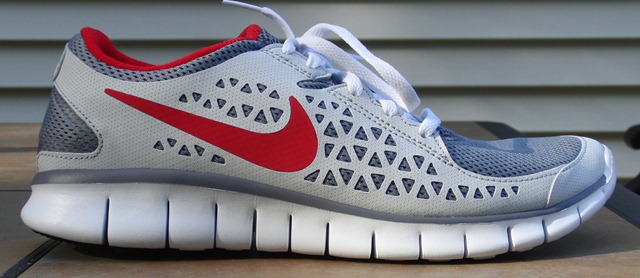
The above being said, my overall feelings about this shoe are actually quite positive when it is placed in its proper context. I have long been a fan of the Nike Free line, and the original Free 3.0 was actually the shoe that started me on my journey toward more minimalist running shoes. Part of my frustration when the Free Run+ was released was that it seemed like the Free 3.0 had been discontinued, which it apparently was not since it can still be purchased at various places (like Running Warehouse) – whether or not the Free 3.0 was resurrected with the emergence of the minimalist movement, or whether it never actually went away is a question for which I’d love an answer. Anyway, given that the Free 3.0 is still around, the Free Run+ has a definite place as a transitional minimalist shoe – I’d classify it as a gateway shoe to minimalism in the same vein as I defined the category in my review of the Saucony Kinvara. The Kinvara and the Free Run+ are both very popular shoes right now, and for many, one of these will likely be the shoe that encourages them to move toward more and more minimal options (much as the Free 3.0 served this purpose for me). Given this, the remainder of my review below will be largely written in light of my view of the role that this shoe fills – a transitional shoe for those heading toward more minimalist designs, or even an end of the line shoe for those wanting a bit less shoe who might not want to go too extreme in that direction.
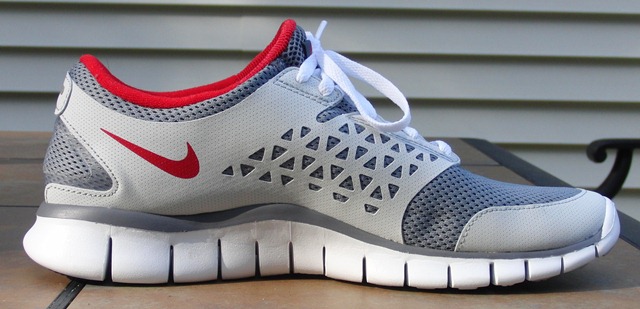
Appearance: As always, Nike pays careful attention to the appearance of their shoes, and the Free Run+ is no different in this regard. It’s a great looking shoe, and comes in just about any color you can imagine – this fact alone seems to be a testament to Nike’s confidence that the shoe would be a big seller. Ads for the Free Run+ are colorful and highlight the shoe’s flexibility, and it’s one of the few more minimalist shoes that you will see on the walls of shopping mall shoe stores like Foot Locker and Finish Line.
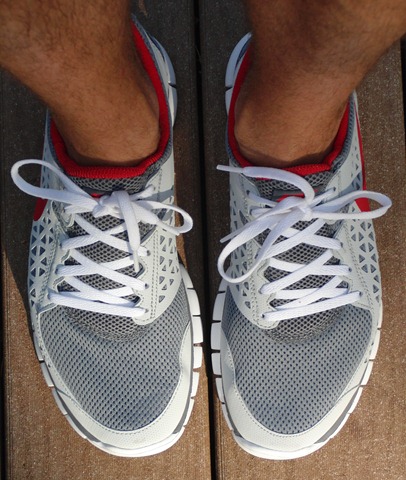 One oddity about this shoe is that it has a curved last and an offset lacing system, which makes it look like the shoe bends medially when viewed from above (see photo to the left). My sense is that this is more a function of the lacing system altering appearance than anything structural, but it makes for a bit of an odd look from above.
Although not an appearance element, it’s worth noting for those who might be interested that these shoes do accommodate a Nike+ sensor under the insole. I have long since abandoned the Nike+ system due to it’s inaccuracy, so I have not used the sensor in these shoes.
Fit: This is where the Free Run+ really shines – it’s one of the most comfortable shoes that I own and I often wear it out and about simply for this reason. In my opinion, the uppers on the Free shoes are among my favorite on any shoe – the sockliner is very soft, and I really like the bootie design on the Free Run+. Although the shoe is supposed to be capable of being run in sockless, my attempt at doing so resulted in hot spots that could easily have become blisters had I continued, so I would not recommend them as a sockless shoe (I have run sockless in the Free 3.0 and Saucony Kinvara without issue).
As for sizing, the shoe runs true to size for me, and the fit is nearly perfect. The forefoot is plenty roomy for my medium width foot, and the heel through arch fit is nice and snug. There is a bit of arch support, which will likely turn off those more interested in truly minimalist shoes, though it is slightly less pronounced if you remove the insoles.
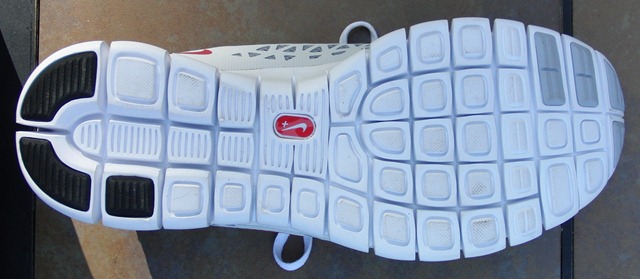
Function: Here’s where things get a bit tricky. Whether or not you like the Nike Free Run+ out on the road is going to depend largely on what you want out of the shoe and what you plan to use it for. As I mentioned at the outset, the Free Run+ is thickly cushioned (though a tad firmer than the Saucony Kinvara) and has a moderate heel lift (about 7mm). Thus, ground feel is not great, and the heel will not be one that helps get you immediately onto your midfoot/forefoot. On the plus side, they are extremely flexible (due to the extensive siping/grooves on the sole – see picture below) and very light, so if you are coming from a heavier, more traditional shoe with a 12mm heel lift, you will definitely notice a difference going into the Free Run+. It is for this reason that I view the shoe as a good choice for someone looking to transition slowly into more minimalist shoes (some minimalist runners oppose this transitional approach, but it worked just fine for me).
If you are already a minimalist runner and prefer shoes with minimal cushioning and as little heel as possible, the Free Run+ is probably not a great choice. However, I find it to be a good shoe for recovery runs and long runs, and nearly chose it as my shoe for my BQ marathon attempt a few weeks back (I opted for the Kinvara). I’ve run long runs in them with little issue, and did a half marathon simulation in 1:35 during my last training cycle and they felt great. For an all-out, marathon length race I like a shoe to have a bit more cushion and don’t mind a slight heel lift, so the Free Run+ fits the bill better than most shoes out there.
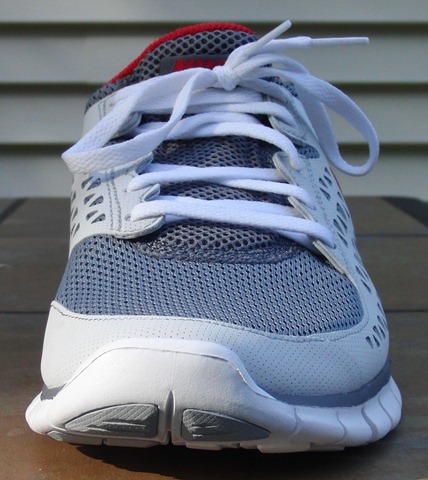 A few last thoughts on running midfoot or forefoot in the Free Run+. It took a lot of work for me to transition to a midfoot striking running stride, and I still lapse from time to time, but I can run midfoot fairly easily in the Nike Free Run+ now that I have become comfortable with the gait (see video below). That being said, as I have mentioned above, I would not choose this shoe as the ideal one to get someone off of their heels. It will help you get a feel for what it is like to run in less shoe, and will help in the process of acclimating to a lower heel lift, but my feeling is that if you really want to work on a midfoot/forefoot running stride, you need a shoe with as little heel as possible.
Conclusion: In summary, the Nike Free Run+ is a great looking, very comfortable shoe that is an excellent choice for someone who runs in traditional trainers and wants to transition to less shoe. For someone who has already made the switch, it can serve a role as a recovery and distance shoe, and my feeling is that the Free Run+ would hold up well as a marathon shoe for more minimalist runners as it provides some protection from late-race form-breakdown (though I would probably recommend the Saucony Kinvara over the Free Run+ as a marathon shoe since it is a bit lighter and has a bit less heel). The Free Run+ will likely see continued use in my rotation, and although it is far from barefoot-like, it fits nicely in the transitional minimalist category.



 About Peter Larson










Nice review, Pete.
Hey Pete – thanks for the review. I had a pair of Free’s awhile back and was totally turned off by the heel lift and the arch support. Even though I have low arches, any type of support is really uncomfortable for me. Would you say these shoes have more or less arch support than the original Free 3.0’s?
They are pretty comparable in terms of arch support to the original Free
3.0, but definitely a bit higher in the heel than the 3.0.
Nice review, Pete (as usual). The Free Run+ is my current running shoe. I wanted to run in a lighter shoe, but I have wide (Fred Flintstone-esque) feet. The Kinvara was too narrow, but the Free Run+ fits.
One thing that slightly irritates me about the shoe are the deep grooves. Though they provide the shoe with a great deal of flexibility, they pick up small rocks and gravel constantly.
Thanks Rob – I too am always picking rocks and sticks out of the sole of the
Free’s – the price we pay for flexibility I guess…
Good review, I wish they would offer a zero heel to toe drop.
I’ve heard rumors of a Free 1.0 – we’ll see if they’re true.
Sent from my iPod
Seems that Nike still hasn’t grasped the forefoot/midfoot landing, with the only carbon on the sole being in the heel. Aside from that, this might be a good candidate for the garage tinkerer to customize the heel lift as needed…
Yep, I’ve seen these zeroed out before, and sounds like it worked pretty
well. Saucony has the same issue with no rubber on the lateral forefoot in
the Kinvara, but I suspect the Free’s will be a bit more durable in that
area as the sole material is a bit more solid.
Pete
Hi Pete, nice review, been lurking for a while and enjoying all your posts. I also found the “New Runner’s Perspective” review from a while back interesting. I’m a somewhat natural midfoot runner (neutral/supinating) (based on a couple of videos, one at a ChiRunning workshop). Having had persistent shin splints in the Asics Nimbus recommended in a running shop since I started running a year or so ago I recently got hold of the Free Run+ (almost impossible to find in the UK!), having decided to try going more minimal rather than trying to find something with (even) more cushioning. After about 100 miles in them I’m finding them a big help – some sore calves but my shins are getting much better, no problems landing midfoot, and the really interesting thing for me is that my cadence has gone right up. In the Asics I would average about 82 spm, which I’ve been trying to get up to at least 85 according to the ChiRunning principles (I am tall at 6’4). From the first run in the Nikes I’m very naturally settling into a cadence of 88-89spm. Whether this is due to the light weight, flexibility or lower heel I don’t know, but I’m pretty sure it’s helping my shins. I’d like to try the Free 3.0 or Kinvara, but none in the UK right now – a bit of a gamble given shipping from USA! I’m told we will have the NB MT101 mid-November this side of the pond, so may give those a go too…
Thanks for the comment Mark – it’s amazing how much of a difference it makes
to get out of the bulky shoes. I felt the same way during my transition – my
first run in the Free 3.0 was a major aha! moment. Have you checked out
Inov8? They’re based in the UK and make some very minimal shoes.
Have tried on some Inov8 (X-Talon 190), very light but they seem a weird shape for my foot and the upper creased in a strange way – didn’t seem flexible enough. I got myself a pair of new balance NB130 flats a while ago (amazingly light) and am just working up the courage to try a proper run in them :)
Thanks Pete, helpful review. Curious as to what kind of mileage lifetime are you seeing out of these though. Comparable to Launch/Kinvaras?
I’m probably only nearing 100 miles. Unfortunately, since I run in so many
shoes (due to my reviews), the one thing I can’t really give good info on is
durability. Miles get spread between ~10 pairs at any given moment.
Pete
I have owned about 3 pairs of 3.0’s now, 2 pairs of 2nd gen and 1 pair of 3rd gen.
1st Gen #1 – has about 300+ miles on them, you can tell that the sole has been compressed to about 2/3 of its original size, but since I don’t care much about cuishioning anyway, the less the better. Though it’s definitely less comfortable to run in these than the newer pairs I have.
2nd Gen #2 – died after about 100 miles; it’s been a while but I think the sole started sliding which made it pretty uncomfortable to run in
3rd Gen – has prob about 150 miles on them right now, and they still feel very comfortable and bouncy.
I imagine the Nike Free+ would prob have a shorter lifespan since it has more cuishion/technology.
Hope this helps.
Thanks for the review. I use the Run+ in the gym and short running. (though my mileage is fairly limited anyway) I work in back and forth with the Brooks Mach12 spikeless right now and it’s a nice alternate shoe and holds up well to a wide variety of uses beyond just running.
The one issue that I have is that the Nike doesn’t feel very secure on my foot. I’ve never actually had it slip off, but I have trouble with getting the laces and heel snug and it’s often in the back of my mind when I wear the shoe. (This could be due to the fact that the Mach12 is extremely snug.) I have a fairly wide foot so snugness is usually not an issue.
Used the Nike Free Run+ on a easy 13 mile run yesterday… I like the softness and comfort of the uppers… and that is about it. Problems: the cushioning on the midfoot/forefoot area felt hard and stiff compared to my Kinvaras and Mizuno Waveriders… (the heel cushioning has never been an issue with me for all my shoes… so no problem there….), after about 2 hours of running I developed a blister on my small left toe… I have never gotten a blister from any running shoe unless I am racing a marathon, the last time was probably over 20 years.. so this was strange. Conclusion: They will not be used for mileage longer than 8.
Interesting how we are all different – toebox feels roomy in the Free Run+
on my foot, but I’ve had major blister issues with some other Nike shoes.
Thanks for the great review Pete, keep posting god bless and good luck for all your races.
I’m not a runner (yet) and like many people, I’ve read Born to Run, and have been inspired to get running. I’ve tried on and off in the past to get into running, but it never stuck. The concepts and advantages of minimal and barefoot running seem pretty clear, so I would like to start in that camp. Many of the articles talk about the transition to minimal running for established runners, but not for beginners. So being that I’m a blank slate and have no muscle memory or form to really speak of, what would you advise for someone just getting started?
Do you still think a transitional type shoe like the Free + would be a good place to start, or would jumping more extreme to the minimal side be more advisable, since there are no built in habits or tendencies? It seems that the benefit of some cushion, when done with a proper midfoot form would be the best of both worlds in terms of comfort. I guess I’m willing to give the VFF’s a try, but see that used more to mix things up, than as the bulk of the running.
Also, it seems that you use different shoes for different purposes, like when training vs racing. If one shoe were to be chosen, with the goal of wanting to be minimal or minimal-like, what would you think would fit well for that purpose?
(And like you, I find myself probably swayed too much to asthetics and design. I don’t really dig the Kinvara’s styling. The trail Minimus looks sweet, but I’m not so sure about the road version [plus the current lack of info about it])
Finally, it looks as though guys like Jurek, Jenn Shelton, and Chris Mcdougall aren’t even running in a minimal type shoe. I guess this relates to your comments about form and technique in elite athletes when you filmed the Boston Marathon and posted your observations.
Thanks for your hard work and enthusiasm on this blog!
I agree with the review. I have own several versions of the free line. My only complaint is that they are a magnet for rocks, pebbles, twigs and other small objects.
7mm rise heel? maybe.. I don’t realy measure it but I feel it is almost flat. this may be due to its inside sole curve from lower heel to high arch support then to lower forefoot
I measured with calipers, insole included. It’s flatter than a typical
shoe for sure, but not zero drop by any means.
Pete
I have a question regarding both the Nike Free and the Vibrams. I have an 11 year old son that is already an accomplished long distance runner, 5k’s around 21 min and 10ks around 45 min. My cousin is an orthopaedic surgeon and he recommended having my son run barefoot as it would be much better for his feet, legs and back, not to mention he would probably run faster. My son loves to run and I am trying to help facilitate that, but running barefoot on asphalt and concrete is not an option, so of the two which shoe would you recommend for a serious runner who is also still growing? I have asked several of the Dr’s I know and since none of them haev tried either shoe they are unable to adivse me.
I’ll begin by saying that I’m not a medical doc and thus can offer
only opinions, and don’t take any advice here as anything more than
that. The Frees will provide more cushion and are thus more forgiving.
They are also very flexible, which is a big plus. The Free 3.0 is a
nice shoe. The Vibrams require more adaptation and there is some risk
involved during the transition period. However, they are more like
barefoot if that is what you want. A third option is to go with a
spikeless cross country flat like the Brooks Mach 12 – I have a doctor
friend who recommends those for kids. My best advice is to go to a
store that will allow your son to try these shoes on and see which
feel best to him.
Pete
Have you read the article in The New York Times on the Nike Free? It’s on how the Free is fashionable to and in the end of the article the creator of the Free says that the problem was trying to not make it look like a foot. It was in the Lifestyle section of this Sunday’s Times.
Thanks for the heads up, I’ll check it out.
Pete
I bought a pair of these back in Feb. and I didn’t like them much after the first couple of runs. I tend to have problems with plantar fasciitis in my left foot and these seemed to exacerbate it. But looking back I think the Chicago cold affected my gate and probably made me slip back into a heel striking motion.(Something you mentioned as well) I went for a 5 mile run today in them and felt great! I’m thinking I’ll use these for a while with the warmer weather coming then switch to the Merrell Trail Glove or NB Minimus Trail.
NB: The stupid thing with these, and the ‘Free Run+ 2’, is that the gap in the strengthening material, beside the ball of the big toe joint, is exactly where they’ll wrinkle, tear and fail.
Don’t Nike ask customers for feedback?…No, of course they don’t! What was I thinking?
Nike are a bad company. Losing the plot.
Using it as a transitional shoe, what’s a better option the Free Run + 2 or the 3.0 V2?
For a wider foot, the Free Run, for a narrower foot the 3.0.
I have the ‘Free Run+ 2’ (in a size 7UK they are 0.4oz heavier than these originals). The ‘Free Run’ range having such high ratings just shows they’ve been bought by non-runners. They’re not even pretty enough, with no real swoosh logo, to impress casually. Firstly, my feet are 26cm long – a Nike size 7UK – but my 7.5 (8.4oz) pair fit perfectly and are very comfortable to walk in. However, when used for running you’ll soon realise the ‘Free Run’ soles are a dangerous gimmick! The supple soles put a large bending force on the metatarsals and you’ll soon feel a rheumatic ache. The dull aching will also be felt in the ankle and up to the knee, due to a lack of cushioning from the tough sole rubber – needed to prevent the rubber from splitting between the segments. What’s the benefit of these supple soles? There is no benefit. Your metatarsals will fracture before they have time to adapt. I had a constant dull pain for 2 months before giving up on them and getting some AdiZero Adios instead. The ‘Free Run+ 2’ have another design flaw too – the band of support material has a gap beside the big toe joint, exactly where it’s needed to prevent wrinkling and tearing! I’d guess they’d last 500 miles, at best. Also, the soles have no grip and, after my 1st 5 mile walk, the little tread they do have was worn flat! Very slippy on smooth, hard surfaces, but ok on soil or sand.
Nike – just bring back some proper shoes, like the Zoom Jasari iD instead!
Pete,
Do you know if it would be possible to lenghten the toe on your right Nike Free Run, to accomodate your slightly longer right foot, while keeping the snug fit on the left side?
And a more general question; how many millimeters do you prefer to have in front of your big toe, when you buy a new pair of minimalist runners? That is, when your foot is fully rested, not swollen et cetera?
Keep up the awesome work!
Anders.
Anders,
Not sure on modifying the forefoot. The Nike’s are pretty comfortable out of the box for me. As for room in the front, I generally try to have about a thumb’s width in front of my big toe.
thank you
that was a great review holy shit
I’ve just bought a pair of these (steeping up in shoe from 18 months vibrams!) and have about 60km on them. Originally wanted Free 3.0 but despite being told by shop assistant the upper/fit is identical, the 3.0 were just too tight across my forefoot.
I am quite enjoying these however, except for the rather high arch support – after about 10km my foot feels a bit like it has cramp. I’ll try without the insole to see whether that helps as some have suggested. All-in-all I have high hopes – at last I can run on rocks/stone again!
i am just looking for one pair of nike free run “`
where i can buy
Hey, are they good for skateboarding??
Please reply
I am in the Army ROTC program at my university and I end up running extensively at least 4 times a week,4-7 miles each, on concrete/roads. Most of the time these runs are really fast paced and intense workouts. Do you think this shoe is ideal for that? The reason I’m asking is because I’ve been having slight knee pain and I’m not sure whether I should just buy a new pair of regular running shoes that absorbs shock better or transition to minimalist shoes that prevent heel striking. My shoes are about two years old and are pretty worn out already.
Thanks !
This shoe is not likely to stop you from heel striking, still far too much cushion. That being said, it’s a solid shoe for running, and if you combine it with some form training that might help with your knee. You might try and check your cadence by counting how many steps you take in 30 seconds then doubling it. If you are well below 170 it might be an indicator that you overstride which can cause problems at the knee. In that case form work might be of benefit.
—-
Pete Larson’s Web Links:
-Performance Health Spine and Sport Therapy<http: about-us=”” dr-peter-larson=”” performancehealthnh.com=””>
-My book: Tread Lightly: link to ow.ly
-Blog: https://runblogger.com
-Twitter: link to twitter.com
-Facebook Page: link to facebook.com…
-Discussion Forum: https://runblogger.com/forum</http:>
Hi My son, aged 12, always asks for a pair of Free Run as it is fashionable. When we approached 2 shops, I got the idea that Free Run is too soft at the back and do not provide enough protection for teenagers like my son who may play basketball, footy anytime. Do you think Free Run is suitable for teenagrs who do a lot of exercise?
Thanks
Mandy
If he’s strong probably not a problem, though it might not be the best shoe for a sport with a lot of rapid changes in direction like basketball. The Free is really flexible and may not respond well to sudden directional changes at fast pace.