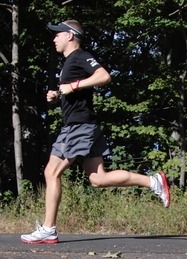
 If you’ve been following this blog for the past few months, you’re probably aware that I’ve developed a deep interest in the topic of running form, and have spent a good amount of time working to modify my own form to a shorter, quicker stride with a midfoot landing. Well, after a long process and a lot of practice and hard work, I finally feel like I’ve clicked into a new comfort zone with my running form. As I’ve said before here, my reasons for trying to change were mainly to see if I could, and to find out if there was any benefit to me in doing so. I was not injured, nor was I particularly unhappy with my speed/efficiency, but as an evolutionary biologist I find the notion of running like my my ancestors did, and my 6 year-old son currently does, appealing, and I figured I’d make myself a guinea pig and give it a shot.
Let me start by showing a video of me running in the Manchester City Marathon from last November (2009):
Runblogger Machester City Marathon from Runblogger on Vimeo.
What you’ll notice in the video above is that I was a heel striker, though not as pronounced as some others I have seen in the same race, and my leg was extended a bit more at the knee upon ground contact than I would have liked, though again not so bad that I would call it extreme overstriding. I probably could have continued running like this without much problem, but I’m an experimenter, and an opportunity for self-experiment like this simply could not be turned down.
Below is another video of my gait from early Fall 2009 – again, a very distinct heel strike in Nike Free 3.0’s:
Super Slow-Motion Running in Nike Free 3.0’s from Runblogger on Vimeo.
My approach to form change began mostly with me running once a week or so in Vibram Fivefingers KSO’s. I was very cautious with the Vibrams, and used them in this manner for about 9 months. For quite awhile, the Vibrams were the only shoes in which I was able to run easily on my midfoot or forefoot, mainly because they lack a heel and almost force you to shorten up your stride and avoid heel-striking. Earlier this summer I got a pair of VFF Bikilas, and built my mileage up in them to a long run of 15 miles – I found the Bikilas to be even more effective than the KSO’s for my stride work, possibly because my KSO’s are a size to large for my feet and I could only run in them with Injinji socks.
During this past summer, I began working on my form in a much more focused manner. This was spurred in part due to prodding by some friends on a discussion forum that I participate in (thanks Harry and Tuck!), and I did a few barefoot runs just for fun. Running barefoot is one of the most effective ways to do form work since your feet can really sense the interaction with the ground, and you have to be very conscious of what you are doing. I have done as many as 2 miles on asphalt fully barefoot, though it’s been a bit since I have returned to it. I also found speed work on a track in my Brooks Mach 12 flats to be very helpful – by running fast on the track with no music or distraction, I found that I could really focus inward on my body. I used Steve Magness’ cue to “put the foot down behind you” as a way of trying to shorten up my stride in front of the body and get my landing a bit closer to the center of mass (i.e., roughly my hips), and I also tried working on increasing hip extension behind the body on the track (the latter is a work very much in progress).
While doing nearly all of this, I still found running on my midfoot or forefoot to be very awkward and inefficient in any shoe that had any form of heel. This includes things like the Nike Free 3.0 or Saucony Kinvara, both of which have only a 4mm heel lift. I had reached a point where I was fairly well convinced that I would heel strike in any shoe that was not zero-drop. Then something strange happened. I received a test pair of GoLite Amp zero-drop trail shoes in the mail, and took them out for a spin one night. The GoLite Amp is a fairly bulky shoe (12.5oz) and does not line up with my typical preference for very lightweight shoes, but it has no heel lift, and I was very curious to try it out. To my surprise, despite it’s bulk, I could run in it on my midfoot almost effortlessly. Something clicked that night, and for the next week I did all of my runs in the Amp or in another test shoe I had received, the Mizuno Wave Universe. The Mizuno is by far the lightest shoe I own (3.8oz), and it has a 5-6mm heel lift. However, I found that like the Amp, it was effortless to run in them with good form. What once felt awkward now felt natural, and I was clearly now using my leg musculature to absorb much more of the impact shock (could definitely feel it in my quads).
The strange thing is that ever since that week of running only in the Mizuno Wave Universe and GoLite Amp, I have been able to carry my form over to any shoe with a reasonably reduced heel. It’s almost as if my body said “OK, I know how to do this now, and from now on it’s going to feel comfortable.” It felt like after a long trial period, the new motor pattern was finally accepted by my body that week, and has now been committed to muscle memory. This may sound totally crazy, but it was my experience, and right now things are going very well.
As a result of all of this, I now believe that you can run easily with midfoot/forefoot form in most shoes with a reasonably low heel, but that it will be much easier to get there if you employ some form of zero-drop shoe along the way (or go barefoot). For me, the Vibrams were a huge help, and the GoLite Amp, though not an everyday running shoe for me due to its weight, made me really realize the value of zero-drop. My muscles are getting stronger, and I feel like I am getting more efficient with my retooled stride – hard to know if I am any better off now than I was last Fall, but it certainly has been a fun and eye-opening experiment. Form change is possible, it just requires patience and hard work.
There’s one other thing that I have found very helpful in my attempt to modify my running form, and it’s something that my friend Mark Cucuzzella talks about a lot – get flat as often as possible. Whenever I’m not running, I try my best to be either barefoot (around the house) or in shoes with little or no heel lift (Vibrams, Birkenstocks, yard work in Nike Sneakerboats, walking in GoLite Amps, at work in black Nike Free 3.0’s). My goal now is to be done with all forms of majorly heel lifted shoes for almost all occasions. I still find value in shoes with some heel lift and will continue to use them regularly (e.g., things like the Saucony Kinvara, Nike Free, etc.), but gone are my days of running in anything with a traditional 12mm heel lift.
I’ll prelude my current form videos shown below by saying that my form is still very much a work in progress, and this will probably continually be the case from here on out. Now that I have become more aware of my running body, it’s hard not to think about the little things that one might try as a way to further improve. If you notice anything in the following videos or have any suggestions for me, I’d love to hear your thoughts in the comments!
First, here is a video of me running in Brooks Mach 11’s from early July – pretty big heel strike, and my son follows me to show how it should be done (in Crocs!):
Second, here are three clips of me running taken yesterday in the Nike Free Run+, Saucony Kinvara, and Newton Distance Racers. All three show pretty decent midfoot form with the foot landing more-or-less directly below the knee – this is what I have been aiming for. It’s hard to run naturally when you know you are filming yourself, but this is a pretty good set of clips in which I attempted to zone out and run as I do when out alone on the road. Making progress!
You might also like:
 Why a majority of runners, even among international elites, are heel strikers by Blaise Dubois
 A Contrast in Form: Variable Running Gaits at the 10K Mark of a Marathon/Half-Marathon
 My Interview on Jason Fitzgerald’s Strength Running Blog
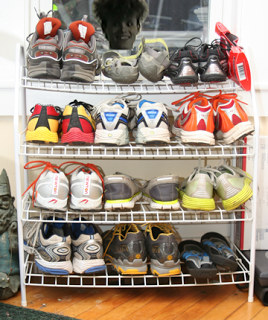 Choosing a Running Shoe: How My Perspective Has Evolved
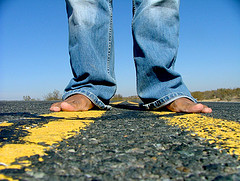 Barefoot Running: Thoughts on My First Barefoot Run


 About Peter Larson










Great info! It seems like a lot of runners assume you have to start barefooting it cold turkey or something to improve your form. I’ve been taking a long time to transition down, because I was running in motion control shoes with orthotic inserts that had a pretty tall heel cup. So I was working out in shoes that were probably the equivalent of 2-inch heels. Ugh. I think my achilles was actually shortened from running in those as much as I did. Since spring, I’ve been running in shoes with a much lower heel, though it’s still raised a little bit. I’ve also been going barefoot or wearing flat flip flops or kung fu shoes for every day activities to get my achilles and calves used to my heel being at the same level as the ball of my foot. Using Vibrams once a week is a great idea. I bet my feet are ready for it now, too.
I’m definitely a Vibram proponent, but you do have to be careful with them
at first. Start slow and only for short runs, ease off when there is
excessive soreness, and be smart. I actually just bought a pair of Bikilas
for my wife – she’s an overstrider with a big heel strike and has had
chronic hip issues.
Pete
Definitely be careful when transitioning to minimalist shoes like Vibrams. I came down with top-of-the-foot-pain because I did too many miles too soon. I didn’t give up though. I took a three week break from running and then got back into it, running in regular running shoes for most of the week, and running in my Vibrams once and week. I’m still doing no more than two runs per week in the Vibrams. I’m hoping by spring that my foot muscles will be strong enough to handle running in Vibrams full time.
I’m a 61 year-old runner, running in Merrell Trail Gloves for one year now. It is the shoe I have looked for over 40 years of running. I can’t imagine anything better, with the possible exception of the toe grips. After one year of running, the forefoot soles of the shoes are a little worn — I could do another year in them. I was a decent master’s runner, still doing sub-5 minutes miles in my late 40’s. Now, I mostly just enjoy myself.
BTW, I’m from West Hartford, Ct., now living in Montreal where I teach the Alexander Technique. I have given barefoot running workshops in Switzerland, Montreal, and will give one in NYC in the Spring.
Excellent, glad you found the shoe. Good to hear from another runner from WH!
I have plantar fasciitis and orthotics. I have been using the heel stike running method for over 20 years. Just switched to zero drop shoes and mid to toe stile running method. Now I don’t need orthotics in zero drop shoes as it stretches the calf. I had to switch my foot strike do to runners knee. So not only does the mid to toe strike prevent runners knee but it also elevated my plantar fasciitis. Hope this helps. Transition time on the calves is pretty crappy but 100% worth it.
Nice improvement Pete,the enly thing I noticed was there was not much arm movement going on [but this does depends on running speed, how fast were you going?] maybe you could think of driving your elbows back with a little more force.
Rick,
p.s. you seemed to look best in the saucony’s.
Rick,
Didn’t have my Garmin on, but it was a comfortable speed. I noticed that
about my arms – I have a very high carriage with little movement – wondering
if it’s a response to the fact that I usually run with a handheld bottle or
dog leash in hand (or both!) on most runs. To be honest, I really haven’t
messed with my arms at all, so maybe that’s something I should look into in
more detail.
I agree on the Saucony’s – that’s going to be my marathon shoe next week!
Pete
Pete, I tend to use a high arm carriage too, think as long as your shoulders are down and relaxed there is no problem.
I’ve noticed that many African runners hold there arms quite high and it seems to be less tiring.
If you concentrate on driving your elbows back in short fast movements it can help increase stride rate or if you use more range of movement as you drive back with the elbow it can help increase your stride length, as Steve Magness showed in one of his articles arms do play an important role in effecting running form.
One last thing, maybe you can try leaning just a little from your ankles to get a forward lean [like Ryan Hall etc], this can help you generate better horizontal power and also you can use your weight to push against the air resistance or headwind!
This post in interesting and informative, thanks for sharing the videos.
I’ve noticed the same thing. Once my body got used to what good form felt like, I could reproduce that same way of running, even with a higher heel shoe. My body just remembered how to do it. Occasional short barefoot runs are what really helped me tune it in. I’m doing almost all my runs now in asics piranhas, except my longer runs are still in Mizuno Wave Ronin 2 (has a heel, but I can still maintain good form).
I have ditched all my higher heeled shoes for everyday life as well. I am loving a pair of cheap faux chucks for running errands and whatnot. Totally flat and no arch support, super lightweight.
btw, loved the video of the kid in crocs. When I watch my son run, I’m amazed at the beautiful, natural form. Oh, if you are looking for a good kids running shoe, I ran across these link to zappos.com… They have preserved my son’s natural form, and have helped my daughter rediscover hers. (She ran in traditional heavy cushion, higher heeled shoes for a while).
The best kids running shoes, in my opinion, are low-top converse all stars. Basically cloth upper with a flat rubber bottom. Both of my boys (4 and 7) have them and run everywhere they go – with perfect form. I won’t buy them traditional running shoes, and I avoid anything else that has a heel.
Chris,
Amazing, isn’t it! I have the Ronin’s now as well, and they seem to be just
above the heel striking threshold for me – bit too much heel at 9mm offset.
We’ll see if that changes with time and my form continues to be ingrained.
Pete
It will be interesting to hear how your recovery time is after your upcoming marathon.
Tuck,
I predict pain no matter what shoe or form I use :) In all seriousness, I
did 19 miles in the Kinvara last weekend at an easy 8:20ish pace and was
able to maintain form the entire time. The question will be whether or not
my muscles are strong enough to take the brunt of impact absorption at a
faster pace for a full 26.2 – I don’t think I’m fully there yet as a still
get quad fatigue (it’s getting better, but still there), so it will be
interesting.
Pete
I too had a realization that my biggest obstacle in trying to run with better form was in fact any kind of heel rise in whatever shoe I was wearing. I am currently trying out the vivo barefoot evo’s, which have zero heel. I’ve been using them for walking around in all day as well but find myself wishing I had an alternative “softer” shoe to make this transition a little easier (feet are pretty sore). Any suggestions? I did try the golite amps but was turned off by what I felt like was way too much arch support and too narrow toe box.
Funny how feet are different – I find the Amps to be overly roomy. The arch
support is an issue with the insole – if you remove it it goes away. That
being said, it’s a very heavy shoe for me, and not an everyday training
shoe.
I’m liking the Mizuno Wave Universe – has a very low profile even with a
mild heel lift, and a very roomy toebox. Excellent shoe, but expensive. I’m
also a fan of the Kinvara, but it is more heavily cushioned, so if you don’t
like that, it might not be for you. Until companies like Altra and Skora get
their shoes on the shelves, our options for lightweight, zero drop shoes are
very limited.
Pete
I think since using the Bikilas and now the Evo’s, my toes have gotten used to having such a wide area and it actually feels like my foot has spread out a little more. I’m looking forward to trying the Altra, which look a little wider.
Thanks Pete.
Pete,
Just curious of your opinion, how do you feel about the upcoming new balance minimus all having a 4mm heel rise? This is definately a little disappointing to me as I was really looking forward to these coming out.
Todd,
If you asked me a month or two ago I would have said I was really
disappointed, but now that things seemed to have clicked a bit I feel very
comfortable running in a shoe like the Saucony Kinvara, which also has a 4mm
rise or the Mizuno Wave Universe, which is 5-6mm. I think the Minimus might
be a bit closer to the ground than the Kinvara – we’ll see – I should be
trying them out at some point. I’ll be wearing the Kinvara at my marathon
next week.
I think there is more to it than just heel rise – a firm sole and a closer
to ground ride can also work fine for me even if there is a bit of a heel. I
need to take my Brooks Launch out and see how they feel – they’re an old
favorite, but have a 10mm or so rise – definitely pushes that upper limit.
Pete
Great information Pete, thank you for sharing your continuing journey! I too have been trying working on form and cadence this summer just not as thoroughly as you have. You have inspired me to work harder on this for improvement. Thank you!
Thanks – keep plugging away Jeff!
Pete
Another superb entry Pete!
Once you start wearing zero-heel lift shoes it’s really tough to wear anything else. My wife and I know the feeling too well.
We have been either barefoot or wearing VFF’s as our main shoes since early-July (I have to wear steel-toed boots at work… darn). Errands around town, visits to amusement parks, training for our 1/2 marathon this weekend, whatever. My wife went for an 8 mile run on Wednesday and only had her Adidas trainers that she used to love. She took them off after 5 miles and ended up going barefoot… pushing a jogging stroller. Her quads were killing her after wearing the trainers. She swears she’ll never wear anything like that again.
It really is a lifestyle change.
Absolutely true – going all-in helps a great deal, and your feet and legs
will thank you. Just got my wife into Vibrams for the first time yesterday –
can’t miss her hot pink toe shoes!
Pete
Wow! You have really crossed the threshold and become a different kind of runner. Kudos for taking such excellent film (in slo-mo!) to illustrate your running form at various points along your journey. Those films make it crystal-clear what you mean when you refer to, for example, a mid-foot landing. (A lot of runners hear these terms and don’t know what they mean.)
If a picture is worth a thousand words…then, since each of your clips is > 100 frames, each of your slo-mo clips must be worth 100,000 words! (If only you could get paid by the “word.” :-)
Five years ago, after a half-marathon left my knees and hips feeling like they’d been worked over by a gang of street thugs, I read all I could about heel-striking vs. forefoot strike, and decided that by being a heel striker, and weighing > 180 lbs, I was pounding the heck out of my knees and hips with every stride. So I reprogrammed my brain. With every step I focused on my landing, and said to myself: “Land on the forefoot… Good! Forefoot… Good. NO! Not the heel. The forefoot…” This was my interior monologue for every run, for about six weeks.
Sounds boring of course, but it worked. I became a forefoot striker. For years I ran in racing flats (Saucony Fastwitch series)…and never landed on the heel.
This Spring I decided to make a full commitment to low-impact running. I did short runs barefoot on roads, and longer trail runs in shoes…and finally transitioned to a fully-barefoot running style. I’m still working on it…but I can tell you, my knees and hips have been very happy.
My friends ask me if I’ll keep running barefoot in the winter. I’ll just read your reviews, and then buy a pair of zero-drop shoes!
Thanks for the great research and reporting.
Ken,
The stories of successful transition are always so similar, and the one
common thing I see is that it is a slow, long term process that eventually
gets ingrained. You can’t expect change to happen overnight, but when it
does, it feels like an amazing accomplishment. I guess old dogs like us can
(re)learn new tricks!
Pete
Great post Peter. I especially loved the videos. I enjoyed seeing your progression from heel striker to mid-foot. It’s been a pleasure to follow your journey!!!!
Excelent, Pete.
I am from Brazil and follow with enthusiasm your blog. I try to apply what I read here to my running experience. I am getting the same conclusions that you are. I now use a zero drop shoe, and it almost forces me to run midfoot and with a short stride. After a severe plantar fascitiis in the first semester, I am now free of it, thanks to my running form, now I am sure. If I use the old Nike Vomero that I still have, even if I try to run midfoot, I feel my fascitiis will start again. I will be experiencing for the following months, but I am sure that what we see now is something that will soon be widespread to the general public. People like your wife or mine.
best regards,
Sergio
Thanks Sergio – I have heard many stories like your of people overcoming
injury by chaging shoes or form. There is definitely something to it. It may
not be needed for everyone, but it’s something to consider for anyone with a
history of nagging running injury.
Pete
hey pete,
pete,
great post (and blog). i’m looking forward to your upcoming review of the nike free+. i’ve generally been training with my nike free 3.0 but i’m thinking about trying out the free+ for full marathons.
james
Looking good Pete!
You are clearly a midfoot striker, without any apparent overstriding. Also, your upper body looks solid as well. As I’m sure you know since the two are inherently connected its hard to address issues in your feet without also being mindful of how your upper body relates and or possibly contributes to lower body issues. Also, form work takes a lot of time and I think you’ve come a long way in short while.
I also made the transition from overstriding heel striker to midfoot striker with a shorter, faster gate. I’ve done similar videos, including a fatigued video (at the end of a threshold run for example) to show how my form holds up as I become fatigued. I think it might be an interesting experiment for you as well to see how this new gate withstands exhaustion.
-Tait
http://teamfirspring.com
Tait,
I’ll be finding out how I hold up to fatigue a week from Sunday in my first
Fall marathon!
Pete
I’m sure you will be. Good luck!
-Tait
http://teamfirspring.com
Hello Pete. The Kinvara and Frees are pretty light shoes, how has it been transitioning into the Newton’s? Does the extra weight play a factor in your stride or is that really a non-issue now that you have changed your gait?
Enjoy the blog BTW!
Pete,
Is it just me or did you have just a bit more “spring in your step” in the Kinvara ;o)
Keep up the great work (both in form and educating the running proletariat).
Judd
Pete – Clear improvement! Great job. You’re right, as good as you’re becoming your son shows the most perfect and natural form! Between that observation and Steve Magness’ data on Kenyan runners’ rapid natural cadence it’s clear that our biggest task as runners is ‘unlearning’ what the ‘traditional’ running shoes have taught us. Also, great job on getting your wife to try on the Vibrams on a run!
I found this post incredibly helpful, especially since I had my first running experience today in 7 years! My doctor approved my starting the “Couch to 5k” training program. I have been hiking in VFFs for months now, and am right at home in them. I found in the short segments I was running I did indeed naturally land on my forefoot. It was so different from my memories of running years ago. Maybe it was the exhilaration of a new beginning in this sport, but I even felt like I was running fast :~) Your videos are great for helping me focus on my own form.
Hello! I’m sure you will be. It’s been a pleasure to follow your journey!!!! It’s a Great post Peter.
Pete, I am so glad Mark U forwarded this to me. I, too, am dilegently working on “correcting” my form. My Coach lives in CO and is a Certified Newton coach. I thought I was landing mid-food, but video revealed the complete opposite. I’m glad to hear that, after a concerted effort, things “clicked” for you. It gives me hope. I invite you to check out my latest blog post whereby I showed that a quick cadence doesn’t mean a short stride length. I ran at my race pace & 180 bpm cadence and took pictres of the distance traveled for each stride (I was at the beach). The results were amazing. http://www.bqordie.blogspot.com
Thanks for the comment and the link to your post – I’ll check it out.
Pete
Thanks for the info on the Go Lite’s. I never would have heard of the company otherwise. I just placed my order with Zappos. I’m loving my Kinvaras right now and can’t seem to get back into my Pegasus 27’s, which I used to love and did the SF marathon in only a couple months ago. I always learn something or pick up a new tip from your blog. Keep it coming!!
Thanks Tom – much appreciated!
Pete
Just stumbled on your blog for the first time. Good stuff! I’ve been doing the midfoot/minimalist thing for a little over a year now – following a really nasty leg break – and it has been an amazing transition. I don’t know if you were influenced by the book, Born To Run, but I was. I found the coach the author used in the book, and it turns out he runs a social network for “natural born runners.” You might check it out…
http://www.runningwitheric.com
Also, I did a podcast on Born To Run a few months back that you might find interesting.
link to enlightenedcaveman.com…
Lastly, being an evolutionary biologist, you might find my blog interesting, as well. Here’s an opening post that lays it all out…
link to enlightenedcaveman.com…
Good luck!
Thanks for the comment and the links!
Hello fellow runner! Love the blog, keep up the great work. Congrats on the new form, your body will thank you for it for years to come. Even though your heel strike was minimal, it’s amazing how much of a jolt it can give your body, and it will show up wherever your weakest link is. I, also, am attempting to clean up my running form. I am using the Chi Method as it seems to gel with what I know after years of doing yoga and pilates ( both of which I started as a means of improving my running!!) but I know some use Pose… whatever, as long as it’s helping us avoid injury, run more freely for longer and maybe faster (!!) and have more fun doing it. Some of the descriptors and advice you gave helped imprint the ideas in my mind more clearly. Thanks so much!
Thanks for the comment – and you’re right, do what works best for you!
On Tuesday, November 2, 2010, Disqus
This is fascinating stuff, thanks – I’m at the start of an equivalent journey (I hope)… looking at my big, chunky shoes with suspicion and wondering “can I go flat??’ “Will I hurt myself if I do?” – always the chicken-and-egg question. Which comes first – the technique or the shoes? You’ve encouraged me to take the plunge, so thanks!
Incidentally, if you’d like to see some running videos from my side of the Atlantic, I’ve just started a new vlog… http://runtodiscover.blogspot…. – I’d love to know what you think.
Thanks for the comment, and good luck with your transition!
Sent from my iPod
If you haven’t seen this small book in .pdf form already, check out “Running Fast and Injury Free” by Gordon Pirie. It is available as a free download at a few sites. The opinions and training suggestions of this champion are remarkably informative and truly inspiring. Although the weight training and nutrition info may be dated, the booklet as a whole is great for all runners, even older folks like me :-) . Fortunately for me, I’m a short distance guy who likes to stay on tracks, esp. gravel. Perhaps it’s my addiction to beta-endorphins. So I may have already had the “proper” technique.
I’ve actually read Pirie’s book – great stuff!
Pete,
Thanks for sharing this wonderful information. I became a runner 2 years ago but had to quit because of leg pain. I have been cross training, stretching, have seen 2 phys therapists…with no luck. A friend introduced me to your blog and I’m now hopeful that altering my form will allow me to get back on the road.
Glow slow and be careful – it takes time before it feels normal. Good luck!
Pete
Thanks for your post! I went out an got the GoLite Flash after reading. Took my first run last night and WOW! They really do force you to strike mid to fore foot. I have been running in the Nike Free’s 5.0 for about 6 months now as I transitioned to the new running form. Sometimes I still wonder if I am getting it, but after running in the GoLite’s one time I know I have it. As far as the weight, they are still way lighter than the old Brooks Beast that I used to plod around in!!
makes quite a difference doesn’t it!
On Wednesday, January 19, 2011, Disqus
I learned that the reason I couldn’t find my mid-foot was because I was still kicking my foot too far forward. The thing I do now is simply lift up my heel (by raising my knee, and not kicking out) and have the momentum and gravity bring my foot back to the starting point under my waist rather than forcing it to with physical strength (which,from my experiences, may lead to over-striding). I think that could make a big difference in your stride Pete; this technique took a lot of stress off of my legs, and I feel awesome running now.
Thanks Calvin – it gets more and more comfortable as time goes on. I now
tend to focus more on something similar to what you wrote – have the foot
land as it just starts to pull backward.
Pete
Pete, I know your thing is running, but do you have any advice for aged walkers with bad knees — i.e. kind of shoe?
Unfortunately I can’t help as much with that one since walking is a very
different activity than running from a biomechanical standpoint. I think the
biggest key is to wear something comfortable that doesn’t squeeze you foot
too much.
Thanks Pete. Didn’t mean to put you on the spot. I know running and walking do not equate. Just thought that since you get so much information on running shoes, some walking shoes might have been scattered in there somewhere, accidentally.
Velga, a couple of the principles apply; take shorter strides and gently roll from the front of the heel (rather than back) to the beginning of the forefoot, rather than toes – and a loose, comfortable flat shoe is best.
Thanks Jeff. Will try to keep your suggestions in mind while walking.
Pete,
Can one run with too much of a forefoot strike? In my adjustment to my new Merrell Trails, I’m getting new tightness in my upper hamstrings. It almost feels like I’m trying so hard to avoid a heel strike that I’m overcompensating by striking mostly on my toes and somehow constricting my hamstrings. My left hamstring in particular is way tight & sore. stretching helps more than anything to relieve the pain.
Your style is terrible… using a minimalist shoe could be for you very dangerous!!!
Are Vans ok minimalist casual shoes?
Sure – pretty flat, maybe a bit narrow, but if they’re comfortable then no
problems here.
In my run coaching you would still be considered a heal “striker”.
There is no such thing as a mid foot strike since the heal touches the ground first and the braking action ensues. Take a look at the video on my site of this lady and pay attention to the after video. That is how you run….with the ball of the foot touching, not striking, the ground.
http://www.freetorun.net
Pete, thanks for your ideas and videos. I’m recovering from a hamstring injury and am taking up long distance walking for a while. Finding the midfoot might be a key in better healing, as I will not be extending the leg as far forward. I might be exacerbating the hamstring issue by the heelstriking movement. I’m gonna try this, and look for some flatter shoes too! Thanks!
Greg, i can attest that finding the midfoot strike can make a lot of difference in minimizing injuries. once you find it, you should notice that there is a lot less jarring. my legs & feet & ankles & hips have never felt better!
Thanks for the feedback! It’s worth a try if you have been injured, just be
careful not to force it. With the right shoes, it will come naturally.
Minimalism in shoes is a fad.
…that has been around for the vast majority of human history, minus the
past 30-40 years.
Well, my feet & legs & ankles & knees & hips have never felt better since i switched to minimal shoes. Read up on the topic. Most shoes were minimal until the shoe companies introduced more structured shoes in the 60s. There is a lot of good research available on the virtues allowing the human foot to support itself naturally and use shoes primarily to prevent cuts & scrapes & provide warmth when needed.
I run 3 miles a day, sometimes more. I am needing new shoes and am thinking about getting the Vibram Five Fingers OR Merrell Pace Glove…which do you reccommend? I have run barefoot some and have noticed that my feet and ankles do not hurt like they do when I run in my Nike’s!!
Toes or no toes, that’s the big factor. I find the Merrells to be a bit more
versatile.
Minimalism is not a fad in my opinion. Bulky built up heels and cushioning is the fad when you look at the grand scheme of running shoes. Just wondering what your views on larger people (6 foot 4 inches and 220lbs) running minimalist is. Im by no means the typical small running frame but I am military and run quite a bit. I just picked up some New balance Minimus MT10 and did my first run yestaurday. I kept it to 2km quite shorter then I normally run however I experienced some considerable discomfort on my foot itself. I think I am slightly to far onto my forefoot then I need to be though. i was skeptical about having a lower impact run then my Reebok Zigs and Asics cumulus but it actually felt better (other then the foot pain)
I’m 6’3″ and 200-ish. I’ll defer to Pete but I doubt if size makes any difference in terms of the value of minimal footwear or not.
I had a few discomforts in my first runs in my minimal shoes. but they all went away over time and now my legs & feet & hips & back all feel great. i’d advise patience…
The author says he did everything to correct his form except for the most important thing he didn’t try. What he should have tried is sessions of speedwork, or interval training. We senior masters have known for decades that high speed intervals have more influence on correcting the runners form than anything else. The other benefit is that intervals recruit fast twitch muscle fibers. Also, if you follow the studies on the subject, they bear out that you shouldn’t strike at midfoot at all, but that point halfway between the midfoot and the heel. Finally, there is a clear distinction between form, technique, and style. That is to say, when it comes to form, it’s not a matter of “one size fits all”
It’s in there, 2nd paragraph after the 2nd video – speed work on a track was one of the most helpful things I did. I’m also curious which studies you are referring to?
I’ve recently enjoyed reading the articles on your blog. I’m quite surprised that it took you so long to transition to a mid or forefoot stride.
I’m guessing since you are indeed an avid runner, it is harder to totally just reduce mileage and do form runs until your new stride is second nature.
My experience, after taking up running full-time after a 15 year absence, is that it has only taken me 8 weeks tops to fully transition into a mid foot strike. Granted, I only had maybe two months of light running (3 x 2miles per week) before fully commiting to a more efficient stride.
I did this transition to what is akin to a running boot, Adidas Supernova Sequence 4, with Superfeet insoles. I believe that the key is that once my form got sloppy and I could not maintain at least a mid-foot strike, I would call it a day and go home.
In the past two weeks, I’ve added a transitional shoe, the Mizuno Wave Musha (I consider myself to have a mild pronation–verified by my own videos), to have a lighter shoe with a lower heel/toe drop ratio. In the first run, I was impressed that I was landing all forefoot and just how much lighter these were than the Adidas. Just ran three 1-mile repeats in the 5:50 range, which is only 25 seconds slower than my best in high school.
I’m finding myself wanting to have less cushioning than even the Musha’s have, so I’m excited to transition again to something like a Minimus Road in another 8-12 weeks.
I guess that my take away message to those that care to read is that it may be easier for someone just starting or just getting back into running to start off with good form from the get-go than it is for a veteran that has years of muscle memory to work against and future races to train for.
Thank you for including your son’s foot strike in one of the videos. I saw something interesting that I will focus on as I work on my transition from being a heal striker to a more natural and neutral strike and stride. What I observed is that your son did not have any toe raise in his forward stride and his toes actually were pointing down until right before his foot made contact. Looking at your midfoot strike videos, I am assuming (I haven’t taken video of me running) that my foot is doing something similar to yours with my toes raising above parallel to the ground during the forward stride. This is something that I’m interested in focusing on as I continue to develop my stride along with the speed work that you mentioned.
I’m hoping that this change in my running stride will allow me to run again without aggravating an long list of injuries I have acquired over my 37 years.
Thank you for your insight on minimal running and a midfoot strike.
The toe movement is somewhat variable among individuals. Raising the toes can help to tense up the arch prior to contact via the windlass mechanism.
Fantastically helpful – thank you.
Hi Pete, great to see how your running have been changed for the better i guess. But how long time did the “full transformation” of the stride take for you?
I’m still working on my stride, I play with it all the time :) I’d say about 6 months is a good timeframe for most.
Great article. I did a similar transition to midfoot-landing form by starting out barefoot.
I found that spikeless cross country shoes are the cheapest, most comfortable minimalist shoes. No padding, no heel drop, half the cost of today’s other minimalist shoes.
My first pair was Asics Hyper XCS, out of which I got over 1,000 miles. They still have 500 miles left on the soles, too.
My current pair is Saucony Kilkenny XC4. They are a dream.
Sorry to ressurect an old one but I’m just starting running and bought some ‘traditional’ running shoes earlier this week. I then read up on running (Born to Run and various other books) and discovered that my heel striking is not what I’m supposed to do, I had no idea! Since I bought my new shoes on the basis that I needed extra cushioning in the heel to protect me from my heel strikes I’m thinking of swapping them and making myself go straight into midfoot landings.
So my question is, do you think it’s advisable for a new runner to go straight into minimalist shoes? I will be doing an absolute beginner programme anyway, just been walking briskly so far, as I have zero fitness at the moment (and I’m overweight, by quite a bit). Also I don’t think I’d be going for full barefoot as I run in the dark and I dread stone bruises!
I personally think as long as you build up gradually then starting as a beginner is as good a time as any – that way you minimize the development of bad habits that can become ingrained. You might consider a transitional shoe like the Saucony Kinvara or Mirage, or perhaps the Brooks Pure Flow or Cadence. Definitely don’t do too much too fast, even if you decide to stick with traditional shoes!