
This is a somewhat long and unorthodox review, so I’m going to begin with an unorthodox introduction. I remember back in middle school we used to have a police officer come to class and talk to us about the dangers of drug use. One of the things he used to discuss were “gateway drugs” – those were the mild “drugs” like cigarettes and alcohol, which if you began to use them, would lead you down a slippery slope to the point where you’d be sniffing coke or shooting up heroin out behind the school at lunchtime. What, you might ask, does this have in any way to do with a running shoe? Good question – bear with me and I’ll try to explain.
Like gateway drugs, I have found that many people who make the transition to minimalist running begin the process with a gateway shoe. A gateway shoe is one that has many of the characteristics of a truly minimalist shoe, but still possesses some of the creature comforts of the familiar, high-tech, big heeled shoes that most runners have run in for the past 20-30 years. A gateway shoe gives a runner a taste of the freedom offered by a truly minimalist shoe (or, god forbid, running barefoot), and once a runner tries one of these out, it’s often a quick slide to the point where they, somewhat paradoxically, succumb to the throes of a raging minimalist shoe addiction. Sadly, it’s an addiction that I know all too well.
Lately, two shoes in particular have hit the streets and have garnered rave reviews from shoe junkies. These are the Saucony Kinvara and the Nike Free Run+, and I originally did not intend to buy either of them. However, both have apparently been huge sellers, and numerous friends have provided glowing reviews of each (I have now posted my own Nike Free Run+ review.). In particular, more of my on-line friends than I can count have jumped on the Saucony Kinvara bandwagon, and it has become the shoe of choice for many looking to move towards less shoe. Quite frankly, I suspect that the Kinvara may have become one of those very gateway shoes discussed above that causes runners slide down the slippery slope toward minimalism. Given the hype, I had to try the Kinvara for myself (this was a personal purchase, not a sample shoe), and having put in nearly 60 miles in them, including an 18 miler and some speed workouts, I feel ready to share my opinion.
To be honest, I have been asked about when this review was going to come out more often than for any other shoe I have tested. Furthermore, my original post providing some initial thoughts on the Kinvara has garnered big traffic numbers here on the blog (it’s currently my #2 post overall in terms of reader traffic). The Kinvara is clearly hot, and though true minimalists will probably cringe when I say this, I believe that it is going to play a pivotal role in the future of the minimalist running movement. Why, you ask? There are a number of reasons. First, if in fact the Kinvara is selling as well as it seems that it is, it may be the shoe that helps prove that money can be made from minimalism. Let’s be quite honest – minimalist shoes will not go mainstream and the movement will likely fade away if nobody buys this type of shoe. The success of shoes like the Vibram Fivefingers, Nike Free, and the Kinvara will go a long way toward spurring further development from the big manufacturers, and this has the potential to help shape the future of shoe design and marketing.
The second reason why the Kinvara is a pivotal shoe is that for many people it represents the first shoe that they will have worn that doesn’t fit neatly into the traditional style of running shoe that most people wear (i.e., relatively heavy and with a big heel lift). Sure, racing flats have been around forever, but they are generally not heavily marketed, and a lot of runners have never considered them an option. The Kinvara, however, is being heavily marketed, and it seems to have come to represent a “safe” option for those wanting to try less shoe. It deviates from most modern shoes in that it’s very light and has a low heel to toe drop (4mm), but it retains a hefty degree of cushion and it provides a very cushy ride. Once you go from a heavy trainer to a light shoe like the Kinvara, it can be hard to go back – this is exactly how I found myself on the slippery slope. About a year and a half ago I bought a pair of Saucony Fastwitch 2’s, which are a lightweight trainer that represented my personal gateway shoe. Once I started running, and setting PR’s, in the Fastwitch, there was no going back – the rest, as they say, is history. My suspicion is that for many people, the Kinvara will have the same effect.
Given all of this, how does the Kinvara actually perform? Below are my thoughts.

Appearance: As I’ve mentioned in other shoe reviews, I’m a sucker for a shoe that looks good. The Kinvara is a fine looking shoe, but not overly flashy like some of the others in my collection (Brooks Launch and Mach 12 come to mind). The upper is mostly just white and black on my pair (though I have seen pictures of a slick all-red version), and the sole is bright red. Saucony offers the Kinvara in a wide variety of color schemes, mostly by varying the midsole color, and this is a testament to the marketing effort they are putting into this shoe. Rarely do we see a lightweight training shoe with so many color combinations to choose from.

Construction: This is a category I’m including for the first time in a review, and it’s probably one I should have added in a long time ago. One of the issues that has been brought up in reviews of the Kinvara is durability, particularly premature wear on the sole. The problem is that, probably in an effort to minimize weight, Saucony went bare bones on the more durable black rubber outsole elements on the bottom of the shoe (see picture to the right). The lateral heel is well covered, but the forefoot is only speckled with small triangular patches of outsole, which are surrounded by far less durable EVA midsole material (the red foam). In what I consider to be a design flaw, there are no outsole elements along the lateral side of the forefoot. In a 4mm drop shoe being pitched as one that can help people transition to a midfoot/forefoot stride, having no protection for the lateral forefoot EVA is a problem. The reason for this is that mid/forefoot strikers tend to land on the lateral edge of the forefoot, after which the foot rolls medially. What happens then is these runners land on unprotected EVA, which wears down rather quickly as a result, creating the durability issues that have been reported. It has not been an issue for me since I tend to mildly heel strike in anything that has a heel lift, but for a true forefoot striker this could be a problem. It’s high time we see more shoes truly designed with a forefoot striker in mind – although still only a small (but likely growing) part of the market, this has long been an under-served population in the running world when it comes to proper running shoe design.

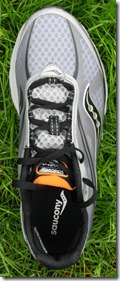
Regarding the upper, the Kinvara has an unusual mesh covered by thin fabric design (see picture at left). I’m curious as to why the under-layer of mesh is necessary, but I’ve had no issues with the design so far. The upper is very light and comfortable, and has a nice, sock-like fit.
Fit and Feel: As mentioned above, the Kinvara has a minimal, sock-like upper and fits very comfortably on my foot – perfect for a lightweight shoe (the Kinvara weighs only 7.7 oz in men’s size 9). It is neither too wide nor too narrow (results may vary depending on foot size), and runs true to size for me. While I would prefer a more anatomically shaped last that is shaped more like my foot (check out the exciting shoe line coming from Altra Running to see what I mean by this), the Kinvara is more comfortable than many other shoes I own due to the minimal upper.
The place where the Kinvara deviates most from a truly minimalist shoe is in the midsole cushioning (the red portion of the sole) – the cushion in the Kinvara is downright thick. While this might make true minimalist runners shy away, I suspect it will maintain the feel of a more traditional shoe for those using the Kinvara as a first foray into a lightweight trainer. Wearing the Kinvara, it feels cushy, and the forefoot does ride a bit higher above the ground than some other shoes. If you want a firm shoe like a traditional racing flat, this is probably not the best choice.

Performance: The Kinvara is really kind of an unusual shoe when it comes to performance. I was initially skeptical about the cushioning, but it feels good out on the road. However, using it on a springy track was not as fun – the combo of shoe cushion and track springiness seemed to make for too much give (I prefer a true flat on the track).
Viewing this as a road shoe, the Kinvara is super lightweight and handles very well. Given the low drop of 4mm (similar to the Nike Free 3.0, Brooks Mach 12, and soon to arrive New Balance Minimus), it doesn’t tend to get in the way of my shorter stride too much, although it does still tend to cause me to mildly heel strike (Update 9/24/10 – I seem to have overcome the Kinvara heel strike – see video below). If you have never before run in a shoe with a lower than usual heel, some adaptation may be necessary, and a period of calf soreness will likely occur after initial use (low drop shoes work the lower calves a lot more). Go easy at first, allow sore calves to rest, and all should be fine.
The Kinvara is a neutral shoe without stability elements, so that may be a change for you if you decide to try it and are coming from a stability trainer (I’ve written extensively on my thoughts about the pronation control paradigm elsewhere on this blog). For many, this might be the first neutral shoe that they try, and I suspect it may be one of the shoes that makes people realize that there is a whole world of shoe choice out there that they can now tap into – though some may truly need pronation control, I found that I at least did not, and it’s a lot of fun (but bad for the wallet) when you realize that you aren’t tied to a pronation control category.
I have now used the Kinvara for speed work as well as long runs, and I could easily see myself using it as a marathon shoe given it’s cushioning (I’m still hesitant to take the pounding of 26.2 miles in a flat, particularly since I’m quite sure my form would get sloppier in the final miles). I have no doubt that the Kinvara could handle the distance, and it’s currently one of the shoes that I’m considering for my Fall marathons (haven’t decided yet). It would also work well in shorter races, and I know some really fast guys who rave about it and have thrown down sub-18:00 5K’s in them (Steve Speirs of Run Bulldog Run to name one). I haven’t raced in them yet, so I can’t offer an opinion on that, but for most people coming from a traditional trainer they will make you feel like you are flying due to the low weight alone.

Conclusion: The Saucony Kinvara, although being pitched as minimalist shoe, finds itself in a middle ground along the spectrum from traditional to barefoot-like (I’d say about right in the middle of that spectrum). It represents something of a risk to runners used to a traditional shoe or fearful of anything that doesn’t have pronation control, and it represents too-much-shoe to those who are true minimalists. Yet, despite this, it seems to be one of the most popular shoes around right now (my local shoe store indicated that they are flying off the shelves). Based upon my experience, I can understand why.
The Kinvara breaks the mold of most shoes in the Saucony lineup by having a much reduced heel-toe drop and a very minimal upper, but retains the cushiony feel enjoyed by many runners. I personally have a wide range of preference in shoe choice, and value variability in choice on a given day and for a given purpose. The Kinvara definitely has a place in my lineup, and it will continue to be used regularly. It’s a super-light, fast shoe that will knock the socks off of many runners used to something heavier with a bigger heel lift (literally in some cases – this is a shoe that can be run in sockless, and I have done so myself).
If you are hesitant to try a neutral, lightweight shoe like the Kinvara, you might want to consider the following statement from a recent study published in the British Journal of Sports Medicine: “…despite over 20 years of stability elements being incorporated in running footwear there is, as yet, no established clinically based evidence for their provision.” Next, you might want to check out this article in the New York Times: “Do Certain Types of Sneakers Prevent Injuries?” To a certain extent trying out something new when it comes to running shoe choice can be a bit frightening, because the biggest fear that most runners face is not being able to run due to an injury. However, one will never know if less shoe is an option unless one takes a leap of faith and gives it a try. From where I stand, the Saucony Kinvara is as good a choice as any with which to take that leap.
Update 10/6/2010: Decided to go with the Kinvara at the Smuttynose Rockfest Marathon (full Smuttynose race report here) and qualified for Boston in 3:15:21 – that’s a 9 minute PR. Shoes felt great the whole way, no blisters or hotspots, and recovery has been going really well. Awesome marathon shoe.
Update 10/14/2010: A couple of friends and I put up a detailed review of the Saucony Kinvara as a marathon shoe on the dailymile blog.
You might also like:
 Saucony Virrata Review and Comparison to the Saucony Kinvara 3: Guest Post by Alex Raggers
 Saucony Grid Type A5 Running Shoe Review: A Phenomenal Racing Flat!
 Saucony Hattori LC Lace-Up Review – A Massively Improved Update to Saucony’s First Zero Drop Shoe
 Saucony Peregrine Review: A Rugged, Low-Drop Trail Running Shoe
 Saucony Kinvara 2: Comparative Photos and Update Summary


 About Peter Larson










Pete,
I just got my wife a pair and she too loves them. We might not go back to traditional running shoes. We’re “hooked.”
Great post. Keep the great work.
Judd
Pete- I’ve been a fan of your blog for a while now- Great reviews. I own the Kinvara, and do like it. I’ve run a half in it- not a PR unfortunately, but it felt good. What’s your opinion of the Kinvara vs. Brooks Green Silence for a marathon? Just curious.
Either would work – Kinvara has a lower heel-toe offset, Green Silence is a
bit lighter. Both are on my list of potentials for this Fall. Fit would
probably the best decider between the two.
Pete
I just read your review of the Kinvara. I bought the NB 800s with “Midfoot Strike System” (now discontinued) and ran the L.A. Marathon in them last year. I still run in them sometimes though they now give my forefeet a little trouble on long runs so I bet they’re wearing down (though does that matter as much if they’re minimalist?). The sole still has tread. It has medial reinforcement in the sole, a low heel, wide toe box, not overly cushy, etc. I was wondering how they compare to the Kinvaras, if you have a take. Also, I am willing to go a step further into minimalist country if you have a recommendation besides the Kinvaras for a marathon. For example, I was wondering if you’ve received and tried a prototype of the NB Minimus. Thanks. Greg
Haven’t used those NB shoes, so can’t compare. I do like the Kinvara a
lot, and will likely wear it in Boston in April. I also have the
Minimus, and the primary difference is that the minimus is wider in
the toe box and firmer underfoot. If you can handle a bit narrower
shoe, the Saucony Grid Type A4 is a nice shoe, but it gave me problems
in a marathon – could be more the fact that I hadn’t run in it much
beforehand though,
Pete
On Thursday, February 3, 2011, Disqus
I got a pair of these about 3 weeks ago and I am very impressed with them! They are definitely my gateway shoe and I’m considering ordering a pair of VFF to start getting used to. I’ve run on the road and on the trail with the Kinvara. It is easier for me to maintain a front/mid strike and keep proper form with these than my previous pair of running shoes. As you said, my calves were hurting, but they are adjusting!
At my local running-shoe specialty store two weeks ago I’d tried out the Saucony Kinvara at the suggestion of my fitter – who knows well my preference for minimalist shoes. I liked the feel of the Kinvara a lot, and may end up buying a pair eventually (I was completely unfamiliar with Saucony, having never run in their shoes). On that visit I ended up buying the Newton Stability Performance Trainers which I’d previously had a lot of success with, but it struck me that there’s a lot of commonalities between the two shoes, including both being very light and having a minimal heel to toe drop.
They are awesome, awesome shoes, though unfortunately too narrow for my feet.
I purchased the Kinvara in early June and took them out for a 11 run that evening and loved them. Three days later I did a 13 mile weekend run with no problem. The following weekend I ran Grandma’s Marathon with them. I train mostly with Saucony Triumph and had used the Fastwitch in a marathon earlier this year. I find the Kinvara to be more durable than the Fastwitch, but I echo the concern about the lack of lateral forefoot outsole elements. I hope Saucony corrects this. Still, I plan to buy another pair this year.
An hour or so ago, a few minutes before I read your review for the first time, I ordered 2 pair of Kinvaras after trying them on and running on both treadmill and shop floor last weekend. 1 pair in 8.5 and 1 pair in 9. I’ll train in the same sizes but will race the 8.5 on my left foot and 9.0 on my right as my left foot is shorter. It will look kinda cool too, yellow on the one foot and red on the other. These will be my first set of “minimal/transition” shoes.
Good luck with them!
Pete
Sent from my iPod
Thanks for this review Pete, I have been strongly considering trying these shoes out in the fall, after Akron, and am leaning ever more heavily towards doing so.
Thank you for such a thorough review. This site has really helped a newbie like myself make informed decisions about running form, shoes, etc. Keep up the good work!
My wife went two weeks ago to Miami. I do currently live in South America and because of a couple of good reviews I asked her to bring home a pair of Kinvaras. I have run three times in them so far, right out of the box a 4×2000 Meters threshold training, an 40 minute run and a halfmarathon race last sunday.
Now I have a regret: Why didn´t I ask my wife to buy me several pairs???
After a long time of injury (achilles tendon) I made my comeback earlier this year and now since several weeks I have been able to introduce more and more speedwork back into training. When I did my threshold training I had already the feeling oh wow I am running far too quick (without wanting it), I just ran quicker. The same happened with the easy run. On sunday I ran a local race where the kilometer markers specially in the beginning weren´t correctly set so my intermdiates differed a lot but I ran so relaxed and fast that I was able to dip under 1:30 hour the first time in two years and finished in 1:28:27 and took 7th place in the Masters B category which means 45-54. Thanks to my painfree training and the ultra good ride with the Kinvaras I was able to run a good race. I will definetely use the Kinavars in many races to come and can see myself also running a Marathon in those shoes. Despite being really light they are well cushioned and I had no pain what so ever in my legs. Just feeling great. Love those shoes! No, and I am not working with Saucony!
Thanks for the comment! You’re not alone, the reports I have heard on the
Kinvara have been almost uniformly extremely positive.
Pete
Pete –
Thanks for these reviews. Would you recommend this shoe for a guy who is trail running and wants to transition to a more minimalist shoe?
Thanks,
Dean
If you are mostly trail running, probably not the best choice. Saucony
Peregrine trail shoe coming next year has some similarities to the
Kinvara. new Balance MT100 or 101, and Inov8 X-Talon make good choices
for minimalist trail shoes form what I hear. Don’t hit trails often
enough myself.
Pets
On Monday, September 6, 2010, Disqus
I bought a pair of these last week and have put about 20 miles in on them so far. I bought them because my Nike Frees (7.0), which I wore for about 8 months, started giving me blister problems in the toes when my distance increased past 6 miles or so. Overall, I like them so far. I’m not loving them yet. The toe box is much improved over the Nike construction. No blistering problems even after long runs. However, the shoes do feel a bit too cushioned in the mid-foot for my liking so far, especially in the arch. Doesn’t quite feel as “natural” of a ride as my frees … I wonder if I just need to further break them in.
Sidenote: Aside from the arch issue, I really like the shoe. The weight, the look, the upper construction – all good. Great review Pete, and thanks again for the recommendation to try the Kinvaras. Please keep your information coming and keep blogging! I am LOVING what you are doing for this niche.
Nicole,
My next review will be the Nike Free Run, and I agree, the Free does
have a bit firmer sole. Both are nice shoes, and it’s a struggle for
me to recommend one vs. the other. Really comes down to personal
preference, which is why trying them out is so critical. Thanks for
the comment!
Pete
On Thursday, September 9, 2010, Disqus
I bought the Kinvaras based on the Preview article after having run 6 months exclusively in the VFF KSOs. I’m training for Chicago and as much as I love the KSOs after a 17 miler in mid-July I came to the conclusion there’s no way I can run a full marathon in VFFs and maintain my goal pace.
The Kinvaras are amazing…I’ve run over 50 miles in them and feel like I’m gliding along. My 21 miler last weekend was the first long run since a 12 miler in early July where I’ve been able to maintain the 9 minute training goal pace. I’ve had no problems with the width of the shoe and little trouble in maintaining a mid to forefront strike.
I had considered the Adidas Adios and actually had them for two days based on the store’s recommendation that it would be a better marathon shoe however it was two narrow for my taste (an amazing shoe otherwise). I have no concerns about wearing it at Chicago, other than the wear.
Has anyone gotten up to 125-150 miles in Kinvaras yet? I’m thinking I’ll have close to that amount of miles by the time Chicago arrives and am wondering about the shoe’s performance at that time. I’ve heard that 200-250 miles may be all you can get out of this shoe…
-Luke
I have heard about 300 miles, but it probably depends on how you land
in them. If you are contacting on the EVA rather than the black
rubber, wear will happen faster.
Pete
On Friday, September 10, 2010, Disqus
Pete,
Thanks for all of the info. I’m probably going about this backwards, as I am currently running in VFF’s. After tibial stress fractures in the same spot during successive marathon training seasons, I decided I needed to try something different. The VFF Bakila’s have worked well for me, but it’s still early – my mileage will hit 30 this week with a long run of 7 or 8 miles. I’ve overcome the calf soreness of the first couple of weeks, have had no foot or tendon soreness and mostly enjoy running in them. But … I’m not sure that I’ll love them in the dead of winter, nor am I convinced that they’re a good marathon choice for me – at least not yet. So I’m looking to go back to a “gateway” shoe. My only concern is that none of them come in a wide width. Based upon your observation, which of these gateway shoes is most likely to accommodate a wide forefoot?
I get this question a lot, and unfortunately there aren’t any that I know of
that currently come in wides. That being said, I find the forefoot of the
Mizuno Wave Universe to be pretty roomy, and word is that New Balance will
be releasing the soon to arrive Minimus in widths next Fall. I also find the
Newton Distance and Nike Free Run+ to have a bit of extra space in the
forefoot. None are exceptionally wide, but they might be worth trying on.
Pete
Hi Steve,
I partially run in FF Bikilas, slowly working up my kms, but in the meantime I am too looking for a gateway shoes for my longer runs.
I have wide feet, they get wider in the toes. I spend about half my childhood barefoot, and as an adult suffer in almost all shoes. I remember seeing an image somewhere (sorry can’t find it again) of an adult foot that had never worn shoes and an adult foot that had always been shod. The barefoot foot looked like a ducks foot, the shod foot looked deformed. My feet are somewhat in between and although I love that I am not totally ‘deformed’, well at least in my feet, it does make shoes a major problem. I LOVE my FFs, my toes love the FFs, but its true on longer runs some cushioning would be nice.
I tried on a pair of Kinvaras based on all the positive stuff from this review. I didn’t actually run in the Kinveras because just trying them on was clear they weren’t for me. I loved the low T2H drop and the cushioning, but I found them very narrow in the toe box. Even just trying on, my toes felt pushed together, it seems impossible that they would be able to splay during a run and I find if I can’t splay when I walk or run I get an ache that slowly turns into big pain in the outside edge of my foot. The pointy toe makes the shoe look sleek and probably reduces weight, and it obviously doesn’t bother most people, so if you have pointy feet I think the Kinveras might make a great gateway shoe.
Personally I am very impatient to try some of Altra shoes, they claim to have a big toe box, should be out in April 2011.
Niki
Oh I found the image I was looking for. Here it is
link to freegrowthblog.com…
Great review. It hink you may have pushed me over the edge into wanting to try out something a little minimal compared to my stability trainers.
Do you see any problem in using a shoe like the Kinerva for faster running workouts and races while switching back to a stability shoe such as the Brooks Adrenalines for slower recovery runs and long runs? Just wondering what the effect may be on the legs and body if any harm would come from this? Any help would be appreciated.
I’m a big fan of mixing up shoes, so I think you should be fine. I tend to
view different shoes as being suited to different purposes, and because of
all of the reviews I do I have over ten pairs that I wear regularly! Kinvara
just carried me to a marathon PR and BQ – great shoe!
Pete
Hey Pete,
Wondering if we can get an update on the milage you’ve run in these shoes along with a pic of the wear. I’m considering buying these shoes, but I’m concerned (like others) about them wearing out quickly.
Zach – I have about 125 miles on them, including a marathon yesterday. No
major wear problems so far – my suspicion is that it’s true forefoot
strikers who will have the most difficulty – I tend to land midfoot in them.
Pete
Pete,
Like you, I loved the Fastwitch 2, and bought several pairs before they were discontinued. Now I’m almost out, and tried the Fastwitch 4 as a replacement (which feels relatively unchanged), but everyone’s talking Kinvara. As a fellow F2 aficionado, does the Kinvara seem like a good progression from the F2?
Jake – I like the Kinvara a lot more than the Fastwitch actually, mainly
because of the reduced heel and a bit more comfortable fit in the forefoot
for me. It’s a great shoe – one of my current favorites.
Pete
I agree about the arch issue. Too much support there compared to the rest of the midsole.
Can it stand up to a heavier runner. I’m about 210 and I run 30- 35 miles a week. I have been increasing mileage to get ready for a half marathon in November. The shoe that I am currently running in has been used for almost all mu runs since July and is really breaking down. I’ve even gone so far as to pull out some old shoes to try to save some miles but to no avail. I usually only run in one pair of shoes and replace them when the ar shot.
Hard to say – it’s fairly well cushioned, but some have had durability
issues. If you are hard on your current shoes, particularly on the outside
of the forefoot, these may not be a high mileage shoe. Mine seem to be doing
just fine though.
Hi Pete,
My apologies if you get this question all the time and I have somehow missed it parusing your blog comments but how would you advise one ‘fit’ a more minimalist shoe? Obviously a shoe like the VFF or Bakalia is going to fit more snugly but in a show like the Kinvara do you stick with the traditional ‘1/2 size bigger than normal shoes’ rule or tend to go by feel/preference? Cheers,
Chris B
I generally just go with my standard shoe size, and adjust if needed.
I find that feel works best for me.
Hi,
What would be the Trail/Mixed alternative to the Kinvaras ?.. My weekly runs are in a mix of terrains, 50/50, and i would love to try minimalist shoes that would serve in botjh terrains.. Thoughts ?
This guy actually uses the Kinvara for that purpose:
link to irunfar.com…. Saucony is
coming out with a shoe called the Peregrine next year that will sort of be
like a trail Kinvara.
Yeah, i’ve heard about the Peregrines. I guess that i’ll wait for them to get out instea dof buying the kinvaras now.
Thanks
Good review. I bought a pair of Kinvaras about 5 weeks before my first marathon (the Marine Corps) after doing almost all my training in Nike Free Runs.
But after two weeks, the last two of heavy training before tapering, I started to have heel pain. Thinking I was heel striking I sought advice in my local shoe store: should I go back to the Free Runs for the race, or is my form not as efficient as I had thought (I found that I could run 21 miles in the Free Runs completely pain free).
No, I heard, I probably was developing plantar faciitis. I consulted a podiatrist who showed me how the Kinvara’s bend in the middle, a recipe he said for developing PF, while the Free Runs bend at the ball of the foot.
I put my Kinvara’s in the closet and switched back to the Free Runs for the race and have been fine since, chalking up my situation to running too many miles too quickly in the Kinvaras instead of building up distance slowly in them.
What’s your take? Now that my race is over I’d like to experiment with more minimalist shoes than the Free Runs. I’d even be interested in running in the Kinvaras again. But I have to say that I am glad that I didn’t blow my chance of running the marathon this fall after all my training.
We all react to shoes a bit differently, so maybe the Kinvara is not
for you. If you are doing well in the Free Run, have you considered
stepping down to the Free 3.0?
Pete
On Tuesday, November 9, 2010, Disqus
I just began running in a pair of these shoes. With less than 20 miles on them I ran a PR (1:30 age 46 M) in the half marathon of about 3 minutes. I also found that I had no soreness the day after the race, so ran another 8 miles the next day.
Good article on this shoe. Thanks for taking the doubt away from my decision to buy them. I’m stoked about transitioning to minimalist shoes, and I appreciate all the fair and careful analysis on both sides of the debate. Thanks Pete
Pete, I’ve transitioned to a forefoot strike in the last 2 months since my first 5K in October; today was a 5K “Freezer Burn” run here in the Missoula, Montana area (it was 17 F at race start), and I ran in my new men’s Kinvaras for the first time. (I’m a 5’8″ female who bodybuilds too). Despite icy slippery patches on significant portions of the course – AND never having run in the Kinvaras before – I set a new PR, totally unexpectedly.
Wow. Thank you, thank you for the reviews you post here – they’re enormously helpful. LOVED my Kinvaras (and was asked about them several times by other women!). I have also been training in my Brooks Mach 11s (thanks to your review) though not now that there’s a lot of packed slippery snow on my running routes.
A great shoe, but they really need to sort out the durability, I pronate on my forefoot very slightly and the EVA was wearing down pretty quickly after the first week. They’ve had about 250-300 miles, and will need replacing soon, not really good enough considering how much they cost. Anyway, hopefully some Nike free 3.0s will hold up better.
Hi, I just bought a pair of these based on your review and although I have only run in them twice I am in love (although I am still getting used to the fluoro yellow color and the comments I get from my workmates when I put them on to run home!). After a long and frustrating road to find a shoe that didn’t aggravate an old knee injury I ended up a Brooks Glycerin 6 wearer for several years (I have a stockpile as I didn’t like the 7 or 8). I have been wanting to transition to a more minimal lighter shoe for a while though, however have been unable to find the right one. This is made much harder by the fact that I am Australia where even though I buy online from the US we have very little choice of shoes of this type to try on. I have Nike Free, Mizuno Aero and Nike lunaracer which I use for all my shorter runs, but none are quite right and I keep coming back to the Glycerins for long runs and marathons. I feel that has now changed with the Kinvaras and it could be the start of a long and wonderful relationship. In fact I am even considering wearing them for a marathon I am running in 7 days time, even though I know that would be foolish seeing as my longest run in them to date is just 12kms.
Glad to hear that you like them! I ran my Fall marathon in them, but
had done a lot of mileage in training with them beforehand. Always
iffy whether to run a marathon in a new shoe.
Pete
On Sunday, December 19, 2010, Disqus
Yes, alway hard to choose between what the brain and the heart want to do! I think I may be sensible just this once.
Love your site by the way, although it has caused my company many hours of lost productivity since I discovered it last week.
So, I just finished my second run in my new Kinvaras and I am finding this to be a really interesting shoe. I went with the Kinvaras after spending the last year in VFF KSOs and Bikilas and barefoot. I found both VFFs to be comfortable, but (for me) lacking in cushioning for long runs. I read a lot of Pete’s reviews and tried two cross country shoes before deciding to go with the Kinvaras.
Right out of the box, these were easily the most comfortable running shoes I have ever owned. Amazing. They are so light and airy that they feel like socks. I went with a 1/2 size bigger after reading some reviews on sizing. I have just slightly over one thumb width between the ends of my big toes and the ends of the shoes. Pretty much perfect. I actually find the Kinvaras to be slightly wide in the midfoot. When I ran in Brooks Adrenalines, I went with the narrow model. I thought that running in VFFs and barefoot over the past year had caused my foot to widen a bit, but I guess that is not the case. The Kinvaras do not feel sloppy, just roomy in the midfoot. It is actually kind of nice because my foot can spreadout upon landing. Keeping the heel firmly locked down was not a problem. When I wear my old brooks now, they feel tight all over, which causes a bit of claustrophobia.
Before taking the Kinvaras out on the street for the first time yesterday, I ran up and down a hallway in my house. I immediately noticed how the shoe corrected my pronation, almost to an annoying degree. It felt clunky. I had to really focus on landing flat on my midfoot to avoid feeling the shoe hit on the outer edge and then flop to the middle. Once I got out on the street and up to “speed” this effect disappeared and I got a smooth ride. Landing flat on the midfoot was no problem, and the shoe seemed to let my foot do what it needed to do instead of controlling things. What I focused on was running quietly, like I did barefoot or in VFFs. I know if I can hear my footfalls, I am not running properly. I was able to do that in the Kinvaras once I got my stance and lean just right.
In looking at the bottom of the shoe, it seems like the black inner lugs are actually recessed a bit and that the colored outer lugs will hit the ground first. I don’t know if it is just my pair or what. After two runs, I can see slight wear only on the black lugs, which is exactly where I want to see it. The outer lugs are still pristine, albeit dirty. Weird.
I think I recall Pete saying he could still heel strike despite the minimal rise of the Kinvara. I experienced the same thing at first but, like Pete, was easily able to adjust my stride a bit to land nicely on the midfoot. Even with the minimal rise, I still feel the shoe press against my heel after the midfoot landing. It is not annoying, just noticeable. It’s probably because I am used to avoiding heel striking so much.
A lot of people have said the Kinvaras have a lot of cushion. Compared to barefoot or VFFs, sure, but not compared to just about every other shoe. I actually find the mid and forefoot cushioning to be just about ideal. It is just enough to make for a comfortable ride while being thin enough to flex where I need it to flex. It doesn’t feel dead like thicker traditional running shoes. 9 miles in VFFs was, for me, kind of a struggle and my feet would kind of sore near the end. I don’t think that will be an issue with the Kinvaras. I can’t wait to do a good long run in them.
Oh yeah, these shoes DO feel fast. That is always welcome.
I really hope Saucony doesn’t change things with the Kinvara 2 if at all. They pretty much nailed it the first time.
One weird thing: the label in the tongue of my Kinvaras says “Unisex.” This is weird because I know they make a women’s version. I wonder if mine are old, like from around when they were first released. They were cheap on Amazon, but I don’t know if that is because of an unpopular sole color (green) or what.
I would like to thank Pete for the great reviews of the Kinvara. They really helped in my decision making process, and even though I have done only two runs, I am confident I made the right choice.
Awesome follow up Aaron – Greta to hear they are working out for you so far!
Pete
On Friday, December 31, 2010, Disqus
I put about 800 miles on my first pair of Kinvaras before I finally decided that they might be breaking down unevenly. I have pretty decent form – after taking some running mechanics classes and working on it for months – and indeed, the old Kinvaras looked fine. No tipping in or out, or anything like. But closer investigation showed that the squishiness of the sole was different on the inside and the outside, leading to some imbalance. Still, 800 miles on a near-minimalist shoe is pretty impressive. I’ll probably start paying more attention as I get closer to 600 miles next time.
Solid mileage on the Kinvaras! Thanks for the feedback.
Pete
Pete, do you know about the roadmap for these – is there a new version coming out? I just got an email from the store I bought mine from saying they are on the “endangered” list and won’t be available soon. Do you know if this is true?(
Kinvara 2 is coming – mostly just a cosmetic update:
http://blog.runningwarehouse.c…
Pete
Bought these for winter track season. After about 200 miles, the upper has two small tears near the base of the midsole on the medial side, near the big toe. The wear on these shoes is substantial; the lateral side of the shoe has been rubbed completely flat, but the triangle lugs are holding up surprisingly well, with just as much wear as I would expect in a regular shoe. I would not suggest training in these for winter; my toes get pretty numb on those windy days! I have not tried these in the summer, but they may be more suitable for the warmer months.
I’ll just stick to my reliable Nike Free Run…
Very detailed information on the Kinvara… I’ll certainly buy this and see for myself if this will be a good minimalist running shoes.
I have had these shoes for about a month now. I bought these to use on the track for speed workouts. I have since started using them for everything. They are extremely light and feel very similar to my racing flats. I get the same extra energy wearing these that I get when I wear my flats. The shoes promote a mid/forefoot strike that helped me run a lot faster than in my Mizuno waveriders. I wear out shoes pretty quickly so I will see how these hold up over the long term.
I’m giving up on the Saucony Kinvara. While it is a fast shoe (set my 3rd best PR 10k with it in Nov 2010), the width in the metatarsal/toe region is very confining (I have traditionally fit fine in a size 10, the size of these shoes). So much so that I have had several incidents of one toe chafing another toe to the point of bloody socks after distances of 10k or more. That has never happened to me in any other shoe. While I feel I am ’rounding the adjustment curve to true minimalist running (I do 3 boot camp exercises sessions in Vibram FiveFingers KSOs), I’m not there yet. So, I need to move on to another ‘gate way’ shoe. Next up for me is the Nike line.
…meant to say that I do 3 boot camp sessions per week in FiveFingers…which include some short sprints and suicides on gym floors.
If you don’t like narrow, don’t go Nike. Far narrower than the Kinvara
except maybe the Free Run. New Balance Minimus might be a better bet.
Thanks Pete! What a coincidence. I was just asking runners on my Facebook if they had any comment on the NB Minimus line…good to know.
I got enthousiastic on the Kinvara through this blog about two weeks ago. Since two hours I have my orange (I am Dutch :)) Kinvaras. I ran 4 miles to the store on my Nike Free 3.0v1 and back on the Kinvaras, with the Nikes in a rucksack. I like them already. I really like my 3.0s, but I like the Kinvara also already. At least they make a better first impression than my previous new shoes: Nike Lunarglide (I know, totally uncomparable). The Kinvara compared to the 3.0: they feel to weigh the same, the Kinvara feels more like a glove around your feet and they give you a more cushioned feeling upon landing (maybe partially because the 3.0 have has ran 637km/ 400 miles already – but I think it is due to another design of the sole). I really hope to break the Kinvaras in within 3.5 weeks so I can run my second marathon ever in Rotterdam on the Kinvara. I bet you I will. I will come back on the Kinvara after more kilometers. At this time I like them, but I think I will replace my 3.0s by a new pair of 3.0s as well. All my present records I ran on 3.0s (except the Marathon – I did not dare this a year ago, as I was just a novice in minimalistic shoes).
Thanks for the report – glad you like the Kinvara!
Pete
Hello Pete,
Great blog!
I have very wide feet and was running with Asics 2140s 4e. My wife bought some NB MT101s and I started looking into the minimalist shoe world. So far, I ordered the VIbram Five Fingers Komodo and the Alta Instinct. Can you give anymore info on your thoughts about the Alta? Think I went with a good option? Seems like there are so many good shoes out there. Hard to pick for a beginner and not enough money to try them all.
Thanks!
Altras are as good a choice as any. Shoes are so individual that you really
have to just pick a pair, find out what you like and don’t like, then
progress from there. Good luck and enjoy!
Just got a new pair of the Kinvaras and have only put one run on them but I already love them! The traction was better than I expected and the weight is incredible! They fit well and I plan to use these for my marathon later this year.
Love your blog and enjoyed this review. I’m sorely tempted to give the Kinvaras a try, but wondering if they are a good match for me. I’m pretty far away from a “minimalist” shoe right now.
I have (freakishly) high arches and suppinate a bit as a result. I’ve been in Nike Vomeros with custom orthotics for the past 2 years. That’s worked out OK (half-marathon PR, first marathon), but my shoes just feel so heavy and clunky that I’m itching to try something lighter.
I’m assuming that putting orthotics in Kinvaras defeats the whole purpose. Or not so? If I don’t run with orthotics to support my high arches, am I increasing my risk of injury?
I’d appreciate any thoughts on suitability of the Kinvaras for me.
thanks
You won’t know unless you try is I guess my best advice. Everyone is a
bit different so determiningif a shoe will work for you is tough. I
recommend checking out the shoe at a specialty running store where
they will let you do a test drive. Go easy and see how it feels.
Pete
Pete,
I’m a big guy, 5’10” , 197 and I run in the kinvaras, I use a sole ultra insole that works perfectly with the shoe, I noticed that on long runs( 8-10 miles for me) my feet became fatigued so I tried the insoles and they work perfectly with the kinvaras. I am spoiled with this shoe, run pain and knock wood injury free and have several pairs. I am curious about trying the mirage but at this point they are perfection, keep up the good work on the site!
Thanks! I’d tell you that if you like the Kinvara, stick with it. The Mirage
feels similar, but firmer to me. No point in messing with what works!
Pete
Thanks Pete!
Thanks, Pete. I figured I’d just have to take a leap of faith and give them a test drive.
I was just wondering if you had any general thoughts on Kinvaras vis-a-vis high arches.
No problem, I personally don’t view arch height as an important variable in
choice of running shoes. Three military studies came out last year that made
this very point:
link to well.blogs.nytimes.com…
Pete
I didn’t care for the Kinvaras because they were too narrow. Nike Free Run + is roomier and has a bit more heel. They were fine on a 13 miler. But for the L.A. Marathon (in the rain) I went w the Brooks Launch and was very happy with them.
I did it! I ran my second marathon yesterday, Rotterdam the Netherlands, on my new Kinvaras. And I liked the shoes much. Maybe a little too much: a fantastic quick first half was followed by a heavy and much slower second. Nevertheless, with 3.24’12 I did ran a PR. And I can not blame the heavy second half on my shoes. My alternative trainingmethods – I hardly train more than 15 kms at a time, and I only trained two times 21 kms last 12 months – works for a really slower marathonpace, but not for my 3.15 attempt yesterday (halfway time 1.36!).
Back to the shoe. Untill yesterday I ran 80kms on my Kinvaras. Yesterday I added 50%. And I loved the Kinvaras all the way. I only have one small blister on one of my small toes, but that toe blisters easily, and the blister is small compared to my normal blister on that toe with traditional shoes. It’s really a toe problem, not to blame to the shoe.
And another succes with the Kinvaras, last tuesday I ran a PR on the by my company required annual Cooper test: 3400meters (not even on a 400 meter track but on a normale road with 180 degrees turns). Last year I ran 3250 on a track on Saucony Triumph 6. I did learn that year that you can better run this test in the week before a marathon, than in the three weeks after.
Resume: I can highly recommend the Kinvara! With the Nike Free Run 3.0 it is my most preferred shoe. By far.
Excellent performance – congratulations on the marathon!
Pete — love your blog! I just wanted to thank you for your detailed reviews. I picked up the Kinvaras because of your positive review and also because they were also on sale. I raced in them this past weekend and pr’d in the 8K. I’m looking forward to using them in more events. Have a strong run at Boston!
Thanks Ric, appreciate it!
Pete
Pete, I have been following your blog for about 15 months now, since I first took up running seriously after many years of ‘recreational jogging’. The blog has been my main educator in whole issue of running gait and shoe choice (and I mean ‘educator’ seriously – I am a college lecturer like you). My first trainers were Asics Blackhawks with the usual big heels, but since last summer, under your influence and that of writers like Malcolm Balk and Danny Dreyer, I have been doing more and more running in acqua shoes and training myself to forefoot-strike. It was your reviews of the Kinvaras that finally decided me to take the plunge and choose them for my first marathon, the Brighton (UK) Marathon on 10 April. They are so hard to find here in the UK that I had to buy online and hope I got the size right, but I did and they were perfect from the start. I did a half-marathon in them a week after I bought them, then three weeks of final training, then the Brighton Marathon. I amazed myself with a time of 3:48.
For me the shoes are just a dream to train and race in. I have wide forefeet but I do not experience them as narrow at the front at all, and, just as say in your marathon review, I didn’t feel my feet at all in them in the marathon. So far I have run 150 miles in them, mainly on roads, and there are no signs of the durability issues you mention on the forefoot sole.
Only one niggle with these shoes: the top of the left side of the left shoe rubs against my ankle a bit. My solution was to use a piece of sticking plaster on my outer left ankle for a few weeks (including in the marathon) until the shoe softened up, which it has.
These shoes have been so good for me that I am planning to buy another pair as soon as the Kinvara 2 comes in and they get a bit cheaper …
Many thanks!
Thanks Andy – glad to hear they are working out for you, and happy I could
help. I saw the Kinvara 2 at the Boston Marathon expo and it is basically
the same shoe with a slightly modified upper. Looks like they changed the
external fabric to something a bit more durable as some people have had
tears develop. Like you, I may pick up a pair of the originals once they
drop the price pending arrival of the newer version.
Pete
Magnificent shoes! I ran exactly 100 miles on them (160km) and they are fantastic. Today, 10 days after my marathon on them in Rotterdam, I wanted to go for a long, relaxed run. For the first time on the Kinvaras again. The runs in between I ran on “normal” running shoes. So the Kinvaras felt light again. And they did nog want to let me go for a sightseeing walk around. My first km was in 4’02 minutes (14,87km/hr). And all the next kilometers were above 14 km/h. After 8 kms I decided to go for a Half marathon record attempt. And I succeeded. Finally under the 1.30 hrs. And not just with seconds: 1.27’41! I am so happy. Great shoes! I will be looking for new Nike Free 3.0’s as well, but my Saucony Triumph and my Nike Lunarglides will be replaced by minimalists eventually as well…
Picked these up and have had 3 runs in them so far ranging from 2-3 1/2 miles. First two on the treadmill and a 3 1/2 miler today on the road. Love them! Last May I injured my calf by not transitioning from a standard running shoe to a zero drop in slow fashion. Today not even tenderness from the run so that’s a good sign. I’ll continue to do short runs on and off the treadmill every other day and hopefully I’ll be on the road to being a stronger and more efficient runner!
Good to hear it – the Kinvara is a nice step down shoe.
I was just over on the Runner’s World website reading their Summer Shoe Guide and saw the Kinvara 2. It says that the shoe has a 28 millimeter heal height and a 21 millimeter forefoot height. On Running Warehouse though it says 21 in the heal and 17 in the forefoot. Do you know which one would be more reliable? Or which one is right or are they both wrong?
Pete has a great post at link to runblogger.com…, on the science of measuring heel drops. It is not an exact one!
Not exact, and far from standardized at this point!
Pete
Thank you and I was just wondering because they were so different in terms of the measurements. The link you put up AndyC doesn’t work by the way. It says the page doesn’t exist.
The Kinvara is about 6mm heel raise with the insole in. I use a flat insole
from a pair of Nike Frees and that lowers it to about 4mm.
Pete
Thank you a lot Pete. I love reading your blog. Thanks for all your great insight.
Here’s the link again: link to bit.ly. The post is called ‘Heel-Toe Drop or Offset: What Does it Mean in a Running Shoe?’
Pete,
I tried thesecshoes on in the store today largely based on your review, and fell in love right away. I have one problem though; the 9.5:s are very snug, whereas the 10:s feel way too big. Could I go with the 9.5:s and remove the insoles without compromising the shoes? Is this what you do?
Keep rocking and thanks!
Anders, Stockholm.
I’ve run without insoles without a problem. Sockless also works, but not
sure I’ve tried both at the same time.
Pete
Thank you for the reply! I wanted to ask you about one more thing. Many people seem to be complaining that the Kinvara is not very durable, especially with regards to the cushioning. Do you agree?
Depends on how much you typically scuff your soles. Mine still look pretty
good after 200 miles.
Pete
A keen runner girl on Nike+ was saying these hurt her back when she uses them. But it’s true what Pete says about light trainers – once you go light you never want to go back…It’s like sex with black men! ;) *Jokes*
I now have a similar shoe – the marathon world record-holding – Adidas AdiZero Adios.
I’ll add my mini review for the Adios here:
Firstly, they weigh 197g/6.95oz in a 7.5UK (8US). However, you’ll need a whole half size up, because ‘most’ companies make minimalist shoes too small, so they can make exaggerated weight claims. They are really narrow and quite short, but you’ll also need thick socks as the heel material is quite abrasive and the bottom lace eyelet above the big toe joint can irritate and itch the skin. Despite the narrowness at the toe box, the heel may feel a bit looser and the foot heel can slide around slightly inside the shoe. This slight instability is compounded by the heel sole (and entire sole) being very narrow and, thus, giving the sensation of running on a knife-edge, with a disconcerting fear of a nasty ankle-roll injury (I’ve only done 10 miles so far and I’ve escaped any bad ankle-rolls – hopefully I’ll gain more trust in them, eventually).
The cushioning is far better than my abandoned ‘Nike Free Run+ 2‘s (dangerous, metatarsal-snapping, gimmick) and the soles are quite rigid. The tread/grip, although flat, has small, yet hard & coarse, black plastic-like nipples that give good trail-running traction (assuming they’ll not wear away badly).
As with most leightweight trainers, the thin upper cloth, meshed, material looks very vulnerable to wear and tear beside the big toe joint – not at all helped by the ‘sharp’ insole pushing against it from within (like the – tiny – Nike Lunaracers also do). This is where my wonderful Nike Zoom Jasari iDs failed after c.600 miles, and they were clearly tougher (8.9oz), so I’d be amazed if these last 500 miles (and I only weigh 10 st 7lb and run like a deer).
Mine are the latest Adidas green colour all their athletes, unfortunately, are currently wearing – I really only like black & white!
In summary – I’m happy with them and I’m more likely to like them more with each run, provided they hold up and I lose the constant fears of instability – 8/10.
…I’d rather have some new Nike Zoom Jasari+ iD though! Look how pretty mine were!: link to tinyurl.com
My son wants these shoes for school. I can say he loves to run. My question is the screen part on the outside of the shoe…Does it hold up for at least 6months? It looks like it would easily tear and look bad. Can you help me with the answer/
The Kinvara 2 has been released, and I think they will hold up better.
Pete
I received a pair of the Slime Green Kinvara from Zappo’s while I was out of town. So of course I had to try them out this morning! I ran 5 miles and they felt great! I’ve been using the Nike Free Run’s for most of my shorter training runs, but I think I’ve found a replacement for ALL of my runs. I’m gonna do 16 tomorrow in them, hoping it goes well!
I’m not a big runner but work out at CrossFit that does require a lot of shorter runs/sprints with the occasional 5k thrown in the mix. Plus lifting weights and jumping around. I’ve been using Nike Free runs for the past 6 months or so and have liked them a lot – I love the flatness of them and my running form has improved greatly but I’ve been feeling I needed more on the upper. I bought some Kinvaras but haven’t worn them yet. Do you think they’d be a good match?
Thanks!
Jess
The Kinvara has a pretty minimal upper as well. The Saucony Mirage and Cortana both have a similar profile sole but with a more substantial upper.
I just stumbled upon your blog the other day and I have to say it’s great!! I’ve been a runner for about 3 years now and have done a bunch of 5K’s, 15K’s and half marathons. I was training for the Chicago Marathon this fall but suffered my second (first was 3 years ago) stress fracture to the lower tibia. I’ve been running in a stability shoe and was just fitted for the Asics 3030 which is classified as a stability + shoe. I was given “Born to Run” after my injury and started reading up on the barefoot movement. I’m a heel striker and feel that may have to do with my injuries (that and over use…I tend to run long runs frequently). I was looking into the Kinvara’s but wanted your opinion. Should I start with the Saucony ProProGrid Mirage, they seem to have a little bit more stability. I only slightly pronate with my left foot due to a bad sprain years ago that I never had properly rehabbed. Can you wear insoles in a minimalist shoe? I’m looking into the aLine insoles to correct the pronation and trying out a minimal shoe…any suggestions on the best/safest route?
Thanks J
I tend to not view pronation as a major factor in choosing a shoe unless it is extreme. But, if you are concerned, the Mirage might be the better choice, though I can’t honestly say that it is better at controlling pronation than the Kinvara (or any other shoe for that matter). The Kinvara is a bit softer, but it does not have the plastic piece under the arch that is intended to improve stability in the Mirage. I’d say try on both and go with the one that feels more comfortable.
Hi,
Always enjoy dropping in here and reading your running thoughts.
Do you have a sense of how many miles a pair of Kinvaras has lasted for you?
Steve
I have 200+ on my original pair. Midsole has compressed, but they are still in good shape. Because I do so many reviews, I tend to accumulate miles very slowly on any single shoe.
Wow. 8 minutes. That was quick.
I’m 180 pounds and am on my 5th pair. My impression is that somewhere between 200 and 250 miles they just don’t feel as good. I hadn’t measured for compression, but your remarks seem to give this some validity.
I compared my old pair to a new pair of Kinvara 2’s, and there is noticeable compression and widening of the sole.
I live near a Saucony outlet store that is liquidating their stock of Kinvaras for $50/pair. i’m currently running in VFFs and Merrell Trails, mostly 6-ish mile runs, sometimes up to 8 but never more. I’m trying to figure out whether a pair of Kinvaras would be a good addition to my wardrobe. They certainly have a more solid sole than either of my current shoes and might be more comfortable over a longer distance. My sense is that they are a good choice for longer runs but maybe less so for my distances. Any thoughts/ideas/reactions from anyone?
I still use them as a long run shoe…
I went with your recommendation Pete. I am recovering from stress fractures and wanted something with more padding than the usual minimalist shoes. I didn’t want to spend a lot because I know that I also want to get the New Balance MR00’s when they come out in March (or whenever it ends up being) and my wife is bugging me about my shoe fetish. I got the original Kinvara’s because your review of the new ones says they are very similar to the originals and Saucony is selling the old ones off at a bargain price. I have found them to be great so far. The toe box could do with being wider but I can live with that. I’d like to see Saucony do a zero drop that is a sister to this shoe with a minimalist last that allows toes to splay. regardless, it’s a nice shoe and thanks for your thorough and fair reviews. Always appreciated.
Thanks Simon!
Just got a pair of these on closeout. They rock. Switched to minimalist shoes about 2 yrs ago after 12 years of running with knee and hip pain. Last 2 years, prior to switching, of running with “podiatrist” recommended max support and cushioning shoes with $300 custom orthodics was unbearable to the point of I only ran when I had to for the Army. Switched to minimalist (VFF, Mach 12, NB Minimus) and no more leg problems. Tried out the Merrell Trail Glove for 1 run and jacked my ankle pretty good. Can’t do anything faster then about 7:45 splits now in my Minimus’s or KSOs. Just ran a 13:58 2mile and 22:02 5k in these and it felt great. Awesome shoe. Thanks for the great website!
Glad to hear that they’re working out for you!
Sent from my iPad
Yesterday ran my first race in my Kinvara 2s – I’v been loath to ditch my Brooks, which I’ve been wedded to for the best part of six to seven years – and smashed by HM PB. A great course and pitch perfect weather was a big contributor, as was some pretty intense training, but the shoes provided a very welcome confidence boost. Having something so light on your feet – and with decent cushioning – is a real positive.
In terms of affect of the shoe on my running style, I can’t say I noticed any difference. Blisters in the same places after the race. Will probably keep rotating with my Brooks, the Brooks getting the lion’s share of my mileage. Kinvaras feel like a special occasion shoe.
I agree. The Kinavara’s are terrific running shoes. Went from the Hurricane (rant 2 marathons in them) to the Kinavara this year. Ran NYC marathon earlier this month. The comfort and lightweight were terrific. Love my Kinavaras.
This review is great- so helpful- thank you!
At the beginning I was enchanted. Unfortunatelly, my kinvaras did only about 400 km. For me it is rather kind of “fitness” – not “running” shoes. Looks nice, but can not be compared with real running shoes like inov-8.
I had been running in the kinvara 2 and just ordered the saucony triumph 9 to beef up support on my long runs. I have run twice in the triumphs and hopped online and ordered the kinvara 3’s. I love the kinvara 2’s and feel like te triumphs make me so slow-only hope the 3’s live up to my2’s.
I’ve found that once you move to a light shoe it’s very difficult to go back to heavier trainers!
—-
Pete Larson’s Web Links:
My book: Tread Lightly – link to ow.ly
Work: link to anselm.edu…
Blog: https://runblogger.com
Dailymile Profile: link to dailymile.com…
Twitter: link to twitter.com
Pete,
I had been using the Cortana’s but reading your review of the Kinvara, I’m considering switching over. Money wise and a little less shoe. What are the largest differences you see between the two lines? I’ll be running mostly 10k’s and 1/2’s this year. thanks for any input.
I only ran in the original Cortana, but my recollection is that the Cortana was softer and had a more substantial upper. The Cortana has actually been discontinued, it is replaced by the Zealot. The latter is a similar shoe, really nice upper, but pretty firm in comparison to the Cortana and Kinvara. I see no issue in using the Kinvara for 10K-13.1, I’ve run marathons in them twice with no issue. Great shoe!