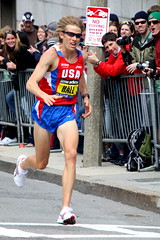
 Image by -nanio- via Flickr
If there is one thing that I have learned in 15+ years of teaching and studying biology, it’s that variation is the norm rather than the exception. Variability is the reason why biology is sometimes called the “sloppy science,” and it’s the reason why undergraduate biology majors at my college are required to take a course in statistics. Statistical methods are the tools that we use to tease out pattern from often messy piles of data, and they allow us to come to not always very clear-cut conclusions. The upshot of this is that in any sample of data there is going to be variation, and there are going to be outliers who don’t follow the statistically supported pattern.
As an anatomist, variation is inherent in nearly everything that I teach and study, from the frogs that I wrote my dissertation on, to the cats, pigs, and sharks that my students dissect in the laboratory. Variation is the bane of my student’s existence in the anatomy lab, and it often comes as a surprise when I tell them that the exact pattern of branching blood vessels in one cat may not be exactly the same as that in the cat on the next bench over. Some cats are muscular brawlers, whereas others have muscles so wispy that it’s a wonder that they could support their own body weight. Anyone who has taken human gross anatomy in medical school has probably observed the exact same thing in the human cadavers that they dissected. Variation is normal. In fact, it’s essential – variation serves as the raw material upon which natural selection can act in the process of evolution, and it’s ultimately the reason why we can now run down the road on two legs instead of four.

So what does this discussion of variation have to do with running? I’ve been thinking a lot about running form lately, and have gone so far as to start experimenting with my own stride. It is therefore with a great deal of interest that I read the following quote by Alberto Salazar: “There has to be one best way of running. It’s got to be like a law of physics. And if you deviate too much from that–the way I did in my career–it can be a big handicap.” From a purely biomechanical perspective, I tend to agree that there is probably an optimal way for a human to run, but the biologist in me keeps coming back to the topic of variation. Humans are highly variable animals, probably much more-so now than when we were developing our distance running skills millions of years ago out on the African savannah. Take one glance at any gathering of humans and you will see short people and tall people, thin people and heavy people. You will see some with biomechanical abnormalities. If you could look beneath the skin, you’d also find variation in bone structure and muscle composition, as well as innumerable other anatomical and physiological differences. Getting back to Salazar, variation is why they had to develop a shoe insert for Dathan Ritzenhein’s unique metatarsal structure. Given this, I find it unlikely that there is a single “perfect” running form that will equally apply to every single human being who runs. I may not be an expert on running mechanics (not even close!), but I know a thing or two about variation, and the realist in me says that what works for a sub-5:00 miler may not work for those of us who run our miles at an average pace of 8:00 per mile or higher. Variation in all of its forms needs to be taken into account when talking about things like an ideal running form.

My goal in this post is to address the topic of variation in running form as it applies to a small sample of elite runners. This past April two of my students went down to Boston and filmed the first 1000 or so runners to pass the ~17.5 mile mark in Newton during the Boston Marathon (on Washington St. near the intersection with Commonwealth Ave. – see picture at right from Google Street View – it was a relatively flat stretch of the course). The film was recorded in slow motion at 300 frames/second (see below), which allows a high degree of accuracy and detail when examining aspects of the running stride. Despite this, it can still be hard to see exactly what is happening in a streaming video, so what I have done here is to extract still images from my videos for four runners at a standardized moment in the gait cycle (I will be doing more of this at different points in coming posts). The runners that you will see are four of the top five finishers in the 2010 Boston Marathon: Robert Cheruiyot (the eventual winner), Tekeste Kebede (2nd place), Meb Keflezighi (5th place), and Ryan Hall (4th place). In the yellow singlet behind Cheruiyot you can see Deriba Merga, who rounded out the top five by finishing 3rd – I have omitted him below since he is somewhat obscured by Cheruiyot in the video.
Elite Men in the 2010 Boston Marathon – Super Slow Motion from Runblogger on Vimeo.
What follows is not an exhaustive analysis of running stride in these runners (I’m hardly qualified to do that), but rather an attempt to point out that even at the highest level of competition, running form is highly variable. Why is this important? The main reason in my mind is that you can find innumerable published descriptions of how best to run, or what the optimal running form is. Often these descriptions share key points (e.g., avoid overstriding, avoid excess vertical and horizontal motion, etc.), but they also often differ greatly in the details and it’s hard to know just what you should be doing out on the road or trail. For this reason I’m going to take a look at three aspects of the running stride and discuss the variation seen among these four elite runners. We’ll start with one of the most hotly debated aspects of running form these days – footstrike.
Footstrike
If you want to start an argument among a group of runners nowadays, all you have to do is bring up the topic of footstrike (or how it relates to shoe choice, but we’ll avoid that equally controversial topic here). A lot of runners are interested right now in the idea of adopting a more “natural” midfoot or forefoot footstrike (I’m very admittedly guilty of this myself and have been playing with chaining my form for most of this summer). Others think this change unnecessary, and don’t buy the argument that moving away from the ubiquitous heel strike will improve efficiency or reduce injury risk. It’s not my goal to settle this argument here, and I think there’s a lot of work that needs to be done before we can come to a clear conclusion on the issue. Nevertheless, I like to experiment, and the evolutionary biologist in me is a bit enamored with the idea of running as our ancestors did. Maybe I’m crazy, but I’m having fun.
Back to the point, the ultimate question is whether one style of footstrike is “optimal” or better than the others. Famed runner and Nike Team Coach Alberto Salazar clearly thinks that midfoot/forefoot is the way to go, and was recently quoted as saying the following about heel striking: “It’s like having a tire with a nail in it.” He has gone so far as to recently convert two of his elite runners, Alan Webb and Dathan Ritzenhein, from heel striking to midfoot striking, and it’s going to be very interesting to watch how these guys do going forward (Ritzenhein is running the NYC with his retooled stride this Fall). Barefoot and minimalist runners also advocate for a midfoot/forefoot footstrike, mainly due to the fact that scientists like Daniel Lieberman have shown that this is the way humans run when not raised in built up, high-tech shoes (not to mention that it’s very hard to heel strike while barefoot or in an un-cushioned shoe). Lieberman also showed that heel striking is associated with a greater initial impact force, though how that plays out in its potential relation to injury risk remains to be seen. On the other side of the issue, you have the running shoe companies, who have been producing shoes for nearly 40 years that are usually designed to absorb shock associated with a heel strike. The vast majority of runners out there run in these shoes and are heel strikers, and there is some risk to moving away from a shoe style that our body has adapted to. That’s not to say that it can’t be done, but it takes time and effort, and many don’t see conclusive evidence of a benefit big enough (or any benefit at all) to justify the effort needed to change (I have variously felt this way myself in the recent past).
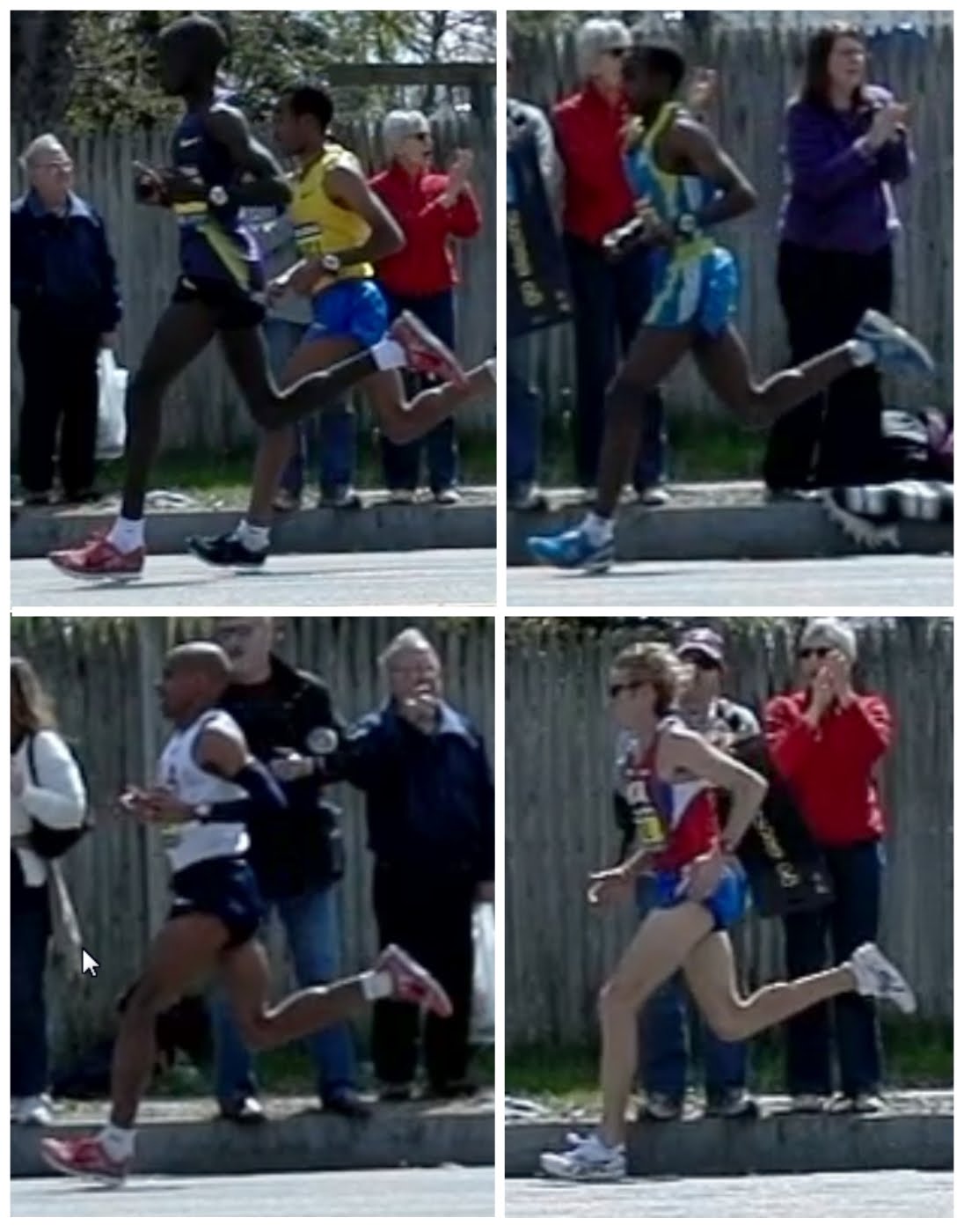
One of the interesting notions that I have seen espoused in various places is the idea that elite runners never heel strike. I’m not sure where this belief comes from, but it’s out there. However, it takes merely a quick glance at the pictures below to see that this belief is untrue. Of the four runners pictured, all but one make initial contact on the heel (Ryan Hall is clearly landing on his midfoot). That being said, the degree of heel strike seen is highly variable. Robert Cheruiyot lands only very slightly on the heel, and it’s almost indiscernible when watching the streaming video (the pictures below depict the exact moment of foot contact with the ground). His weight almost certainly comes down on the midfoot, and his heel strike is about as mild as a heel strike can be. Tekeste Kebede has a more pronounced heel strike with a more extended leg, and Meb has by far the most pronounced heel strike of three (while apparently wearing the same shoe as Cheruiyot). Interestingly, both Cheruiyot and Kebede strike on the midfoot on the right side (not shown – I wanted to standardize the side shown on all runners), showing that there is variability even within individuals. I wouldn’t be surprised in the least if there was also some degree of variability in the same foot from stride to stride. The point is that even among elite runners competing in one of the highest profile races in the world, there is a high degree of variability in form, and they clearly have not converged on a single “optimal” running form.
One can come to two conclusions from observations like this. First, perhaps these guys are using the footstrike that works best for their individual bodies. Maybe a midfoot strike is what works best for Hall, and a heel strike is what works best for Meb. Alternatively, it might be possible that some of these guys are doing things that are not optimal and could be improved through a bit of stride tweaking. Based upon recent events, I’d suspect that if Meb went out to the Nike Complex in Oregon to work with Salazar he would be weaned off his heel strike as the first order of business. Meb won the 2009 NYC Marathon, but has also suffered numerous injuries in his career, both running related (he fractured his hip in the 2007 Olympic Trials), and flukey (he injured himself trying to escape from a bulldog). It’s hard to say what such a change might accomplish, but it’s certainly interesting to think about, which is why Ritzenhein’s performance at NYC this Fall will be a must-watch.
What does all of this mean to everyday runners like me and you? Well, if this level of variation is apparent in 4 of the 5 fastest runners at Boston, you can be sure that it would be found among recreational runners as well. It also shows that you can run really fast using either a heel strike or a midfoot strike, but it doesn’t say anything about whether altering stride from one form to the other would result in improvement. Maybe Meb would be faster with a midfoot strike, maybe he wouldn’t – we’ll probably never know. Incidentally, this is actually the major reason that has pushed me to try to move away from my own heel strike – the experimenter in me is simply curious to see what will happen. Will it make me faster? – who knows. Will it reduce my lifetime risk of injury? – maybe, maybe not. The one sure thing is that I’d never get any kind of answer to either of these questions if I didn’t try it.
Arm Carriage
Though less controversial than the topic of footstrike, the way to carry the arms while running is also a form characteristic about which I have read differing advice. Is there one best way to carry your arms while running? Perhaps, but referring again to our elite pictures, you’ll see a great deal of variation in style. Cheruiyot and Meb both carry their arms high with a pronounced flexion at the elbow. Kebede carries his arms a bit lower, just above the waist, whereas Ryan Hall has a unique style in which he keeps his palms open and carries his hands quite low, below the waistline (for more on the origin of Hall’s unique arm carriage, read this – thanks to Rick for alerting me to this in the comments). On my run yesterday I tried to pay attention to what I do, and noticed that I utilize a high, flexed carry like Meb and Cheruiyot. When I tried using Hall’s style, it felt awkward and uncomfortable, but far be it from me to tell Ryan Hall to carry his arms while running. What Hall does seems to work well for him, and like Meb and his heel strike, it’s hard to know if tweaking of the arm carriage for any of these guys would provide any benefit. Ultimately the point once again is that there is variation – elite runners at the highest level of competition do things in very different ways.
Body Orientation
The final aspect of form that I’ll address here is body orientation. I have variously read that the torso should be oriented upright (near vertically) while running, or with some degree of forward lean. This is another case where I don’t really know what to believe, or if one method provides a benefit over the other. However, returning once again to our photos, we can see that Cheruiyot and Meb are fairly upright in their posture, whereas both Kebede and Hall seem to employ a slight forward lean. Once again, we see variability, with little ability to determine if each runner is doing what works best for them, or whether some of them are doing something less than optimal that could be tweaked to provide a performance boost.
Final Thoughts
The basic take-home message from this post is that even elite marathon runners exhibit variability in some of the most basic aspects of running form. If a “perfect” or “optimal” form exists for all runners, either only one of these guys is doing it, or none of them are. More likely, I suspect the answer is that each of us individually has a form that works best given our own anatomy and physiology. That’s not to say that we shouldn’t work on our running form – quite the contrary. The are likely ways that we can all improve, and experimentation, if done carefully, can’t hurt. Do some research and hit the track and try things out, record yourself on video and note your strengths and weaknesses, or maybe enlist the help of a coach – any of these things could potentially help you and your running.
I’ll finish with a few personal thoughts. I’ve spent the better part of the past year experimenting with my running form, particularly with a slow migration away from a pronounced heel strike. Will moving to a more midfoot or forefoot strike make me a better runner? – only time will tell. At least in my case I have some confidence in the path I have chosen. When one of the country’s leading anthropologists shows that humans evolved to run on the forefoot, I tend to listen (I am an evolutionary biologist after all!). When one of the country’s top coaches (Alberto Salazar) at what is probably one the most technologically advanced training centers in the world (Nike in Oregon) starts shifting some of the country’s leading runners from heel to midfoot, it’s not done without careful consideration and study. We have both our own evolutionary history and presumably cutting-edge modern research at Nike both apparently pointing in the same direction, and that is enough convincing for me to at least give it a try. I’ll never be able to run as fast as any of the elites that I’ve talked about in this post, but if my running form transition gets me a new 5K PR or a step closer to my much coveted BQ, the change will have been well worth the effort. If neither happens, at least I will have learned something and I’ll surely have fun in the process, and isn’t that what running is all about?
Update 8/10/2010: Amby Burfoot has added his thoughts on the issue of variability in running form on his Peak Performance blog: http://peakperformance.runnersworld.com/2010/08/aug-10-in-search-of-perfect-running-form-the-debate-continues.html
Update 8/11/2010: For another interesting series of posts on running form, check out this series from Jonathan Dugas and Ross Tucker of the Science of Sport blog: http://www.sportsscientists.com/2007/09/running-technique-is-there-right-way-to.html

Update 8/17/10: Added a second post on running form – this one addresses the question of where the foot should land relative to the center of gravity of the body.
You might also like:
 A Contrast in Form: Variable Running Gaits at the 10K Mark of a Marathon/Half-Marathon
 On Running Form II: Where Should Footstrike Occur?
 Meb Keflezighi’s Running Form in Slow Motion: Boston 2010, NYC 2010, and NYC 2011
 Muscle Tuning and Leg Stiffness: Why Shoes and Running Surfaces Do Matter?
 Observations on Cadence Change With Running Speed on the Track


 About Peter Larson











Thanks Pete – I love the video and the stills you put together. I think there is going to be some variation, and that’s natural, but there are some big-picture running form principles that should be adhered to.
Another interesting aspect of form to study would be their cadence/stride rate. Do you have enough footage to do that?
– Fitz.
I agree totally – there are some things that should be universal,
variation is largely by degree. Even still, you will find some outliers.
I can probably measure stride timing from landing to landing, but not
sure how well that will translate since I only have 1-2 for each.
Pete
Sent from my iPod
Thanks for this one, Peter. Would be interesting to know if your students measured the “flatness” or lack thereof of this part of the Boston course.
I think it would make a difference in footstrike. The photos make this stretch look downhill, but that could be an illusion.
Amby,
Hard to say since I wasn’t there, but I had emphasized the importance of a
flat stretch to them in earlier research. It’s possible that the camera was
just tilted a bit. I have a bunch of real time video and some wider angle
shots, so I may be able to tell from those – I’ve barely looked at most of
what I have at this point. I also sent an email to my student (now alumnus)
to see if I can get a pinpointed location. The whole thing kind of happened
on a whim, but regardless of the grade I find the variation to be really
interesting.
Pete
It looks like the camera was not pointing straight across the street, but somewhat to the right. That might add to the appearance of downhill to the left.
That section looks pretty flat, maybe slightly downhill. The support bike that went through was coasting. The biker may have been resting, though.
That said, the camera was definitely tilting slightly counter-clockwise (ie downhill). Look at the bystanders: their all leaning to the left, (Their right.) The fence slats are similarly all leaning to the left.
Amby –
I pinpointed the location of the video after emailing my student (along with
some help from Google Street View) – it’s on Washington St. in Newton, just
before the turn onto Commonwealth. According to MapMyRun’s elevation profile
for that block on Washington, it’s very flat, with a total loss of only 3 ft
from the previous cross-street to Commonwealth Ave. Her recollection was
also that it was pretty flat.
Pete
Pete – Your students definitely produced some great videos, thanks for posting them! When I first saw them I too was struck by the huge variability amongst these top-elites, especially in their respective foot-strike pattern. My prime motivations in undertaking an ongoing migration to a forefoot/mid-foot vs. heel landing is my view that a more evolutionarily natural strike will logically result in fewer running injuries, and an inherently more bio-mechanically efficient gait (both, as you noted, certainly inferred from Salazar and other top coaches guiding their athletes in this way).
With regards our own individual experimentation, I feel that after warming-up (say, by running at your intended marathon pace on a treadmill), that by holding that speed constant, but varying your foot-strike method (& closely associated running cadence) that you can make some inference to your comparative exertion level, and thus your relative efficiency via your heart rate, respiration, and your subjective feeling. Of course, miracles don’t happen overnight, and as is true with any change there’s initially a shaking-out period which ensues with any major change, and this may be discouraging in the short-term; nevertheless, I’m encouraged, and as you noted it’s certainly fun to try out a new approach.
Absolutely – experimentation has been great fun. I find it very hard to avoid heel striking in most shoes, but when I wear Vibrams or XC flats I can do a reasonable job of maintaining a mid/forefoot stride. Need more practice though!
Pete
An additional note to make things more clear from my previous comment;
Lower speed -> perfect technique gets less important
Longer distance -> muscle fatigue gets a larger factor
Thus, at the marathon distance you will see larger technique variations, and you will see compensations for muscle fatigue.
Heel-striking offloads the calves and puts more work on the hamstrings. Many forefoot runners change to heel-strike later in the race.
Probably more runners would benefit to run for a longer time on the forefoot, but they don’t have the endurance in the calves to do so. This does not mean that heel-striking is more efficient, but merely that many can run for a longer time that way.
However, even in sprinting, were technique is of extreme importance, there are variations, and coaches acknowledge the need to adapt the basic model of perfect technique to individual anatomy. There are very small deviations made though.
The question here would be if heel-striking (with some slight overstriding) actually could be more optimal for a specific individual due to body composition. I don’t know. I tend to think that heel-striking is more of an muscle fatigue issue than actually a better way to run for anyone, but I don’t know.
Regarding your observation of people switching to heel later in races – have you observed that or did you read about it somewhere? I’ve been trying to find published reports on the phenomenon as I have seen it happen in some of my videos.
I have observed it in my own running, and I have read texts by skilled coaches saying that it does happen and is common, but I have not myself done any mass video analysis to establish the statistical fact.
Most recently I saw Steve Magness write about this, but I don’t remember if there were references to scientific articles or not. But you could ask him.
By any chance, do you know the titles/authors of any of the texts you have read about this?
I would have to google then, and it would be as easy/hard for you like for me to find any :-).
However, Steve’s following blog post:
http://www.scienceofrunning.co…
contains reference to one study of this kind, and has an interesting discussion around it.
The overriding factor for distance running performance is physiology and not technique. I think we have to be very careful when trying to draw conclusions about running technique from elite distance runners. Just because someone is an elite distance runner, it does not necessarily follow that they have good technique.
In my “experiment of one”, changing from being a mild heal striker to a midfoot striker resulted in a substantial increase in running speed. Furthermore, my speed increased despite reducing my training to a fraction of what it was previously in order to give my body time to adapt. However, when changing my technique, I did more than adjust my foot strike. Which brings me to my final point, forefoot striking is the result of doing every thing else right, and not the only measure of good technique.
Ken – I agree, form is more than just the footstrike, and I think that is often where people get into trouble when trying to transition. They force a forefoot strike without first considering the totality of their running form.
I like to think of physiology as setting the boundaries or range of performance potential for a given individual, and technique as a contributing factor to where an individual falls within their range of potential. Someone who is physiologically gifted could potentially be outclassed by someone less gifted who is better at using what they have (e.g., they might be more economical when they run).
Pete
Another great post Pete! Thanks for sharing. I think we share similar views on this issue with the main point being that we do not know enough science to decipher what’s optimal form for everyone or if one actually exists.
As a medical scientist just like you, I tend to think evolutionary variation over many generation would prevent a proportion of the population from successfully adopting “natural/barefoot running” as the most optimal way to run. The challenge in my opinion is to find/define this segment of the population and figure out what would work best for THEM.
I’m planning to expand on this thought (and propose a possible solution) on my own blog (with reference to yours obviously) over the next day or two.
Thanks again for your contribution to this controversial debate!
I look forward to you post Lam – let me know when you post.
Pete
If you want to analyze torso posture… look at sammy chalenga… he almost looks like he’s leaning back when he runs
i’m surprised no one finds this interesting :[
Is this what you are referring to – does look almost like he’s leaning back
a bit. Haven’t seen him run before, but seems the style works for him. Once again, variability is the norm!
Pete
I just looked at frame-by-frame on some video from Sammy Chalenga running 10k at 27:08. He has a more upright posture than most, but there is still slight forward lean, say 4 degrees or something, similar to what sprinters often have.
My current view on this posture thing is that you can gain some on hip position by having a more upright posture, and you lose some on breaking forces due to moving the center of mass further back. However, as long as the lower leg is perpendicular to the ground at touchdown, the “breaking force” could just be seen as a force to load the stretch-shortening-cycle.
I don’t have high speed video on chalenga so it is difficult to see, but it could actually be the case that he succeeds even to get a bit negative angle on the lower leg before touchdown, that is he sets the foot further back than many others, thus compensating for his more upright posture.
That upright postures can be very successful for even for long distance running makes me think that POSE and Chi are too much focused on their “gravity drags you forward” concept.
Great post. The comment about mid to forefoot really made me think about my own footfalls. For the past 7 years, I’ve been pushing a baby jogger, which is mostly forefoot; that’s the fastest part to wear on my shoes. I once thought I was a heel-striker but now I’m thinking that the jogger may be changing my gait. Something for me to think about.
Heel-striking is usually from overstriding, that is reaching with the front leg in front of the body. One drill that some do is to have someone run very close in front, to trigger a reflex to avoid kicking into the person in front, and that way get rid of overstriding. The jogger may have had similar effect.
Interesting – I just ran with a stroller for the first time last week,
and definitely noticed a similar effect on my stride. Maybe you’ll see
some video of me pushing a stroller on here soon!
Pete
Sent from my iPod
This is a great post. I think another dimension should be added for foot strike and injury correlation. But its very complex to analyze since you would have to analyze each type of injury vs. foot strike as opposed to lumping in a broad injury category to get any kind of useful information from it.
From my experience, as a heal striker I had problems with shin splints. This led me to thinking my form needed adjustment so I read ChiRunning and started that style. As a midfoot striker I rarely had problems. Since that style went well I wondered if the forefoot striking could be better. And of course curiosity always gets the best of us so I tried forefoot striking with an emphasis of hitting on outside of foot and rolling in and developed Morton’s neuroma. For me, I think my optimum form is a midfoot strike with a slight lean. While practicing that form, my speed and endurance improved without any set backs due to injury.
Pete,
On Ryan Hall’s arm carriage;
Efficient running style
In the years that followed, Hall stopped playing other sports and focused solely on running. He trained throughout high school, coached by his father, who managed to build on Hall’s neutral gait and endow him with an unusual but efficient running style.
Mickey Hall’s methods were unorthodox yet strangely effective. One time, he resorted to tying Hall’s upper arms to his body in order to curb his tendency to let his elbows loosen out too far, which was wasting energy. The result is a running style worth watching. He runs with his head straight, steady and erect, and the arms have minimal movement, hugging the body in a way reminiscent of some of his Kenyan competitors.
TAKEN FROM
link to asics.co.uk…
Pete running biomechanics has interested me for a long long time, back in about 2000! I saw a documentary on channel 4[ British TV]about a guy who worked for the Nike R and D department, he studied the running movement of the fastest two legged animals and birds [Kangaroos and Ostriches [which can run at 40 mph] as well as studying man.
his conclusions were very interesting, the human foot {arch]and leg muscles, tendons act like springs and and forefoot running was the most efficient!
I think but I might be wrong this guy went on to work for SPIRA, but i might be wrong, I do know he invented some prototype shoes which had springs in the forefoot.
Thanks Rick – I added the link, with credit to you, in the post.
Pete
Nice (if long!) article, Pete! Great perspective.
My guess is that people’s bodies naturally “find” their ideal, unique, and most efficient running forms all on their own, over years of training and racing (and perhaps a little experimenting).
Personally, I think we venture into uncertain, and possibly risky, territory when we try to change our own, unique running from to conform with somebody else’s idea of the ideal. Same goes with training plans, race strategies, diet, sleep, and shoes. (I ate a half of an entire apple pie an hour before running my half-marathon PR, and burped pie fumes the entire first half of the race. It worked for me — but I wouldn’t recommend it to anyone else!)
We’re all an experiment of one.
And I love that!
Jim Graham
Some thoughts on footstrike from behind a desk.
If you look at the picture of Mr. Keflezighi, you’ll notice, that his heel impacts the ground directly beneath the ankle joint. Suppose his foot, heel to toe is about 30 cm long (big feet, like mine). His forefoot will hit the ground at 30 cm from the initial position of his ankle. He will thus push off at 30 cm from the original position of his ankle.
Were he to land mid foot, his heel would impact the ground behind his ankle joint (taking my own foot again as a measure, roughly 7 cm behind the ankle). His forefoot will thus land about 22-23 cm before his ankle joint, so he loses 7cm every step. At a rate of 180 steps a minute, he’d be about 700 metres an hour slower. It would make a difference of some 4 minutes on his marathon time.
I know this is a gross oversimplification, but it suggests that there may be a benefit to heel striking and that it might be correlated to stride rate, foot size or the individual dimensions of the heel.
We can make this model just a little bit less simple, by taking into account that in a heel striker, the flight phase is a tiny bit shorter than in a mid foot striker, because the heel is lower. If a midfoot striker can cover the 7 cm difference in the longer flight phase, then hel striking becomes useless.
Again taking my own (shod) foot as a measure, ankle to ground is about 14,5 cm in heel striking and about 12 cm in mid foot striking, so the difference is 2,5 cm. To recover 7 cm forwards in the flight phase during these 2,5 cm downwards, the forward speed would have to be roughly 2,8 times the downward speed.
Now the downward velocity can be calculated using Newton (well actually: using an online calculator) once you know the vertical displacement of the centre of mass. For simplicity, I am ignoring the accelleration during the last 2,5 cm downwards.
If you hop up and down 30 cm during each flight phase, you’ll have an downward velocity of about 8.7 km/h upon hitting the ground. During your extra 2.5 cm downwards, you need to cover 2.8 times that distance forwards and hence need a forward velocity of some 24 km/h (15 mph) to cover 7 cm during the extra flight phase. At a vertical displacement of 20 cm, the downward speed becomes 7.1 km/h and the forward speed needs to be about 19 km/h (11,8 mph). If I an not mistaken, that is about the speed needed for Mr. Keflezighi´s personal record on the marathon. If, the vertical displacement is something like 10 cm, the downward velocity becomes 5 km/h. To overcome the 7 cm you need to run 14 km/h (8.7 mph). This is well within range of many amateur athletes.
If athletes bounce up and down no more than roughly 20 cm, this suggests that there may be a point of transition, below which a heel striker has the benefit of a couple of extra centimeters each step. The point of transition depends on forward speed and vertical motion. Slow athletes and athletes that hop up and down a lot -in short, beginning or fatigued athletes- may benefit from heel striking.
I know this is all very speculative, simplified and crucially dependent to the exact dimensions of the foot. The idea is nice though.
Running is a great exercise and when there are marathons arranged and celebrities run with common it is inspirational for a fitness gear up in every ones life that is essential in the age where there is a lot of stress and work load and busy lives and obviously neglect of exercise.
So, did changing to a forefoot strike help improve your times?
No, but that’s not why I did it. Just curious to experiment and see what would happen.