One of the great things about this blog is that through it I have met some very thoughtful people who share my deep fascination in the topics of running mechanics and shoe choice. I’ve recently started exchanging emails with a fellow runner from Sweden, Anders Torger, and he apparently has as big a shoe problem as I do (must be something about our Swedish genes). Like me, Anders is also a fan of filming himself in various shoes to see how they affect his running gait, and he has made some interesting observations about how his feet react in neutral cushioned shoes, particularly regarding pronation (the inward roll of the foot upon footstrike). I asked if he would be willing to write a post explaining his findings and his thoughts on the topic, and he happily agreed. Without further adieu, here’s what Anders has to say:
The popularity of traditional neutral lightweight running shoes is increasing as a result of the growing minimalist running movement. Other than for specific strength and form training many view barefoot running as a bit too extreme and use lightweight neutral shoes as an alternative – halfway to barefoot. The idea is that you get some cushioning but not too much, and by having it neutral you don’t support the foot with motion control features so you get some barefoot-style benefits too. The problem with this approach, however, is that for some people neutral cushioned shoes may not work as you would expect.
Straight to the point – in some case neutral shoes may exaggerate rearfoot pronation. This is little talked about, but among shoe experts quite well known. Supinators are suggested to use soft neutral shoes, why? Because that type of shoe typically exaggerates pronation so it may cancel out the supination.
Rearfoot pronation is a natural part of the foot’s own shock absorption mechanism and a motion control shoe does not try to stop it, but rather hinders it from becoming too extreme – what is commonly called over-pronation. Unfortunately, due to sloppy handling of the word in media and running stores, many have come to believe that pronation is bad and/or that motion control shoes aim to stop it from happening completely.
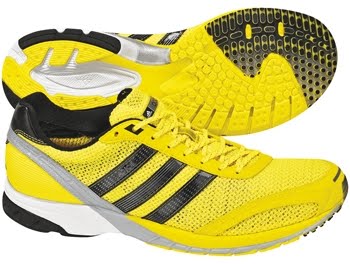
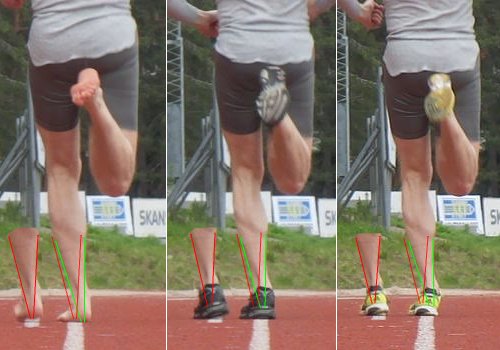
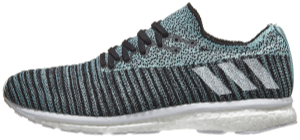
Below are photos of me running barefoot, in a stability/support shoe designed for moderate to severe overpronators (Asics Kayano) and in a neutral lightweight marathon racing shoe (Adidas Adizero Adios – see picture at top of post). The red lines show the lower leg position at initial contact, and the green at maximum pronation. For a layman a fully pronated foot may look a bit nasty, but I can assure you that in the barefoot case it is within normal range. As seen, the stability shoe does not significantly change my barefoot mechanics (at least in terms of pronation), normal stays normal. However, when using the “neutral” running shoe there is obvious over-pronation.
So why does the neutral shoe introduce over-pronation, which does not exist in my barefoot running gait? There are several contributing factors. Let us start with the midsole.
A neutral running shoe has a single-density midsole (i.e., the midsole cushioning is uniform in composition across the sole). Where is such a midsole easiest to compress? Same all over the midsole? No. If the pressure is in the middle there is midsole material all around it which will resist compression. However, if the pressure is near an edge of the midsole, there is only material on one side and thus the midsole will be easier to compress there. The farther away from the edge the more the midsole will resist. This means that the midsole will give the shoe a tendency to tilt if pressure is close to the edges. Not what you would consider “neutral,” right?
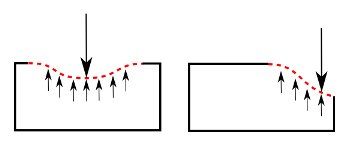
Next, we have properties of the running gait which make it difficult for the shoe to maintain stability. In running, the peak pressure towards the ground is about 2.7 times body weight (in walking it is about 1.5), which means that the foot must be planted close to the median plane so we don’t tip over. This means that the leg is leaning inwards, which in turn means that some of the force will be pointed sideways. This sideways force is absorbed by pronation, but will also press the foot towards the medial side of the shoe. If the fit of the shoe is insecure or the upper is weak, the foot can be pressed slightly off center and pressure comes nearer to the edges, causing the shoe to tilt. Even if the fit is secure, the pressure may during the support phase travel too close to the edge for the shoe to remain stable. If the shoe starts to tilt, the foot will follow searching for stability. This is natural and not due to lack of strength.
In the photo it can be seen that I turn the foot out laterally somewhat just before impact (nearly noone has “perfect” biomechanics such that the shoe is placed in exact direction of running). This offset may contribute to the foot being pressed off center.
Does this exaggeration of pronation happen to all people? No. Is it possible to predict? Not really. It is a dynamic process, and whether the shoe will tilt significantly or not will depend on how the pressure travels under the foot. It almost certainly will not look exactly the same in every runner. The only really safe way is to test yourself and see what happens in a given shoe.
I should also add that in some runners, rearfoot pronation can change depending on running speed, for example showing over-pronation at low speeds which disappears at race pace, probably due to changes in how the pressure travels.
As can be seen in the above photo, I land midfoot in shoes. Type of foot-strike may affect how the shoe behaves – most shoes are designed for a heel-strike, even lightweight racers. This could mean that some neutral shoes have a stronger tendency to cause over-pronation if you have a midfoot or forefoot strike rather than heel-strike, but more experiments are required to verify that.
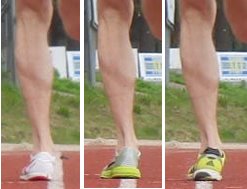
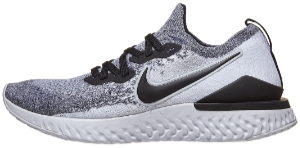
Another question that arises is whether all neutral shoes behave the same way? No, at least not for me. Shoes with narrow, soft and thick midsoles have more tendency to tilt than shoes with wide, thin and firm midsoles, but fit and properties of the upper matter too. I tested several types of neutral shoes, and pronation was increased in them all, however some not as much as others. For example, the thin-soled Asics Piranha and the wide-soled Nike Lunar Racer shown in the photo below did not cause as much pronation. The worst was indeed the Adizero Adios, which does not have a particularly soft midsole but it is rather high and narrow. Unfortunately I have no photograph, but the Inov-8 F-lite 230 did show considerable over-pronation despite its wide base, probably due to a softer midsole and poor heel grip (I have a narrow heel).
A typical saying is that to use a neutral running shoe you need flawless biomechanics, or else you will over-pronate. I don’t think this is a fair way to put it. What you need are running mechanics that happen to provide an underfoot pressure path that is compatible with the inherently unstable platform that a cushioned shoe is. Defining functional gait as the range that happens to work with neutral cushioned shoes is not a good definition. Functional barefoot gait should be the reference. In other words, for many of us stability shoes are not needed to correct for our biomechanics, but rather to correct for problems introduced by cushioned shoe design itself.
There’s been lot of talk about over-pronation in this post. Let us look into why we care about that particular aspect of the gait.
Over the last several decades there has been a desire to find simple foot measurements that can predict injuries and then assign proper shoes to avoid them. Rearfoot pronation has become the main aspect that we look for. However, rather than using video and a treadmill, which can be cumbersome, we have tried to find static measurements on the feet that can predict if over-pronation will happen or not. The height of the medial arch (low, normal, high) is perhaps the most common (as exemplified by the “wet footprint test”). Unfortunately this method is not really reliable, which has been shown in study after study. My feet turn out neutral in these tests, but I still over-pronate in neutral running shoes.
On top of that, we know that some individuals handle over-pronation without injury. Haile Gebrselassie is the most well-known of those individuals. As it happens, he also uses the Adidas Adizero Adios and he over-pronates in them about as much as I do, which the video below demonstrates.
The narrator in the video insinuates that over-pronation is no problem as long as your core is strong and running technique is good. Additionally, he does not mention that Geb’s over-pronation is most likely an effect of the shoes, that is if he took them off and ran barefoot, he would not over-pronate. I haven’t seen Geb run barefoot so I don’t know this for sure though. If you have information on this, please post a comment.
Concerning why some can handle over-pronation and some get injured (like I did last year, despite decent technique and core strength, I’ve trained them both), we don’t really know. It could be just a matter of training, or you may need a special talent such as a super-flexible tibialis posterior.
The recent research paper “The effect of three different levels of footwear stability on pain outcomes in women runners: a randomised control trial” from the British Journal of Sports Medicine has caused a lot of buzz in the minimalist running community. The study used a static foot measurement method to determine degree of over-pronation in individual runners (Foot Posture Index in this case), and then assign neutral, stability and motion control shoes at random within each group to see if shoe type influenced injury susceptibility. It turned out that it did not work at all – motion control shoes fared poorly all around, neutral runners did better in stability shoes, and pronators did better in neutral shoes. However, the study lacks important information. We don’t know how good the static Foot Posture Index measure actually is at predicting pronation in these runners, so the result could have been vastly different if a dynamic method like videotaping runners on a treadmill was used instead. We simply don’t know what actual pronation was like in the shoes. In other words, the study could have just as easily demonstrated that Foot Posture Index is a bad way to assign shoes. Many have the gut feeling that it would not have been any different with a dynamic measurement method, but I personally do not dare to guess.
If I would guess a bit, I think that over-pronation is just one of many risk factors for getting an injury. Seen over a large group, over-pronation may be a much smaller risk factor than we have previously thought (Editor’s note: indeed, this has been suggested by respected experts in running biomechanics – see Nigg, 2001). That, combined with the fact that over-pronation in shoes is not easily predicted by a static test, could have contributed to the result of the BJSM study. Despite all of this, it would probably be unwise to say at this point that we can safely ignore over-pronation when we see it though.
Over-pronation can occur for a number of reasons. It could result from deformed feet, poor muscle strength or control, but also as demonstrated here it could simply be an effect of the cushioning in the shoe. It is said that a large proportion of runners over-pronate, numbers as large as 70% are often stated. However, it is difficult to know whether these estimates refer to overpronation in shoes or in the barefoot condition. Perhaps it is more likely to get injured if you don’t over-pronate barefoot but do it in shoes – the foot getting into a situation it is not used to.
Regarding how large “my group” is, that is those that do not over-pronate barefoot but typically do so in cushioned shoes, I don’t know. If 70% of runners overpronate, I would think that at least half of that group belongs to my group, but within that group the degree of over-pronation will vary, as will the tolerance of it. I don’t know of any actual study that has investigated this, so if any of the readers know please enlighten me in the comments.
What kind of shoe recommendations should we give to a runner then? If you ask a minimalist, you should go for a shoe that alters your barefoot mechanics as little as possible. Of course you will need a transition phase to restore foot function and strength if you have had supportive shoes earlier. Some therefore recommend a step-down approach, using less and less supportive shoes. However, as we see here a less supportive cushioned shoe may actually alter some aspects of barefoot mechanics more than a more supportive shoe. If you want to go minimalist towards uncushioned shoes it may be safer to go directly to them and adjust the dose instead. If you want to use neutral cushioned shoes, do test how they behave when you run. If exaggerated pronation shows up, be observant and use them carefully. Perhaps you are one of those that can handle over-pronation, perhaps not.
What should shoe manufacturers do then? As a complement to uncushioned minimalist shoes we are starting to see zero-drop (or near zero-drop) cushioned shoes, which are all neutral in the traditional sense, that is single-density midsole. These are marketed as not significantly altering barefoot gait, which may not be true since some of us put high pressure close to the edges of the shoe. Perhaps we need a new type of cushioned zero-drop (or near zero-drop) running shoe. A rim of slightly firmer midsole material on the medial side (i.e., a dual-density midsole) may help it become neutral in the true sense, by making the resulting firmness the same in the middle as close to the medial edge. Since pressure seems to most often build up on the medial side, another solution could be to make the sole slightly wider there, but that could affect the balance of the shoe. Compensating by making it wider also on the lateral side is not a good idea since initial ground contact is there and you will then accelarate pronation.
Another interesting aspect is the firmness of cushioning. A typical argument against uncushioned shoes is that asphalt and concrete are harder than natural materials. That is true. However, seldom do we point out that the cushioning in running shoes is actually much softer than most natural soils, so it is not really natural to the foot either. Using unnaturally soft cushioning for racing could be good for performance since it may delay fatigue in lower leg muscles important for propulsion. But should it be used in training and for recreational running? Perhaps not. Shoes with cushioning claiming to be minimalist should probably have firmer midsoles than is common today. Since firmer soles also are more stable (not only firmer but thinner too), the pronation-exaggarating problem may go away as well.
Runblogger Comments:
I find this type of stuff very interesting and thought provoking, and it makes me wonder whether slow-motion video gait analysis should be standard practice at shoe stores to determine suitability of a given shoe for a given person. According to Anders, video analysis is common practice in Sweden, but at least in my small experience here in the US pronation is still just as often determined by eyeballing a runner or by doing arch measurements (if it is determined at all – most big-box sporting goods stores don’t even address the issue). And it still is worth asking just how much of a problem pronation is to begin with?
I’ll finish by re-posting a few older videos of me showing my degree of pronation in various conditions, shod and unshod – they go in the following order – 1. stability shoe, 2. neutral racing shoe, 3. Vibram Fivefingers KSO, 4. barefoot. I’d love to hear your diagnosis!
Running in Asics Kayanos – Posterior View from Pete Larson on Vimeo.
Slow motion video of me running in Asics Kayanos, which are a high-end support/stability shoe. Video shot at 300 frames-per-second with a Casio Exilim EX-F1 camera. Courtesy of runblogger.com/.
Running in Nike Lunaracers – Posterior View from Pete Larson on Vimeo.
Slow motion video of me running in Nike Lunaracers, which are a neutral, lightweight racing shoe. Video shot at 300 frames-per-second with a Casio Exilim EX-F1 camera. Courtesy of https://runblogger.com/.
Running in Vibram Fivefingers – Posterior View from Pete Larson on Vimeo.
Slow motion video of me running in Vibram Fivefingers, which are a barefoot-like, lightweight, non-supportive shoe. Video shot at 300 frames-per-second with a Casio Exilim EX-F1 camera. Courtesy of https://runblogger.com/.
Running Barefoot – Posterior View from Pete Larson on Vimeo.
Slow motion video of me running barefoot on a treadmill. Video shot at 300 frames-per-second with a Casio Exilim EX-F1 camera. Courtesy of https://runblogger.com/.
You might also like:
 How Can Both Barefoot Running and Hokas Reduce Knee Pain?–A Possible Explanation from a New Study
 Your Feet in Wide vs. Narrow Shoes: Great Visual From Altra Running!
 Shifting Into Neutral – A Novice Shoe Buyer’s Experience
 Do Minimalist Shoes Increase Injury Risk?: Merry Christmas Vibram
 Nike Pegasus vs. Nike Free 3.0: Does a Moderately Cushioned Shoe Encourage Barefoot-Like Biomechanics?


 About Peter Larson










Hi Pete, Anders T here… looked at your videos and in terms of pronation they all seem ok by me, certainly within normal range in all cases. The Nike Lunar Racer was the most stable of the different neutral models I’ve tried though, much thanks to the relatively wide sole.
Although angle differences are quite small and hard to see it does seem that compared to me you have a somewhat smaller range of pronation in your barefoot gait, which probably helps when using cushioned neutral shoes, less risk to get pressure out to the side.
Two things really strike me about my own videos – pronation seems very
similar in all cases, and I have a slight asymmetry as the left foot appears
to pronate a bit more. My left foot is slightly longer from heel to tip of
big toe on the left side, and my wear patterns indicate greater heel
striking on the left side in almost every shoe. It’s all very interesting…
Pete
Pete – Fascinating post! Appreciate also the video of Haile’s amazing amount of rear-foot over-pronation, as the commentator is absolutely right – had he gone into any runner’s store and received an analysis, he absolutely would have been put into either stability shoes, or probably heavier and slower motion-control shoes (i.e. leaving the world with Kenyan Duncan Kibet as the current fastest marathon record holder!)
The fundamental point that you raise – it’s often the shoes themselves, and the athletes pressure pattern in them versus the unshod runner’s natural gait – is unquestionably seen in the video of yourself running barefoot and with VFFs – versus several of the other neutral shoes.
Since you’re in the very small percentile of runners who possess a high-speed camera and an ability to perform this type of analysis, it seems to me that this demonstrates the importance of receiving a *good* analysis when trying on new running shoes – particularly when a runner decides to make a significant migration in their type of running shoe.
Mark,
Yes, really wish everybody could do the same thing with video. Even with a
regular digital camera that takes video clips it might be possible to get a
rudimentary look. Thankfully, digital cameras with high-speed capability are
now quite affordable from Casio, so hopefully we’ll see more of this type of
personal analysis in the future. Here’s one that is just over $100: the Casio
FS-10<http: b001otzr3g?ie=”UTF8&tag=thviofli-20&linkCode=as2&camp=1789&creative=390957&creativeASIN=B001OTZR3G” gp=”” product=”” http://www.amazon.com=“”>.
Steve Magness reviewed it on his blog recently:
http://www.scienceofrunning.co…
.
I’d love to see a video of Haile G. running barefoot!
Pete</http:>
Thanks for such a great post! We certainly have not heard much about rear foot pronation in the minimalist running movement, although I’ve heard plenty about it from various podiatrists (I am a flat-footed runner with a large bunion).
Anders comments on how he turns his feet out laterally just before impact, and how runners’ different biomechanics may cause similar issues. In my own transition to a more minimalist shoe, I have worked very hard to get my feet pointing straight ahead when I land. My left foot used to turn out a lot and caused my left knee to wrench in when I ran. Not surprisingly, this was the same foot where I suffered a partially-torn peroneal tendon–twice– and IT band syndrome. Focusing on running from my core, keeping my foot facing forward, shortening my stride, increasing my cadence, and working on hip rotation have all contributed greatly to a neater, cleaner-looking running stride. However, despite all these changes, I am extremely curious to see what my feet look like from behind.
Anders, regarding your comment to Pete, how do we know when rear foot pronation is in the “normal” range? What constitutes “normal”?
What “normal” rearfoot pronation is? It is actually a really good question, because we probably don’t really know. What you can do is study a lot of people and get some sense of what seems to be normal. I think some researchers have established an actual angle, but I don’t really know myself how well accepted it is.
I have myself studied quite many videos and images on feet in running and don’t actually measure the angle but just look at it and get the sense this is normal or not. I might accept larger angles than a podiatrist would do, I’m not sure. Most podiatrists do the same thing though, they use their experience of looking at lots of feet and sort out what they think is normal or not based on that.
Minimalists/barefooters don’t talk much about rearfoot pronation and arch height etc, because there’s more focus on getting a “functional foot” rather than exactly how it looks. And if you start out with an overpronating bare foot the idea is that more barefoot activity will help the problem. There’s not much research supporting this view on the foot (depending on how you see it), but I think it is a good hypothesis. That is you get healthier feet by more barefoot activity rather than giving support (with some special exceptions).
I tend to think that overpronation is mostly a shoe issue, and my hypothesis is that if your shoe increase your pronation significantly from barefoot, you should be careful. So if you do a video, make a reference barefoot and see what happens with shoes on.
oops! The above post should have been a reply to Kirin…
What about lightweight racingflat’s that offer some minimal pronation control? Like the Brooks ST4 or the Saucony Fastwitch 4. Are these shoes an option?
Depends entirely on what you want in a shoe. Those are both
lightweight with some stability built in, but have a fairly high heel
to toe offset. I used to run in the Fastwitch without a problem and
they worked well for me, but my current preference is for shoes with
less heel. I can’t say I’m doing better or worse because of the
change, just a personal preference. I think the point Anders is making
is that true racing flats rarely have stability features.
Pete
On Wednesday, August 25, 2010, Disqus
Excellent post, guys!
I’ve been experiencing ankle pain on the lateral posterial side of my left ankle (sort of behind the achilles tendon), especially when at the extreme range of plantar flex. At first I thought it was something with my achilles, but after reading this, I’m thinking it might have something to do with my running shoe.
I run primarily in the Brooks Green Silence, which is totally neutral, but rather cushioned. I find I overpronate less in the fastwitch 4s, but, like Pete, don’t love the raised heel on them.
While I love my Soft Star running mocs (love love love), I’m not up to marathon distances in them. I’m thinking I might need to try either the Lunar Racer or a minimal shoe with a firmer cushion and thinner sole for marathons.
Any thoughts or recommendations?
Oh man, I wish I hadn’t read this post! I’m a serious overpronator who has recently migrated to VFFs with very good results. now i’m looking for a neutral shoe to take me through the cold, snowy New England winter. now i have one more thing to consider in a shoe. Darn you, guys! <big grin!=””></big>
Sorry!
Seriously, though, this is a great discussion. I have been trying to come to grips with why i was able to move from highly stable shoes with orthotics to VFF without any ankle or knee or shin issues. Obviously moving to a forestrike is a big part of that but Anders’ comments here make complete sense and I can confirm such from experience. as i was easing from my old shoes to VFFs, i also eased out of my orthotics. i noticed that my ankles & knees were objecting when i ran in my old shoes without orthotics.
The reality is that we take shoes for granted when they really can have in
impact on how we run and whether or not we get hurt. Sounds like your
orthotics were basically serving to protect you from your shoes. Get rid of
the bad shoes and go to Vibrams, and the problem goes away. Pretty amazing
when you think about it!
Pete
A new store called S.A. Elite will offer gait analysis on site at it’s Walnut Creek and Corte Madera sites. I just started working there and have been doing my own research about neutral and over pronation. Interesting article and thanks for the videos. Stacy
This is very interesting. The running stores I use for shoes in London test overpronation by putting you in a neutral shoe and then moving you on to more stable shoes until all signs of overpronation cease. This article suggests that this may be a bad test as neutral shoes can actually accentuate overpronation.
In my case I tend to overpronate roughly the same amount regardless of the shoe, although I think the level of overpronation on each foot varies depending on the type of shoes. I have never been filmed running barefoot though – I wonder what results this would show.
I would be interested to know the authors thoughts on this?
I actually have settled for shoes that are fairly firm, but that don’t have a great deal of support (adizero tempo) as I’ve found that anything that over-supports my feet gives me itb tightness.
Great post!
Your density theory is intersting, and makes sense. My local shop is barefoot-friendly, and adviced me to get the Vivobarefoot Neo, as they made me pronate less than e.g. Green Silence when landing forefoot. It made me think that cushioning is not necessarily a good thing. But maybe not as bad as it looks in your videos:
1: Couldn’t it also be that a stability shoe pronates slightly less than the actual foot because of the stiffer sole and heelcap, while as a more flexible shoe, as in flats, could pronate even more than the foot? It’s hard to tell from a gait analysis video how the foot moves within the shoe.
2: I pronate more when forefoot striking than heel striking, but I have no problems whatsoever with my knees. The main problem with overpronation, as far as I know, is the inward twist at the ankles travelling to the knees (and hips). I would think that landing on a weight-bearing pronating heel, and landing on a flexing arch would be two different movements, thus different kinds of pronation? Landing forefoot the heel pronates because the arch gives and not mechanically under the full body weight if you see what I mean?
Any way thanks for a good post!
Have you ever tried correcting your stride slightly to have your feet pointing straight forward on impact? That might reduce or completely remove your overpronation.
Very interesting discussion. I have just started running about 1 1/2 year ago and haven’t found the right shoe for me yet. I notice I tend to over pronate more on my right foot and very little on my left.. does that mean i would need to different type of shoes? lol or maybe one that will make each one adapt independently? Have been working in my form for a few months and notice no more knee pain just by shortening my stride and softer landing.
I have kind of bony feet so I think I need some cushion, but like the whole idea of a zero drop shoe approach. What do you think of the new Altra Zero Drop shoes: Provision or Lone Peak ( trails)?.. I am really considering the women version of these.
What exercises do you recommend for strengthening core strength to aid running?
I’ve been suffing with an ITB injury for about 2 years and just can’t shift it despite seeing various “experts”.
I do over-pronate quite badly and as you would expect perhaps the running store did a GAIT analysis and had me in some stability shoes for their recommendation.
I do circuit training each week and believe I do have a good all round strength and core strength but is there anything specific I can look at doing extra to maybe help.
It makes me think these stability control trainers won’t “cure” me, as 2.5 miles into a run yesterday and my ITB starts giving me problems still!
Why can’t they just make a running / walking shoe for those who over-pronate / have flat feet that is light in weight??? I don’t care if it’s minimalist or not – who cares about the trends – shoe manufacturers need to give us cushiony lightweight shoes that prevent over-pronation.
Thanks for this great post.
I have been running for the last 4 – 5 years and whn I went to the first shop I was told I am a neutral runner and this has since been confirmed at subsequent shops when purchasing shoes. I always wear out the heel on my left shoe long before the rest of it or indeed the right shoe. When I get out off the shower, my wet footprint is almost complete, rather than having a narrow arch. When I am fresh I run on the my toes, but this changes after a few miles and I am more flat footed.
I am fresh when I go to buy new shoes so may be neutral, but is that really correct as my wet footprint would suggest overpronation?
Any ideas would help greatly!!