It’s been a rather interesting couple of days here on Runblogger. Yesterday, after I published a review on a remarkable study in the British Journal of Sports Medicine that looked at the efficacy of pronation control shoes in preventing pain and injury in runners, Christopher McDougall published a post of his own on the same study that was provocatively titled “Breaking news from Nike: We’ve been talking a lot of crap, and selling it.“
In his post, McDougall states the following about the BJSM study: “Essentially, the top scientist at the world’s top sports shoe company is attached to a study that suggests the whole running shoe business is built on nonsense.” I’ve been mulling this over for the past 24 hours, and the implications of this paper are really quite amazing.
First, it’s important to realize that this study was supported by Nike. In the Acknowledgements section of the paper, the authors state that they would “like to acknowledge both Nike Canada, for donating clothing to our clinic leaders, and Nike Global, for providing footwear and funding for this project.” In the Competing Interests statement they state : “A research partnership grant from Nike Global was awarded to MBR, JET and KM to conduct this investigation. GAV is employed at Nike Global.” What does this mean? It means that Nike was well aware that this study was being conducted, and presumably knew of its results.
So why would Nike, the biggest sports shoe manufacturer out there, help to produce a study that essentially shows that all of the pronation control devices that we base our running shoe selections upon are ineffective at preventing pain and injury in the people who are supposed to be wearing them? Let me speculate:
1. Evidence is mounting that these shoes are ineffective at doing what they claim to do. The BJSM study was just one of several recent studies showing basically the same thing (there are a couple of large studies conducted by the military that are referred to in this NY Times article by Gretchen Reynolds – I have them and am working through them now). Other bloggers have discussed the problems with current shoe designs (e.g., this great post by Steve Magness and this one by Amby Burfoot), and hints at the questionable benefits of pronation control shoes have been present in the scientific literature for some time now (see this 2001 paper by expert biomechanist Benno Nigg).
2. If the shoe industry is changing, as suggested by McDougall in another post on his blog, wouldn’t you want to be in position to lead that change? If Nike was fully supportive of the publication of this paper, then I give them credit for helping to produce this data – it’s the right thing to do from a consumer standpoint. It’s clear that we need to rethink how we design and choose our shoes, and it would be a brilliant business move on Nike’s part to push the market and out-maneuver its competitors.
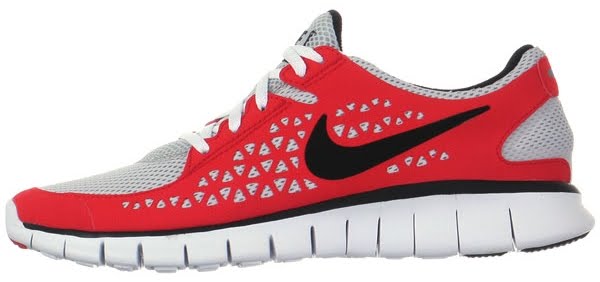
3. Nike is well positioned to adapt to a changing market. They are a huge company, can probably change production directions more easily than anyone else, and already have an established line of transitional and minimalist shoes (the Nike Free line). If traffic to this blog is any indication, the new Nike Free Run+ is a runaway hit, and the Nike Free 3.0 recently returned from its seeming demise. I wouldn’t be surprised if a Nike Free 1.0 is already in development – I’m hopeful that it is.
Although all of this is admittedly speculation and guesswork on my part, as a shoe geek it’s certainly interesting to think about. If Nike is indeed placing itself to lead a change in the market, other manufacturers had better take notice or be left in the dust as Nike runs past them (in truly minimalist shoes).
You might also like:
 Heel-Toe Drop or Offset: What Does it Mean in a Running Shoe?
 Army Study: No Difference in Injury Rates Between Traditionally and Minimally Shod Soldiers
 On Running Shoe Wear and Outsole Durability
 Saucony is Hacking Heels Again: Fastwitch 5 is Going to 4mm Drop
 Newton Running: Q&A With Ian Adamson, Newton’s Director of Product Development


 About Peter Larson










I agree. Nike’s well positioned no matter how the market goes.
Pete, I think your point 3 nails it – Nike are not fools. Running shoes are a competitive arena, in which I’ve never perceived them as the leader (though I’m not the expert you are). If they can build a reputation for setting a new direction (and have greater scale and broader appeal than Vibram), then they can gain a first-movers advantage. I love a post like this that combines the business and science aspects of running – thanks for your coverage of these developments.
Nike is smart. They are listening to the market, instead of ignoring the change.
Certainly, it will be interesting to continue to watch how companies like Nike continue to deal with all of this – thus far, it seems like they’ve been testing the water in terms of introducing new products more than embracing the concept.
BTW – Wow – really great blog. I just discovered you (via Amby Burfoot’s post on RW) and am working my way back through the posts
I would buy a Nike 1.0. I wear my Vibrams everywhere, but hate the attention.
I just read this and although it’s a bit late, I’ll tell you what I think.
I’m a little bit of an insider and expert on the running shoe industry, and to be frank Nike is not faring all that well. Their Free line does sell well, but the remainder of their shoes do poorly compared with their competitors. Nike funded the study because it would boost sales of their Free line, and that’s about it. Their decision to fund a study was nothing other than to boost their Free line. The barefoot running movement won’t govern the future of the industry (and will very likely pass), and as a result Nike’s position will not be appreciably better than it is now.
Thanks for the insight!
Pete
Nike has always maintained its popularity of being at first for shoes and this time also I hope the same.
More likely, Nike was smelling the trend so it funded the nonsense research. Nevertheless, it was just a trend. Look, all fast runners use light and flexible shoes for good performance. It’s hard to get fast (say below 4:00 min/km with shoes that feel like damping. But if you’re going to run on the road and train for long distance at slow paces do yourself a favor and get some cushion (stability or nor). Anyway, pronation is already some sort of cushion. Too much is problematic. Plus, even if *we* evolved for running and talking, not everybody runs and talks the best way. Some need a little help.The point being, not everyone needs to be specially suited for running in the biomechs dept. If you’re just a casual runner for weekly cardio on the running machine you might get away with those trendy feet gloves (fibram or whatever), otherwise get some real shoes (maybe a pair for long slow runs and some others for faster ones.
Minimalist, my ass! Pardon my French.