The recent explosion of interest in minimalist running shoes has brought along with it an interest in specific shoe design features that probably rarely crossed the mind of most runners just a year ago (before the publication of Born to Run by Christopher McDougall got people thinking about these kind of things). One of these is the concept of heel-to-toe drop, sometimes also referred to as heel-toe offset, heel-toe differential, or heel-toe lift (you sometimes also see “forefoot” substituted for “toe”). So what exactly is heel-toe drop, and why are people interested in it as a shoe design element?
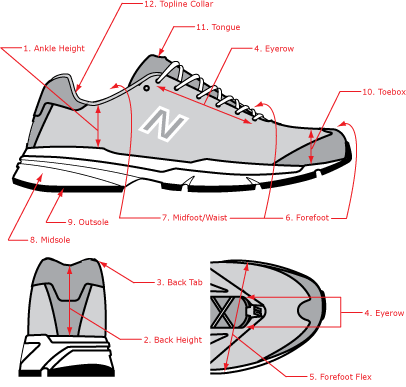
Heel-Toe drop/offset/differential as defined by Brooks Running is “the difference between (midsole + outsole) heel height and (midsole + outsole) forefoot height” (see picture above from New Balance if you’re not clear what the midsole and outsole are). Thus, a drop of zero would mean that when seated in the shoe, the heel and ball of the forefoot would be at exactly the same height off of the ground. A drop of 12mm would mean that the heel sits 12mm higher off the ground than the forefoot. The importance of the HT drop value is that it’s thought that the lower it is, the easier it will be to land on your midfoot or forefoot while running. I’m not sure if there have been published studies confirming this, but my personal experience running in shoes of varying HT drop values, as well as a few of my informal laboratory attempts to correlate heel height in shoes with footstrike, seem to suggest that this relationship is likely real. You can check out these posts for more:
Vibram Fivefingers and Barefoot Running: Does Removing Heel Cushion Change Footstrike?
Relationship Between Running Footstrike and Footwear: From Stability Shoes to Barefoot
Given growing interest among runners in how a given shoe might affect their footstrike, some running shoe manufacturers and running shoe sellers have begun reporting this value as a standard spec on each shoe. For example, Brooks Running has posted HT drop data on their blog for their more “minimalist” shoes, and Running Warehouse lists midsole height for the heel and forefoot for many of the shoes that it sells. I like this trend a lot, as it allows runners to consider one more piece of data to help them make a more informed choice of shoe to match their running style (e.g., it allows midfoot/forefoot runners to more easily find shoes with a lower drop if that’s what they prefer).
Despite the seemingly simple definition, I still find a few points confusing about the concept of heel-toe drop. Some places refer only to midsole height (e.g., Running Warehouse), whereas others (Brooks) include both midsole and outsole height in their calculation. Including the outsole does make a difference in some cases – as an example here are the stats reported on the Brooks blog for the Brooks Launch (one of my favorite shoes):

Brooks Launch
Midsole Height: Heel (22 mm), Forefoot (10 mm)
Outsole Height: Heel (3 mm), Forefoot (5.5 mm)
Heel-to-Toe Offset: 9.5 mm
Tooling Height: Heel (25 mm), Forefoot (15.5 mm)
You can see from the above example that the Launch actually has a slightly lower offset when the outsole is included in the calculation, due to the fact that the outsole is actually a bit thicker in the forefoot (tooling height, another new term to me, is oustole + midsole thickness). What confuses me is why you would ever exclude the outsole, and why the insole never seems to be included in these calculations? Seems to me that the goal is to determine how high off the ground the heel sits relative to the forefoot, and thus all three elements separating the foot from the ground should be included: insole (insert), midsole, and outsole.
Given this, I thought I’d do a little home experiment and measure the heel-toe drop in some of the shoes in my shoe rack. The challenge in doing this is that you can’t simply measure heel or forefoot height from the side of the shoe because the midsole frequently curls up around the sides above the level where the heel sits, such that you might overestimate thickness if measuring in this manner (not to mention that you wouldn’t be including the insole thickness). Rather, what I did was to use a bar clamp that could be cinched up inside the shoe on the insole and on the bottom of the outsole – in other words, I clamped from the top of the insole to the bottom of the outsole. By comparing the length of the clamp bar when fully closed to the length when cinched to the shoe (see photos below), I could calculate the difference and thereby estimate heel or forefoot thickness.

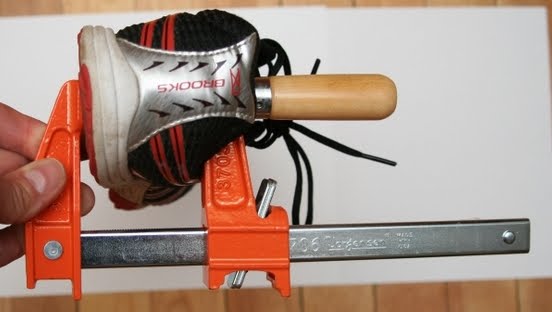
I measured heel thickness at the center of the heel, and forefoot thickness where the ball of the foot (i.e., metatarsal heads) would rest. The latter was accomplished by sliding the clamp arm through the laces between the tongue and the eyerow of the upper, so that no upper fabric was included in the measurement (this couldn’t be done in the Vibram Fivefingers KSO’s or Nike Sneakerboat, so I estimated the thickness of the forefoot fabric and subtracted it from the measured height). All measurements were taken on both the right and left shoes and averaged (measurements were remarakably consistent between sides on most shoes, giving me greater confidence in my data).
Clearly the measurements I provide below aren’t perfect, and a far superior way to do this would be to cut the shoe in half lengthwise and measure thickness with a calipers (which for obvious reasons, I can’t justify doing to my own shoes – but Newton Running has a picture posted of one of their shoes cut in this manner – see below).
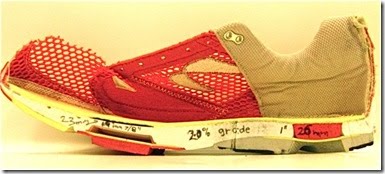
Furthermore, all of these shoes have been worn for varying amounts of time, so I have no idea how much of an effect midsole compaction or outsole wear with increasing mileage might have on these measurements (that would be another interesting home experiment to do, and I hypothesize that if anything, compaction would decrease drop by compacting the heel cushion in a heel-striker like me; regarding outsole wear, most of mine is on the lateral corner of the heel, and was probably not a major factor in these measurements).
Despite the above considerations, I’ve made an academic living out of measuring microsopic parts of animal skeletons, so I’m pretty careful when it comes to taking measurements, and thus I’m confident that these numbers are at least reasonably accurate (and the method used was the same on all shoes).
Update 6/08/09: Ian Adamson from Newton Running was kind enough to leave several comments on this post, including one in which he lists the heel and forefoot thickness for each line of Newton shoes. Since my numbers for the Sir Isaac don’t match his, I thought I’d try to remeasure my Sir Isaac’s using another technique that is also easy to do at home. All that it entailed was measuring the height of a skewer stick, and then measuring the height to which it extended when lifted by the heel or forefoot of the shoe. You can see how I did this in the pictures below:

Below is what the resulting marks looked like on the paper:
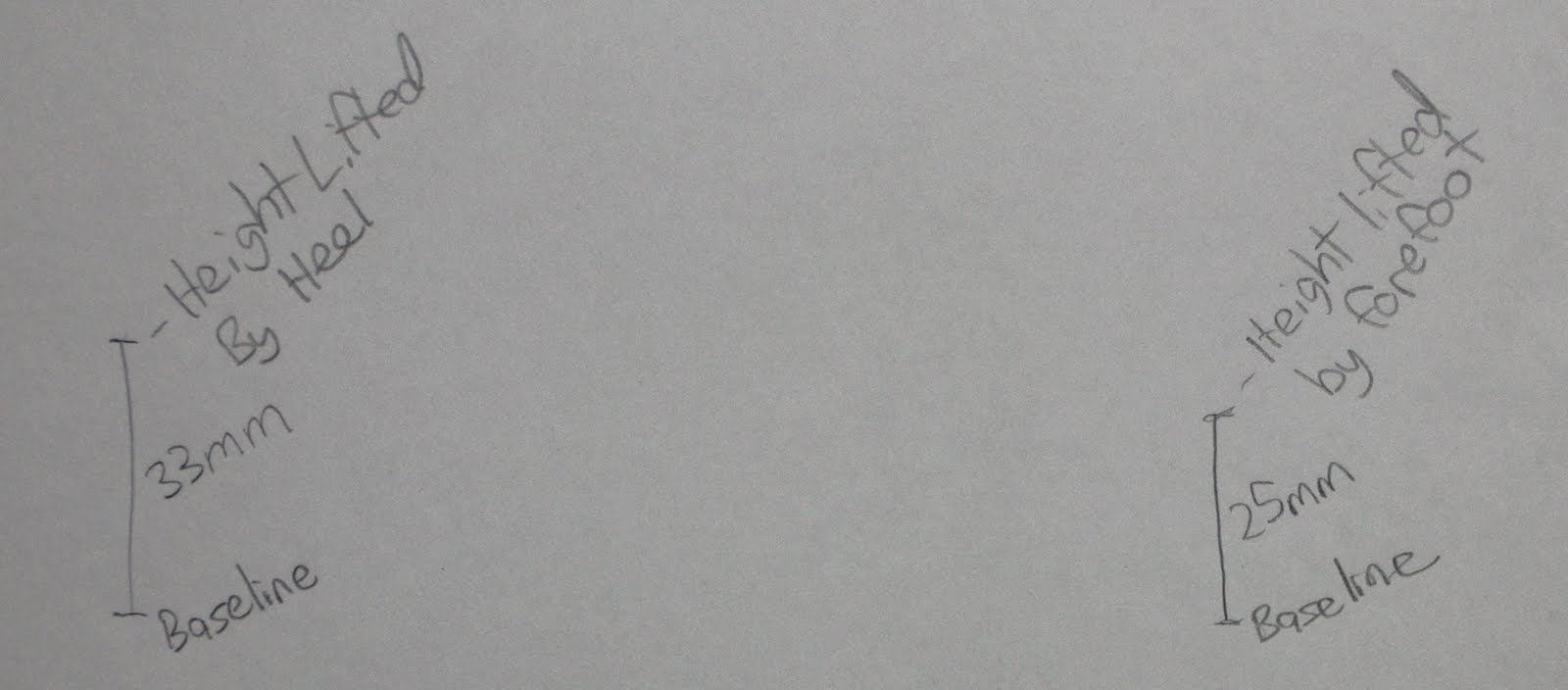
You can see from the above that this method yielded a heel height of 33mm, and a forefoot height of 25mm, which gives a heel-toe drop of 8mm. These numbers are very close to those that I measured using the clamp method (see below – the fact that they are 0.5-1mm larger might be due to the clamp slightly compressing the insole when cinched), and I am confident in their accuracy. Not sure why there is a discrepancy with the numbers that Ian reported below (28mm heel, 23mm forefoot, 5mm drop).
Here are my numbers for heel height, forefoot height, and heel-toe drop using the clamp method:
Men’s Shoes
Saucony Progrid Guide: 31mm heel, 18mm forefoot = 13mm drop
Brooks Launch: 28.5mm heel, 18mm forefoot = 10.5mm drop
Brooks Green Silence: 25mm heel, 16mm forefoot = 9mm drop
Newton Sir Isaac: 32mm heel, 24.5mm forefoot (measured at middle actuator lugs) = 7.5mm drop
Nike Lunaracer: 24mm heel, 18mm forefoot = 6mm drop
Brooks Mach 11 XC Flat: 16mm heel, 12mm forefoot = 4mm drop
Saucony Kilkenny 3 XC Flat: 17mm heel, 13mm forefoot = 4mm drop
Nike Free 3.0 v2: 23mm heel, 19mm forefoot = 4mm drop
Vibram Fivefingers KSO: 8mm heel, 8mm forefoot = 0mm drop
Nike Sneakerboat II: 9mm heel, 11mm forefoot = -2mm drop
Saucony Kinvara: 23mm heel, 19mm forefoot = 4mm drop
Nike Free Run+: 26mm heel, 19mm forefoot = 7mm drop
GoLite Amp Lite (w/ thickest forefoot insert): 19mm heel, 19mm forefoot = 0mm drop
-All men’s shoes above are size 10 except the Nike Lunaracer and Saucony Kilkenny, which are 10.5, and the Vibram Fivefingers KSO’s, which are size 42)
Women’s Shoes
Asics 2130: 31.5mm heel, 17mm forefoot = 14.5mm drop
New Balance 768: 34.5mm heel, 20.5mm forefoot = 14mm drop
Brooks Adrenaline 9: 32mm heel, 19mm forefoot = 13mm drop
Nike Free 5.0: 29mm heel, 19mm forefoot = 10mm drop
-All women’s shoes above are size 9 except the New Balance 768’s, which are 8.5
Children’s Shoes
Asics 2130 (Kid’s 12): 26.5mm heel, 18.5mm forefoot = 8mm drop
A couple of thoughts on the numbers above:
1. First, how do my measurements match up with those published for some of these shoes? It’s difficult to compare absolute heel and forefoot thickness since I included the insole, so instead I’ll focus on the numbers reported for heel-toe drop in a few shoes for which I could find published data on-line (insole height might explain some of the discrepancies):
Brooks Launch: my measured drop = 10.5mm, mfr. published drop = 9.5mm
Brooks Green Silence: my measured drop = 9mm, mfr. published drop = 8mm
Brooks Mach 11: my measured drop = 4mm, mfr. published drop = 6.7mm (after running almost 50 miles in the Mach 11’s, I suspected that the drop was lower than the 6.7mm reported by Brooks)
Newton Sir Isaac: my measured drop = 7.5mm, mfr. published drop = 5m
My conclusion is that it is often hard to know what the thickness numbers being reported by manufacturers include – i.e., just midsole, midsole + outsole, or insole + midsole + outsole. Seems to me the latter is the most accurate representation of where the foot would sit relative to the ground in any given shoe, and that’s what I have reported here (with potential inaccuracies noted above). I should point out that a 1mm discrepancy is very small, and probably negligible from a performance standpoint (and not to mention, also probably well within the margin of error).
2. You can clearly see my preference for minimalist shoes by looking at the drops on most of the shoes in my collection. A more typical trainer like the Saucony Guide (or most of my wife’s shoes in the Women’s section) has a drop of 12-14mm, whereas most of my shoes have a drop of less than 10mm.
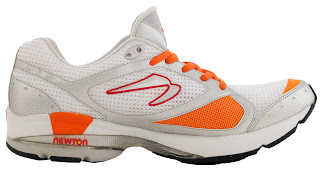
3. The thickness of the heel in the Newton Sir Isaac (see picture below) surprised me. At 32mm, it has a heel thickness that is right in line with most of the traditional training shoes included here. This likely explains why I heel strike in them despite the fact that they are designed to be a shoe to help runners transition into a midfoot/forefoot gait. They have a lower drop than traditional training shoes, but this appears to mostly be accomplished by a thickening of the forefoot and addition of the actuator lugs.
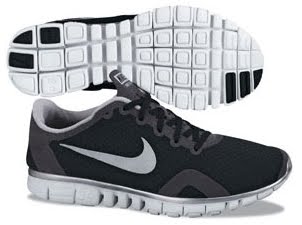
4. Comparing my Nike Free 3.0 (see picture below) to my wife’s Nike Free 5.0 shows clearly that the Free 3.0 is the flatter soled shoe. The heel thickness in the Free 5.0 is not far off what you would find in a traditional training shoe.
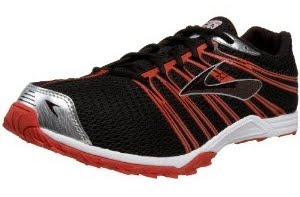
5. Spikeless cross country flats like the Brooks Mach 11 (see picture below) or Saucony Kilkenny are truly very flat (4mm drop for both). They’re also very cheap, which makes them good choices if you can handle a narrow shoe and want to experiment with a low-drop shoe.
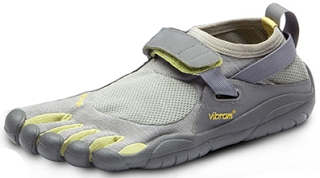
6. The Vibram Fivefingers KSO’s (see below) are a true zero-drop shoe.
7. The Nike Sneakerboat II (picture below) appears to have a negative drop, meaning that the forefoot is thicker than the heel. I’m not 100% certain on the accuracy for this one as it doesn’t have a tongue and I had to subtract an estimate of upper fabric thickness for the forefoot, but I need to take these on a run and see how they perform.
8. My wife, who I’m almost certain is a natural forefoot striker based on her shoe wear patterns (need to confirm this with video), clearly needs some more appropriate shoes for her gait. Speculation altert!!! – maybe this is why she’s had continual problems with running injuries and I haven’t?
9.My 6yo son’s Asics 2130’s have a lower drop than my wife’s 2130’s. This is good, but there’s still an awful lot of probably unnecessary cushion on the sole of that shoe. I’d still like to find him some sneakers with a flatter sole, but thankfully he spends most of his time barefoot or in Crocs.
Hope you found this helpful – I’ll probably add to this list as new shoes find their way into my house. I’d also encourage you to give this a try yourself, and feel free to report numbers for your shoes in the comments. If you have any of the shoes that I measured, I’d be interested to see how your measurements compare.
You might also like:
 Do Vibram Fivefingers Increase Risk of Foot Stress Fractures?: Some Thoughts on Recent Research
 University of Colorado Study Determines that “Running in lightweight, cushioned shoes is equally as efficient as running barefoot.”
 Newton Running: Q&A With Ian Adamson, Newton’s Director of Product Development
 Do Minimalist Shoes Increase Injury Risk?: Merry Christmas Vibram
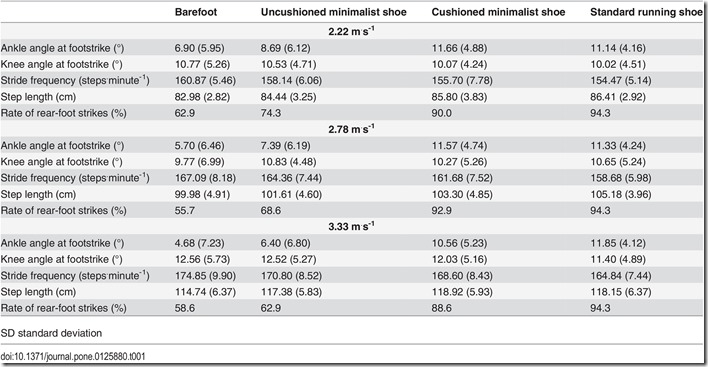 Form Differences Among Barefoot Running, Minimalist Shoe Running, and Standard Shoe Running

 About Peter Larson










Great post, Pete! Nice to see you’re not slouching during your break! ;)
For your son, I’d suggest you try out either the Vivo kid’s line, or the Vans shoes. Vans are wider than the Converse alternative, and are my daughters’ (11 and 7) preferred sneaker.
Crocs are horrid, IMHO. And not just from a fashion perspective.
Gotta keep busy somehow in the summer – why not measure shoes :)
Thanks for the kid shoe tips – I really wish Vibram made kid size
Fivefingers. My kids were actually having a blast racing each other
barefoot on the street today – imagine my pride in watching that!
Pete
Sent from my iPod
Pete, you gotta’ update this excellent post regularly and add some of the other minimalist shoes like the Evo’s and Osma’s.
Harry
Harry,
I’d love to update, but gotta have the shoes to do it, and I can only spend
so much on my “habit” so to speak. I do have a few to add – Bikila, Kinvara,
Free Run+.
Pete
Have you measured the Kinvara?
Thanks for the reminder – just added the Kinvara and Free Run+.
Thanks for adding it! I just read here: link to brooksrunning.com… that the Green Silence has Tooling Height: Heel (21 mm), Forefoot (13 mm) and not 25mm heel, 16mm forefoot as i read here.
Jim,
Brooks does not include the insole in their measurement, which likely
explains the difference.
Pete
Pete i have tried the Nike Free 3 and the heel to toe differential is more than noticeable. Taking a look at the photo of the white part of the sole makes me think that the difference is more than 4mm (This differential is also reported in other sites, i don’t blame you :)
Keep in mind the Kinvara and Type A4 have 2.5mm of extra cushion in the HEEL of the Insole—so in reality the Kinvara has a 6.5mm drop.
I have found the same thing – both Kinvara and Grid Type A4 around 6.5
mm drop with insoles in and measured with C calipers.
Pete
On Monday, November 22, 2010, Disqus
Excellent post! For years I’ve wanted to measure the thickness under the forefoot and the thickness under the heel of my shoes, but could come up with a way to do it accurately (short of cutting the shoes in half longitudinally, which I could not justify for the same reason you couldn’t.)
THANKS for posting this information. I hope that all shoes listed on the internet will include the total thickness under the forefoot, and the total thickness under the heel, as part of their overall specs. That matters a lot to me–at least as important to me as overall weight of the shoe.
Please keep up this data-based and experiential blog!
Ken,
The clamp method seems to work well enough for getting these
measurements – let me know if you try it.
Pete
Sent from my iPod
This is a great write up. Thanks. It does stink to see what my $170 Newtons look like cut open. I always assumed there was fairy dust inside or something.
Here are the design specifications for Newton Running shoes:
Distance line: 25 mm heel – 23 mm forefoot = 2 mm drop
Gravity & Motion: 26 mm heel – 23 mm forefoot = 3 mm drop
Isaac: 28 mm heel – 23 mm forefoot = 5 mm drop
We measure using micrometer calipers under the center of the calcaneus (heel) and 2nd metatarsal head (center for mass and flex point of the forefoot.)
Actual measurements for used shoes will vary depending on running gait. Efficient runners tend to settle both the heel and forefoot equally whilest habitual heel strikers (mostly those transitioning to a natural gait) often lower the heel more and level the shoes out.
Ian Adamson
Dir. R&D and Education
Newton Running
Ian,
Do your numbers include the insole, midsole, and outsole? I tried measuring
the Sir Issac’s again (same spots that you do) and I get the exact same
measurements I reported here – although I’m not using a micrometer calipers,
my numbers seem to be pretty repeatable.
Pete
Ian – thanks for the clarification on the Newtons.
I was initially interested in the Newtons because of my preference for minimalist shoes. I currently train in the ASICS Speedstars, DS-Trainers and Hyper-Speed 4’s and like to mix a bit more cushioning with less depending upon the distance and type of workout.
What turns me off from the Newton’s is the enormous heel and the “actuator lugs.” I’m wary of too much technology in my shoe and it always seemed to me that Newton was trying to “fix” heel-striking with more technology, when I think less is the answer.
Great write up Pete. Thanks. Cheers, – Fitz.
Fitz,
Newton shoes are not designed to be minimalist in terms of less under your foot. Our development and research over the last 15 years lead us to understand that few people will take the time to adapt to less shoe.
Consequently, our approach is to provide a shoe that facilitates a natural running gait, i.e. close to level under your foot, at the same time protecting form unnatural surfaces that most people run on. In addition Newton shoes provide enhanced energy return, up to 80% more than most racing flats, which means greater running efficiency and speed.
We are not trying to fix heel striking with more technology since this is related more to the geometry of a shoe under your foot. Newton technology enhances cushioning and energy return and unlike traditional cushioning technologies does not collapse and take a permanent set. This tends to amplify aberrant biomechanics, which is a whole other discussion.
Like you I am a minimalist, in fact ran track and cross country through college barefoot, so I completely understand where you are coming from. Zola Bud who set two 5,000 m world records running barefoot is also a fan of our shoes.
It makes sense that you like the Hyperspeed. We cut open some time ago (the 2 not the 4) and it was 21 – 14, but with a 5 mm sponge insert under the forefoot. This makes it very close to the ground when loaded and with minimal cushioning.
Newton shoes allow you to sense the ground in a natural position and then level out at about 10 mm under your forefoot when loaded.
Ian,
I’ve seen the study reported on your website about energy return being 80% greater in Newtons more compared to flats. I’m curious if there have been controlled laboratory studies examining oxygen consumption and speed in Newtons vs. other shoes? I find this subject fascinating after having taught Exercise Physiology for the first time last semester. For example, I’d love to see a study comparing Newtons to a racing flat of equivalent weight.
Pete
For what it’s worth, I also measure much more Heel to toe drop (usually about 3-4 mm more than published) in the Newton’s than they publish. They’re still good shoes and better than most out there though.
Here’s a small sample of measurements we have found cutting open popular running shoes:
model: heel (mm) – forefoot (mm) = drop (mm)
NB 790: 22 – 13 = 9
Nike Zoom Streak XC: 24 – 13 = 11
Brooks T5: 24 – 11 = 13
Saucony Hurricane: 35 – 17 = 18
Adidas Response: 34 – 15 = 19
Nike Zoom Tirax: 38 – 17 = 21
Asics Kayano 15: 33 – 11 = 22
Ian,
Thanks for posting this data – my hope is that these numbers become
standard “specs” reported for every shoe. It really helps to highlight
the difference between shoes that might otherwise seem similar.
Pete
Sent from my iPod
[“My wife, who I’m almost certain is a natural forefoot striker based on her shoe wear patterns (need to confirm this with video),”]
Shoe wear patterns are just that–shoe wear due to repeated grinding at that location. Shoe wear is not a reliable determinate of foot strike tendencies (rearfoot, midfoot or forefoot).
A video camera will not confirm your wife’s foot strike with the kind of accuracy a pressure sensor array in her shoe will. A poor man’s version of foot strike predilection is running on a sandy flat beach, and then examining the footprint’s indentations. It is a better way to guess than a video camera, plus you get to go to the beach.
Yep – you are correct. I filmed her yesterday actually at 300fps and she has
a somewhat overstriding gait with a very pronounced heel strike (foot highly
dorsiflexed at contact), nowhere near forefoot. No wear on her heels though.
Might explain why she has constant hip trouble when she runs. Wish I could
afford a pressure mat, someday I’ll get one.
Pete
I wonder why women’s shoes have higher heel-to-toe drops, especially when the angle is probably steeper due to women’s smaller feet. Do you think running shoe companies construct shoes this way since many women wear high heels when not running? Or is there some anatomical reason that women should have a higher heel-to-toe drop in running shoes?
Kristen,
I think the drop is the same in the same model of a men’s vs. women’s shoe.
The difference in the shoes on my post is mainly my taste vs. my wife’s.
She’s far less picky about her shoes, though I’m working on that :)
Pete
After training for the Marine Corps Marathon last summer painfree in Kinvaras, I developed what I believed to be painful Platars in the months following the race. I visited a podiatrist that told me there were 3 kinds of feet, and that my foot is one that needs ample heel-toe- drop. Without it he feels I will always have trouble. He also suggested a fitted orthodic. It was my first visit to a foot DR, so I’m unsure what to think. Have you or any of your followers heard that some feet need a big heel-toe drop to prevent to onset of plantars?
Not sure what the three foot types are – related to degree of pronation? Is it possible that the pain was caused by your increased training load since you had run pain free in the Kinvara previously? If a heel allows you to run pain free, no reason not to do it.
Pete
I`ve got an old pair of Kinvara`s I`m not using and I`m thinking of figuring out how to take the drop out of them so they`re true zero drop shoes. Any ideas or guides?
Haven’t seen it done with the Kinvara yet. I’m contemplating the same
with a pair of Mizunos.
I’m toying with the idea of getting my Grids (which are ‘flat’ around the heel, so easier to determine where to ‘slice’) and using a meat/food slicer to take 5mm or so off.
The altra guys detail how to do it in general by slicing a section out of the heel, cutting out a sliver, below the missile and above the outdoor. Haven’t done it myself and not sure what tool you would use but logics is sound and they say they’ve done it with 1000’s of pairs leading to their own designs…
Inspired by this article and with some down time after suffering from the T.M.T.S (Too Much Too Soon) syndrome in spite of warnings from Pete, I decided to do surgery on my very comfy lawn mower shoes..Asics 1130 gels.
I took them from a 10mm to a 4mm drop using the stick method above from top of insole to bottom of outsole. Removed the hard plastic external arch supports, made a cut below the gel pack, then above the gel pack to remove the wedge, measured them, then adhered them with clear shoe goo and the 6000 product by the same company.
I’ve been walking/trotting in them for a few weeks now and they seem to work fine.
Pics available
People talk about the heel to ball of foot drop (which is good), but are we forgetting the toe-off? It’s the heel to toe drop that should be more concerning, surely. Moreover, who do they make running shoes curl up at the toe? Lasted this way, it means that, if you want to forefoot strike first, when you come down to your heel (so now your toes, ball of foot and heel are on the floor) the shoe is acting AGAINST this motion. This, I believe, is part contributor to the many injuries we see.
The heel to toe discussion is ridiculous. Real runners run in whatever they get for free! quit worrying about the shoe and go running!
I agree.. but whenever I run more than 8 miles, my knees start to hurt.
Whenever I run shorter distances but faster (5k and less) I get blisters.
The proper running sneakers helped to pretty much alleviate this completely. I have a very minimal drop shoe for faster races and a zero drop for longer distances so the heel doesn’t strike first and run up my legs.
I tried changing my stride but it’s much harder than just changing the shoes :)
I’ve used the spirit level or bubble leveller and found that the pair of kso’s I have actually are not zero drop. They in fact favour the heel. Did it on the Treksport, Komodosport, bikila and seeya that I own and all of which are true zero drop. The KSO is not zero drop. The heel is felt while running.
Does anyone know where I can find a zero-foot-drop shoe that comes in a narrow size? The only ones I have been able to find are Keds (which pinch a little on my little toes due to narrow toe box and Earth-Runner sandals made to order (which caused a callous).
Are you looking for a running shoe or a casual shoe? For running, the Saucony Virrata is zero drop and is a slimmer fit. For casual maybe something like TOMS?
Thanks – I’ll check them out. I don’t run. I’m just a senior citizen trying to avoid a recurrence of plantar fasciitis…just trying to be able to walk.
I have slight foot drop, are you describing more toe clearance with a higher drop. When my foot comes through I’m looking for more distance between the toe and ground. Or would you think a zero drop would work better for running?
Drop is just the difference in height between the heel and forefoot, so not sure it would influence toe clearance. Interesting question, not sure of the answer.
Great article. Awesome blog.
I’ m considering switching from A3 shoes (Glycerin, vomero, Nimbus) to 0 drop.
Do you suggest gradually moving towards minimal shoes passing through drops 8, 4 etc or rather trying hard reset and go for 0 drop straight away?
I am a total heel striker, 76kgs and 3h46′ in the marathon.
I’d like to improve my running technique for my knees’ benefit and lower back pain.
Thank you
I’d recommend a progression personally as going lower drop will require some adaptation from your calves. Just take it slow as the transition can take some time, and a foam roller for the calves can be a big help!
These shoe companies are changing the designs each year just for the sake of change, there are no long term studies showing the extra padding and especially the large drops are healthy for children or adults alike – it’s all marketing hype. The proprioception of the body takes care of balance and strike, as long as it gets reasonable feedback from the foots sensors, but as soon as those sensors are suppress with artificial padding in the sole, the body mechanics start to suffer and get confused. It’s like losing your vision or hearing, try running blindfolded or with ear plugs – thats what its like for your sensory system with excessive padding. The options then become which shoes to choose to minimal physical damage – which is not a healthy thing for children.
Keep the drop low, cater for over pronation with toe wedges and let the body take care of the rest, the shoe companies know this but they need to distinguish their products from the competition – just reading the specs for a basic kids shoe is like speccing out the space shuttle, you’d think they want to send you to the moon with those shoes.
Precisely why childrens calves and toes have weakened (muscle atrophy) in the past 20 years. Just look at a regular kids toes and see how skinny they are – due to excessive shoe wearing, too much padding and not enough actual muscle usage. Then look at a kids who has walked barefoot around the house most of his life, nice thick strong and wide toes. Similarly with calf muscles. These kids are going to end up with musculoskeletal problems very early in life unless they get back to barefeet and basic shoes.