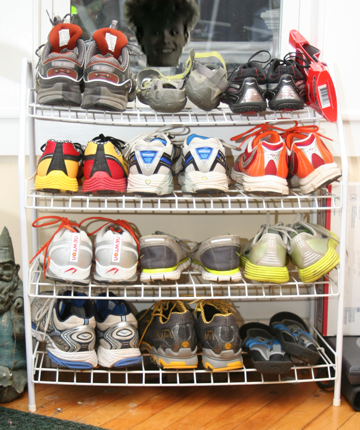
If you’ve been reading this blog for any length of time, you probably realize that I have a bit of a running shoe problem. Not only do I own a lot of running shoes (part of my collection can be seen in the picture to the left), but I actually manage to run in most of them regularly, and I’ve developed a strong interest in footwear design from performance and injury prevention standpoints (mainly due to my professional interests in anatomy and biomechanics). I’m still far from being an expert on shoes, but I’ve learned a lot over the past year, and have found reading and writing about shoe design to be a lot of fun. However, it hasn’t always been this way.
My suspicion is that many recreational runners out there are a lot like I used to be when it comes to choosing a running shoe. Before I started running seriously I didn’t know a whole lot about shoes. Most of the time, I chose a pair based on a combination of aesthetics and price – if they looked good and were priced low, I’d put them on my feet and wear them until they died. I never reserved a pair solely for running (my shoes were always multi-purpose), I had no idea that there were such things as motion control, stability, and neutral shoes, and I wasn’t aware that things like racing flats even existed.
When I started running more seriously about 3 years ago, I followed the advice of a friend and stopped by a local running shop to get fitted for a “proper” pair of running shoes. The clerk at the store who helped me out politely asked me if I had been running solely in the shoes that I was wearing on that day (I had), and pointed out that they were trail shoes and weren’t meant to be used on roads (oops, but they looked cool!). She had me take off my shoes and run back and forth across the store, and promptly “diagnosed” me as a mild overpronator who should be wearing stability shoes. I left the store with a nice pair of Nike Air Structure Triax stability shoes, and just like that – two or three 20 foot jogs inside a running store (not even filmed!) resulted in me almost exclusively wearing stability shoes for the next two years. To be quite honest, after my “diagnosis” I was afraid that deviating from a stability shoe would result in an injury, so I was reluctant to try anything else. I suspect that this experience also is not unique.
Things began to change for me when my race times started to drop in late 2008, and I began reading that a lighter shoe could help shave of a few additional seconds from my times by making my running more efficient (less weight at the end of the leg = less energy expended). I decided to buy a pair Saucony Fastwitch 2’s, a lightweight training shoe that offered some stability (of course – didn’t want to go too crazy!), and logged PR’s in both the 5K and half-marathon in them. Regardless of whether the shoes or my improved training and conditioning deserved credit for the PR’s, I was happy with my transition into lighter-weight footwear, and haven’t turned back to traditional trainers since.
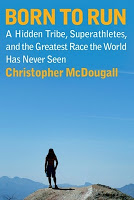
My running shoe obsession exploded early last year when I read Born to Run, by Christopher McDougall (I posted my review of Born to Run almost exactly one year ago). Reading McDougall’s book didn’t so much have the effect of making me want to throw away my shoes – rather, what Born to Run did for me was to make me think about my footwear and question why exactly I was wearing the shoes that I put on my feet. As an anatomist and evolutionary biologist who did his dissertation in an animal locomotion lab (though I studied tadpole skulls and feeding mechanics of all things!), I was familiar with many of the scientists McDougall referred to in Born to Run, and his discussion of biomechanics and the evolution of running was right up my alley.
Perhaps the most important outcome of reading Born to Run for me was that it stimulated me to begin doing my own literature research on footwear and running, to begin thinking out loud on this blog, and to begin experimenting on myself with different kinds of footwear and different running gaits. I learned a lot in a short period of time (and am still learning every day), and among the things I realized were that there is little researching showing that pronation control in a shoe accomplishes much of anything, and that there is woefully little conclusive research linking anything that we put (or don’t put) on our feet to running injuries (read this great blog post by Amby Burfoot for more on this). I bought Nike Free 3.0’s and Vibram Fivefingers KSO’s, and to my surprise was able to run in them without horrific injury. I tried running barefoot a few times, and although I’ve found that it’s not for me, I can see why some runner’s enjoy it.
Most importantly though, I’ve now realized that I can run in just about anything as long as I’m careful to take things slowly and listen to my body. Problems arise for me when I attempt to do too much too soon in a new pair of shoes. As an example, I’ve been testing out a pair of Brooks Mach 11 XC racing flats for a review I’m working on, and found that after running about 25 consecutive miles in them on mixed terrain my left forefoot and heel were getting sore. I shelved the shoes for a week, ran in my more cushioned Brooks Launch for a bit, and came back to the Mach 11’s this past week with no problem whatsoever. I had the same experience with my Vibram Fivefingers – foot pain after my first run (did too much), shelved them for a week or so then came back slowly and have had no troubles.
I’ve now come to believe that rotating shoes is the best approach for me. I tend to think that the more variation in force application that I expose my legs and feet to (via differently designed shoes), the stronger they will become, and the less likely they will be to succumb to a repetitive use injury that might result from continual exposure to the same impact forces over and over again. I think of varying footwear like going to the gym and using the weight machines to work your upper body – you don’t just use one machine every time, over and over again. Rather, you hit your body with different machines which require that different muscles (or parts of a single muscle) be activated, thus making the whole unit stronger. I still haven’t gone back to heavily cushioned, thick heeled trainers, nor do I anticipate that I ever will, but I don’t view shoes as the evil devices that some people make them out to be, and mixing it up a bit seems to be working just fine for me at this point.
So after all of this, what exactly are the things that I now look for in a shoe? I’ll finish by listing a few of the things that matter most to me:
1. Weight. First and foremost, I like a shoe to be as light as possible. I generally look for shoes that weigh less than 10oz each, with lower being better. I have several pairs that weigh in under 7oz each, and I’d have to say that this is ideal.
2. Heel-Toe Drop/Offset. My preference is for a shoe that does not have a large, cushioned heel. Heel-Toe drop/offset/differential is essentially the difference in thickness between midsole + outsole of the heel vs. the forefoot – a drop of zero would mean that when seated in the shoe, the heel and forefoot would be at exactly the same height off of the ground (check out this post on heel-toe drop for more). Most running shoes have an HT drop of around 12mm, meaning that the heel sits about 12mm higher off of the ground than the forefoot. The upshot of the HT drop value is that the lower it is, the easier it will be to land on your midfoot or forefoot while running (to see my personal experiment with heel height and footstrike, check out this post in which I filmed myself and a student of mine in slow motion while treadmill running in shoes and barefoot). I prefer shoes with as low a drop as possible, but I do like some variability so that my calves get worked in different ways in different shoes (e.g., my Brooks Launch have an HT offset of 9.5mm, my Brooks Mach 11 spikeless have an offset of 6.7mm, and my Vibram Fivefingers are pretty close to 0). If you’re curious about heel-toe offset values for a shoe, Running Warehouse publishes it for many shoes as a standard part of its shoe data (which is one of the reasons I like to support them).
3. Comfort. A shoe needs to be comfortable form me to want to run in it, so fit is very important. As an example, my Nike Lunaracers are lightweight and feel very fast, but they are a bit on the narrow side, which created problems for me while running the Hartford Marathon. On the other end, the Brooks Launch is one of the heavier shoes that I run in, and has a higher offset than most. However, it may be my most comfortable shoe, so I run in it often, particularly on longer runs.
4. Aesthetics. Yes, this still is important to me! I realize it’s one of the worst things upon which to base a shoe choice, but sometimes you simply can’t escape aesthetics. It may be mental, but I like a pair of shoes to look fast, and generally speaking, the flashier the better. If I find a shoe to be unappealing, I won’t buy it.
5. Price. I hate to say it, but price is also still important. I can’t justify spending over $100 on a pair of shoes, particularly if it it is touted to be “minimalist.” Some may disagree, but one would think that a minimalist shoe stripped of all the high-tech “features” would be cheaper, not more expensive, right? I’d put forth the Terra Plana EVO as an example of a shoe that fails both of the previous two tests for me – it’s lightweight and has a flat sole, but it’s doesn’t appeal to me aesthetically, and it is way too expensive in my opinion for a shoe that is supposedly stripped down to appeal to the minimalist market. I won’t be buying the EVO.
6. Other Factors. There are other things that figure into whether I like a shoe or not, and these include breathability, flexibility, upper construction, etc. For example, I prefer a shoe that has a breathable, minimalistic upper and a flexible sole (all three of these are exemplified by the Nike Free 3.0), though none of these factors are deal-breakers for me.
So there you have it, the evolution of my perspective on running shoes. I’d love to hear if you experience has mirrored mine!
You might also like:
 My Interview on Jason Fitzgerald’s Strength Running Blog
 Saucony Virrata Zero Drop Running Shoe Review
 Merrell Barefoot Road Glove Running Shoe Review and Giveaway
 The State of the Running Shoe Market: Minimalism on the Rise
 Brooks Running Pure Project: Brooks to Introduce a New Line of Minimalist Shoes

 About Peter Larson










Very interesting point of view !
I think I own as many shoes as you do (most of them has been given to me by manufacturer to have them reviewed on my website) and I fully agree with the 6 factors. However, after having also read Born to Run, I decided to run only minimalist at least for a while (VFF KSO and TERRA PLANA EVO). The EVO aren’t that expensive here in Europe compared to the VFF (or maybe are the VFF rather expensive …). I do prefer the KSO to the EVO for the moment. I should soon receive a pair of ZOOT Sprint which are what’s most close to minimalism in Zoot’s catalogue.
Keep on the great work you do with Runblogger.
FREDERIC link to wanarun.net…
The EVO are almost double the price of KSO’s here in the states, and to be
honest, I like the Fivefingers better from a pure appearance standpoint (if
you can believe that!).
Pete
CHECK HERE FOR A LIGHTWEIGHT NIKE RUNNING SHOE [retro 1976] THAT WILL LAST 3000K !
And still available on the internet for £30
http://runwitharthurlydiard.bl…
Rick,
I’m curious – how much do those Nike’s weigh?
Pete
Nice post as always, Pete. I think you might find this article interesting, as his approach is similar to what you describe:
Why Anton Krupicka Runs Barefoot”
link to runningtimes.com…
Tuck,
Thanks for the link – I recently read a post on Krupicka’s blog about his
shoe philosophy, which I liked a lot. Hadn’t seen the RT article though.
Pete
Great article…. Your experience regarding running and shoe selection is very similar to mine. I have been following your site and it offers sound advice and information to aspiring minimalist runners. Keep up the good work… I currently am running in the New Balance 805 and it works particularly good for a mid-foot strike. This is a discontinued model so I bought extra pairs to keep me going until the minimalist movement inspires shoe manufacturers to put out even better shoes….. My criteria for running shoes is similar to what you stated. #1- Lightweight #2- Neutral #3- Flexible #4- Low Profile (the entire sole including the heel). Again, Great site…… Tim
Thanks for the comment Tim! I suspect we will be seeing a flood of
entries into the minimalist shoe market in the coming year. Have you
heard of the New Balance Minimus – just read something about it the
other day, and am trying to get some details.
Pete
Sent from my iPod
I had to chuckle at this article because this the approach I unwittingly used for most of my running life. Usually run in anything that is comfortable and cheap and light. Run in a little bit of everything- varying from run to run.
Only when did I get really serious and studying the issue, I started getting into trouble.
I would also throw “conditions” in which I am running. A winter running shoe is much different than a summer shoe, a racing shoe is much different than a shoe I do recovery runs in….etc.
Matt,
Kind of funny, isn’t it. The amazing thing to me thinking back is that I
almost never had any aches or pains when I just picked the shoe that I
thought looked best, and now one of my favorite shoes is a cheap XC flat.
Pete
i’ve spent the last two hours reading various posts on your blog. this one was the last i picked out to read, and i’m glad i did — you are basically telling (half of) my running life story! and incidentally, i am also an anatomy teacher :)
i started running serious a few years ago, after dabbling here or there. i *always* picked my shoes based primarily on looks and secondarily on price. i also had no idea that there were shoes specifically designed for different purposes. overpronation? didn’t hear of it until 2006. i got into the specialty running shoe world after trying to train for a half-marathon and sustaining various injuries. although i can’t remember clearly, i knew very little about training at the time, and i’m almost sure that i increased mileage and pace far too quickly. after my first visit to a specialty shoe store, i was put in motion control shoes and like you, was terrified to leave the range for a couple years for fear of injury.
after becoming a much more serious and more importantly, a more informed runner, i’d like to say that my running form improved to the point where i knew i didn’t need all the crazy accoutrements of a motion control shoes. at this point they were forcing me to supinate! but, this is when all my problems started happening. due to a confluence of various shoe-related events, i ended up with a metatarsal injury that’s kept me off of my feet for almost a year. i also have been diagnosed with plantar fasciitis. recommendation of my podiatrist? stiff soled shoes, structured insoles, etc. — i think you know the drill. my recovery has been downright awful, and i have a Very Strong Feeling that all that stiff, hard, rigid stuff is keeping me from getting better. it’s just killing my feet while not letting my feet and legs get any stronger. a couple weeks ago i discovered the adidas marathon, just as a walking shoe. in just three days on those shoes, i find myself able to walk for miles without pain instead of the few blocks it has been. i have no pain upon waking! all this, just by wearing an unsupportive shoe with good shock absorption. i tried jogging in the marathons but this didn’t feel good.
so, after all this, i find myself questioning what i *really* need in a shoe. i overpronate (much worse on the right than left), and i do have this injury that needs some tending to. but do i really need a giant, clunky, stiff brick? i really don’t think so. i find myself wanting to try a simpler shoe but am definitely nervous about injuring myself because i’ve been conditioned to think that i need support from my shoes. i don’t have the strongest leg muscles (i’m including thighs here).
based on what i’ve read on your blog, i’m going to give the various nike frees a whirl and go from there. and if you’ve read this far — thanks for that, and, thanks for all the thought-provoking posts on running science!
Thanks for your comment – 2hrs is an impressive amount of time to spend
reading my ramblings!
Our stories are similar, except that so far I’ve been fortunate enough to
avoid the injury bug. My transition out of stability shoes was scary because
of what I’d been told, but in retrospect I think it was the best thing I’ve
ever done. Everyone’s different, so who knows if it will work for you, but
if you try it and are very careful and adjust slowly, you can hopefully pick
up on any signs of trouble before they become a problem. I’m posting a
reference to another great blog article by Steve Magness on the topic of
running shoes tomorrow, but here’s the link as you might find it
interesting:
http://www.scienceofrunning.co….
My basic take is that if what you’re doing isn’t working (and please be
aware that I’m not a doctor, just another runner trying to figure things
out), then try something else, but make sure you adjust slowly.
Regarding the Free’s, I”m a big fan of the 3.0’s if you can still find them
– just ran in my second pair today.
Pete
hi pete, again, thanks for reading my very long comment! and, thanks for the preview link. as a scientist, it was a refreshing read, since it takes into account the adaptive and integrated response of the human body. the article seems based in scientific reality, as opposed to the nebulous, usually unsupported claims made by various running shoe companies. my motto these days is definitely becoming “do what works.” yeah, i might overpronate, but i only want to treat it like a problem if it IS a problem. there must be a reason i got through a lifetime of gymnastics (talk about using your feet!) and plain ol’ walking all around cities without injury, when i never gave a thought to anything beyond comfort. all my reading and exploration of running science is only making me realize that i’m really better off (intellectually, and maybe physically) trying to figure out things for myself and try, like you, to find trustworthy, peer-reviewed literature on the subject. so, i respect your opinions given what i’ve read here so far, but i’ll be sure not to give them too much more weight than, say, i would to a nike salesperson :) i’ll be curious to see what discussion is generated from steve magness’ article, and i’ve bookmarked your blog for future visits!
Great post! I went to the Running Warehouse link and looked at a dozen or so random pairs of shoes, and none of them seemed to have the HT drop data anymore. All that I saw were data for toebox height, heel width, midfoot width, etc. Did they stop doing it, or am I just overlooking it? Do you know of any other websites that publish those data for shoes? Thanks!
Amanda,
I know Brooks reports values for some of their’s, and RW may be more
spotty than I thought – maybe try the RW Competition store – tab on
top if their webpage?
Pete
Sent from my iPod
Pete – Thanks for having all this info — I came across your site looking for a review on the Saucony Kinvara. I impulse bought them yesterday sine they were so light and comfortable (and had a mid-strike profile i was looking for)
I’ve been running in stability shoes (Brooks Adrenalines) + full orthotics (heel lift/arch support) for over a decade; a few years ago i shifted to mid-foot to lessen the yearly knee and ITBS strains. I’ve been injury free and wanted to take the next step and try a shoe better for mid-strike running.
I am planning on doing my long runs in my Adrenalines and my mid-week (2x) in the Kinvaras — does switching between high and low heel shoes cause issues?
I’ll go by feel as you instructed, but is there a transition period/plan I should try to use? e.g. am I crazy to think I can use them in my next marathon in 4 weeks
Edwin,
I’m a believer in mixing it up a bit with shoes, so I don’t
necessarily see a problem. Personally though, I have a hard time
avoiding a heel strike in more traditional shoes like the adrenaline,
so everything I run in now has a reduced heel to some degree, but I
rotate regularly. Regarding a 4 week transition, I’d say go by feel.
The Kinvara does have some heel, and if you have been midfoot striking
for awhile you might be ok. If your calves get really sore after your
first few runs in them, I’d take it slower as that indicates that you
need more adaptation. Be smart, listen to your body, and all should be
well.
Good luck!
Pete
On Monday, September 20, 2010, Disqus
Pete – thanks for the reply, and i’ll listen to my calves… I’ll post a follow up post marathon if all goes well. thanks again!
Very interesting to read your story of how your running shoe “addiction” came about. I have been running for quite a few years and have been sticking with the stability shoes (Brooks Adrenalines). Only recently I’ve begun thinking about switching things up.
Now I’m considering rotating between my Adrenalines and a lighter trainer/racer for my workouts and races. I’m still not sold on the whole barefoot running movement but I can see that I should be open to other ideas besides what the 20 year old at the running store told me.
Okay, first of all: TADPOLES HAVE SKULLS?
Live and learn.
Secondly, I’m all excited! As a longtime blogger and even longer time runner, it never occurred to me to seek out RUNNING BLOGS until tonight.
So glad I found yours!
Good stuff.
Thanks! Not really skulls in the technical sense, just bits of cartilage.
Like you, when I first started running, a shoe expert looked at my stride for 20 seconds and put me in Brooks Beast. Gah! That was 7 years ago. As my times got faster, the Beasts made my hips hurt. I then wore Brooks Adrenalines for many of my marathons, but again, hip pain and it always felt like my feet were fighting the shoe. Finally, in Feb. of 2010, a shoe guy suggested neutral shoes.. I went from the Etonic Playa (loved them) to Brooks Ghost (hated them – too much shoe) to Adidas Boston and Brooks Launch. Now, im wearing Launches, Asiscs Sky Speed and Saucony Kinvara. The lighter the shoe the better for me, and glad to have found your blog and the cool note about running warehouse’s specifics about heel-toe-drop.. i was just about to ask you where can i find such info. Great blog.
Thanks Kevin!
It was fascinating and enlightening to read about your evolving process of selecting the right running shoe. It can be a bit intimidating for those new to running to determine which shoe is best out of the hundreds out there. Interesting and enlightening post!
I am the type of person who does research before I jump into things, and I have been looking around a lot to prep myself for trying a couch to 5k. I have not run since I was a child, but when I do attempt jogging for a minute or two during a walk, I end up with pain in my archs afterward due to the huge wedge heels on “traditional running shoes”. I naturally try for a mid to forefoot strike, and running on the balls of my feet feels most natural and normal to me. This drove me to research minimalist running shoes and lead me to your blog. Now I am torn between staring out with a low to mid shoe, or dropping straight into a very minimal style, as those are most suited to the way I run. I purchased a pair of New balance WT101s to use as running shoes due to price before I started all this research but it sounds like what I have is probably a good starting point for me. Thanks for having so much information available, and for your shoe obsession.
MT101’s are a reasonable first choice, and should you desire to move to something less the NB Minimus Trail MT10 might be a good next step.
Thanks for reading! I just finished coaching a C25K group and one thing I will say is that aches and pains are completely normal at the start, probably will happen in any shoe. Running is a stress to the body, and it needs time to strengthen. Give it time and build gradually and you WILL get stronger and pain will ease. The WT101 is a great choice to start with, and you can start mixing in a more minimal shoe if you’d like. No need to use just one thing!
—-
Pete Larson’s Web Links:
-My book: Tread Lightly: link to ow.ly
-Blog: https://runblogger.com
-Twitter: link to twitter.com
-Facebook Page: link to facebook.com…
-Discussion Forum: https://runblogger.com/forum
Such a great post, Pete. So many similarities between your journey and conclusions, and mine (especially the description of your shoe fitting experience)! I’m relieved to see that even though I am not as knowledgable and was not as thorough and diligent in my shoe exploration as you, my newfound perception that “the shoes do not make the runner” is not completely off base. I now wear what I like, take the running store’s recommendations with a grain of salt, and listen closely to how my body responds each time I run.
That’s the philosophy I’ve real come around to – try lots of stuff and use what works. Don’t listen to advice that has no real support. Thanks for the comment!
I just came across this post in my attempts to replace an old pair of running shoes. Thanks so much for all the details, which proved helpful without being overwhelming. I’m in the process of training for my first 10K race postpartum. I’ve always been very athletic and did a lot of running pre-pregnancy. (I went to a running shoe store and was told I needed light-to-neutral support, so they put me in the Asics Gel Landreth.) In light of the minimalist shoe movement and my new running goals, I’m thinking of switching to a totally neutral shoe, but I don’t have a glue as to where to start since I don’t know much about my gate and how it relates to shoe needs. Any suggestions?
Good transitional shoes to consider might be the Saucony Kinvara and Brooks Pure Flow.
I had the same experience the first time I ever walked into Road Runner Sports. They put me on a tread mill and concluded that I had a flexible ankle and over pronated so I would need a stability shoe. I questioned how flexibility could be a bad thing even then but went a long with it even though I had years of running in all kinds of shoes with no injuries. I should have listened to my instincts in the beginning but was excited to take my running more “main stream”. I’m glad I have since started to question everything as well and I’m grateful for your blog and other publications that help to back me up.
Thanks, trying to spread the word, but lots of people still stuck on the old way of doing things.
—-
Pete Larson’s Web Links:
My book: Tread Lightly – link to ow.ly
Blog: https://runblogger.com
Twitter: link to twitter.com
Facebook: link to facebook.com…