 Image via Wikipedia
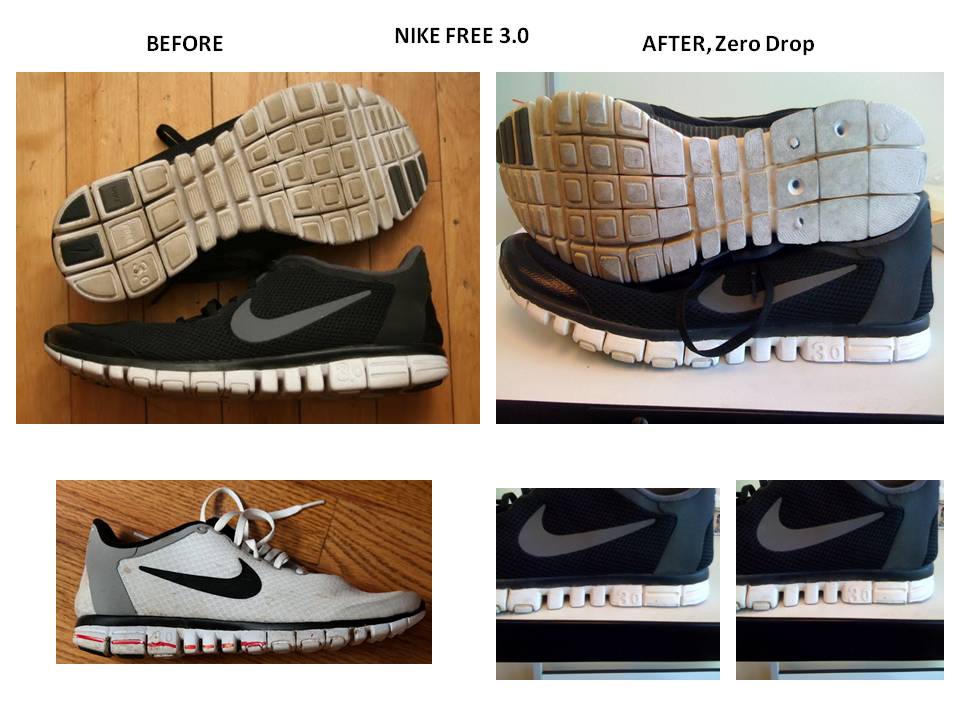
I didn’t really have much intention of doing another barefoot run, but I’ve been discussing the topic a lot lately in an on-line discussion forum, and was convinced by another member that I should give it another try (thanks Harry!). Harry is a guy that got into barefoot running due to frequent injuries experienced while running in traditional shoes, and he saw his injuries resolve themselves as his form changed while running barefoot (he’s now a forefoot striker). He has since migrated back into minimalist shoes (mixed with barefooting) and currently prefers the Terra Plana Evo and a pair of Nike Free 3.0’s that he had a cobbler modify so that they would have no drop in sole height from heel to toe (see a picture of his zero-drop Free’s below – you can read more about Harry’s modified shoes here). Long story short, Harry has made amazing progress, and this morning he won his first race, a 5k with over 500 runners (run in his modified Free’s)! If you want to learn more about him, check out Harry’s profile on dailymile or his blog, My Tree of Life, at http://hhollines.blogspot.com/.
One of the problems with my two previous attempts at barefoot running (you can read about attempt #1 and attempt #2 here on Runblogger) was that they were both done at night, and I suspect this played a role in the difficulty I had scanning the ground for rocks and pebbles, which cause a lot of pain when you land on them (headlamps just don’t cut it for this purpose). I told my wife this afternoon that I was considering doing another barefoot run, but was hesitant about doing it during the day for fear that I might be viewed by the neighbors as some kind of lunatic. She basically told me to suck it up and go, and not worry what anyone might think (that’s why I married her, but I think she’d just prefer I go barefoot full-time so that I’ll stop buying shoes!). I grabbed Jack, and we set off. It’s amazing how much faster you can get out the door when you don’t have to fuss about shoes.
My plan was to run unshod until the moment I felt any kind of musculoskeletal discomfort. I brought my Nike Free 3.0’s along in a Camelbak, and the plan was to pop them on as soon as needed. Things went surprisingly well, and I think doing the run in daylight made a big difference. I did step on pebbles on a few occasions, but it was much easier to scan the ground, so it wasn’t nearly as problematic as on my previous runs. The biggest issue I encountered, and I experienced this on my previous barefoot runs as well, is that some of the asphalt I ran on had a very rough texture and caused a lot of friction with the skin under my forefoot. I didn’t get any blisters, but it was a bit uncomfortable at times. My assumption is that this would improve with time as the skin on my sole acclimates a bit.
I wound up making it 2 full miles, at which point a very slight twinge on the top of my left foot indicated that it was time for the shoes (I’m well aware of the danger of top of foot pain). Although I have been running in minimalist and reduced shoes for over a year, my barefoot running gait is significantly more toward the forefoot, and I don’t want to chance any kind of injury by doing too much too soon. Putting the shoes on immediately felt strange. On my previous attempts I did the reverse and left the house shod, and finished up barefoot. Putting the shoes on after being barefoot made me feel really high off the ground, but springier due to the cushioning. Conversely, it’s also a lot easier to overstride in shoes – my barefoot gait feels more compact and quick when compared to my shod gait. The shoe transition coincided with hitting a trail, so it’s hard to make a really good comparison, but I also feel like I can be a lot more reckless in shoes since I can take my eyes off the ground – this is a definite plus in race situations. Given this, I think the benefit of barefoot running for me would simply be to allow me to really focus on form, which can then hopefully be carried over to running in shoes for the bulk of my miles.
All in all, I’m glad I gave it another try, and I do foresee myself sticking with it for a bit to give it a fairer shake. The scientist in me is also just fascinated by the experiment, and curious as to what, if anything, it might accomplish for my running. I certainly don’t plan to throw my shoes away, but like running in Vibrams, barefooting could wind up being a more regular component of my training arsenal, but likely only when I can do it during the day. We’ll see…

You might also like:
 Why a majority of runners, even among international elites, are heel strikers by Blaise Dubois
 Shorter, Quicker Stride Reduces Impact on Knees and Hips: New Research From Dr. Bryan Heiderscheit of the University of Wisconsin
 RP#16: Barefoot and Minimalist Running: A Word of Caution
 Runblogger Podcast #14: Barefoot Running: Report on My First Barefoot Run
 Thoughts on Daniel Lieberman’s Barefoot Running Paper


 About Peter Larson











I’m enjoying your posts. Thank you for sharing your experiences.
I trailrun in the Vibram Treks. They have eliminated the hip pain I had while running in traditional shoes and I fly when I run in them. However, they are wreaking havoc on my plantar fasciitis. I may try the Nike Free 3.0. Based on your posts, they may work better for me right now. Then I can alternate between the two.
Thanks & Om shanti.
Roberta
Nice to hear that you’re giving barefoot another try. And thanks for the info on the Frees with the shaved heel. Let us hope Nike someday makes it so we don’t have to do such things. Meanwhile…
I’m in the midst of patiently building barefoot distance right now, so my runs aren’t very long yet. One thing that helps me a lot is a very rough asphalt parking lot along my route which, except for that parking lot, is nice, smooth concrete.
Just the minute or so I spend in that parking lot is so painful at first that my body immediately adjusts in order to minimize the pain. When I hit that rough asphalt, my cadence quickens, my posture straightens, and I focus more on lifting my feet — almost as if I’m running over hot coals.
I run back through the same parking lot on the way back, just to reinforce how it feels to run properly. I’m hoping I eventually don’t need the parking lot, but for now, it is a good teacher.
Don’t avoid the rough stuff. Seek it out! :-)
Greg,
Good advice – and I know exactly what you mean when you use the hot coals
analogy. I definitely felt my gait change on the rough stuff. I think I’ve
come to the realization that I’m too much of an experimenter not to play
with barefooting a bit more. I need to satisfy my curiosity!
Pete
Congratulations! I was hoping you would try it again!
Congratulations! In sweden we say: the third time is lucky
(maybe it’s an English proverb also?)
Pete, that is awesome. I started the same way and at one point I ramped up to 40 miles per week of 100% barefoot running, on asphalt, concrete and trails, then, as you referenced, I returned to minimalist shoes. I think shoes have a good purpose but they just need to be designed in light of the natural foot and to promote a more natural stride. I’ll always run in shoes and use barefoot as a tool, but a very valuable tool. It took me 2 years to be able to run on trails with rocks/sticks but not it’s no problem and it is so much fun.
I look forward to reading about your progress.
Harry
Thanks for providing the motivation to do it – not sure what my plan
is going forward, but I’ll likely experiment some more.
Pete
I’ve been interested in the barefoot and minimalist running that has seemed to become really popular recently. I am not sure why it has become so popular but it has intrigued me. I haven’t tried it yet though and I think I’ll have to read a little more before I think about giving it a shot. Interesting to read your experiences with barefoot running.
Doing research before you try it is definitely a good idea, as there are
some risks involved. You just have to be sure to go into it very slowly, and
very gradually.
Pete