
(Update 5/23/2013: The Nike Free 3.0 is now in version 5, you can read my review of the Nike Free 3.0 v5 here)
About a month ago I wrote a series of posts in which I was critical of the newest member of Nike’s Free line of minimalist running shoes: the Nike Free Run+. The strong response to these posts took me by surprise, and though I found a lot of agreement from readers, I think some people misunderstood the point I was trying to make. It wasn’t so much that I had any particular problem with the Free Run+ itself (I’m sure I’d probably like running in them if I had a pair), it was moreso a problem with how the shoe is being marketed as one that promotes “barefoot-like” running despite the fact that it has “more cushioning,” a non-zero heel-toe offset, and increased arch support for “improved stability.” The bare human foot does not have added cushioning beyond it’s own soft tissues, has a zero offset, and has no external arch support for “improved stability.” I find it very unlikely, given these design elements, that the Free Run+ will promote the midfoot/forefoot footstrike that is a hallmark of barefoot running – this was the point I was trying to make in those posts. If Nike had simply pitched the Free Run+ as a minimalist shoe rather than emphasizing the barefoot-like angle in their marketing, I wouldn’t have written those posts. I’d love to give the Free Run+ a try so I can formally and fairly review it, but I can’t justify spending money on it when Nike makes a Free shoe that is more minimalist than the Run+ – the Free 3.0. The latter is the shoe that I will be discussing in this post.

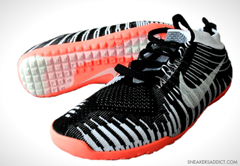
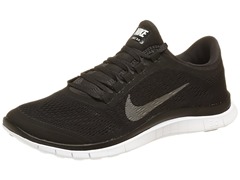
The original Nike Free 3.0 (see picture above) holds a special place in my running shoe collection because it was the first truly minimalist shoe that I ever ran in. I had read Christopher McDougall’s book “Born to Run” early last year, and found his arguments against traditional running shoes to be compelling (I’ve since moderated my views significantly on this – check out this post as an example). I wanted to try going more minimalist, but being wary of jumping right into barefoot running or running in the Vibram Fivefingers, I decided to look for a more moderate transitional shoe – the Free 3.0 fit the bill nicely. It was lighter than any shoe I had previously worn, was very flexible, and had a sock-like upper. I ran and raced several hundred miles in the original Free 3.0 (you can read about my early experience with the Free 3.0 here), with long runs extending to 20 miles, and just last month bought a pair of the Free 3.0 v2, which I have used as both a work shoe and on a few runs. My overall experience with both versions has been highly positive, and I can honestly say the Free 3.0 is one of my all-time favorite running shoes.

Nike Free 3.0 from Runblogger on Vimeo.
Slow motion video of treadmill running in Nike Free 3.0 – mild heel strike. Video shot at 300 frames-per-second with a Casio Exilim EX-F1 camera. Courtesy of https://runblogger.com/.
If the Nike Free 3.0 doesn’t promote a midfoot/forefoot footstrike as happens when I run barefoot or in Vibrams, then what benefit have I gotten from running in it?
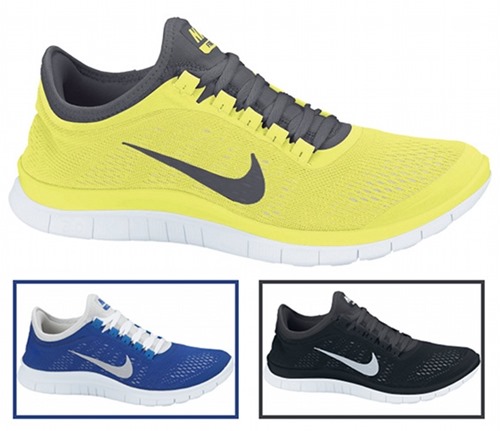
1. Comfort. Perhaps the main reason why I like both versions of the Free 3.0 so much is that they are ridiculously comfortable – they feel akin to wearing slippers on your feet when you run. The upper has very little structure to it – in the original Free 3.0 it’s basically a thin layer of fabric, whereas in the second generation Free 3.0 some cushioning has been added to the ankle cuff (see comparison picture below). As I mentioned above, one of the main reasons I bought a second pair of black Free 3.0 v2’s is so that I could use them as a work shoe – it’s awesome to be able to spend a day with these on your feet as opposed to a pair of heavy, stiff leather work shoes.

2. Weight. The Free 3.0 is a very lightweight shoe, with both models weighing in at under 7oz (in my size 10). You barely notice when these shoes are on your feet.
3. Heel-Toe Offset. I don’t know the actual #’s on the differential in thickness between the heel and toe, but the Free 3.0 has a much lower heel than most traditional running shoes. While there’s still enough cushioning there to allow me to continue heel striking, it was enough of a reduction that I felt it in my leg muscles when I first started running in them. I wasn’t sore in the calves like I was after my first runs in the Vibrams (which have no built-up heel), but the Free 3.0’s did seem to work my muscles in a different way than previous shoes I’d used, and perhaps helped me to have a smoother transition into the Vibrams than others who make the jump straight in.
4. Silence. One of the coolest things about running in the Free 3.0’s (and this may be true of the other shoes in the Free line) is that you can barely hear your footfalls when you run in them – you feel like a cat or a ninja who moves effortlessly and quietly along the ground – sounds silly, but it’s true. This is due with the properties of the material making up the outsole, which despite it’s seeming softness has held up pretty well for me in the original Free 3.0 over 220+ miles of running and walking.
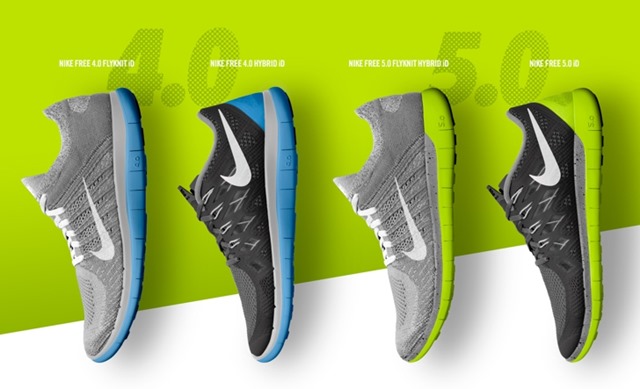
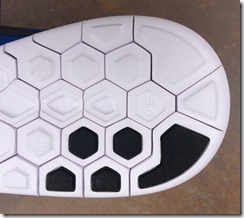
5. Flex. The flexibility of the Free shoes due to their deeply grooved outsole (see picture below) is the real deal – these shoes flex as well as almost any other that I have worn, and it was one of the things I noticed immediately the first time that I put them on. I do believe that they work your feet in ways that stiffer traditional shoes cannot, and this is a big plus for the Nike Free line.

Given the above features, I view the Nike Free 3.0 as a great choice as a transitional shoe if you’re thinking about working your way down to running barefoot or in an extremely minimalist shoe like the Vibram Fivefingers. Some disagree with this approach, saying that going barefoot from the start is the best approach so that immediate sensory feedback from your feet can prevent you from doing too much, too soon, but the transitional approach worked well for me, and I have managed to avoid any serious injuries so far while running in Vibrams over the past 8-10 months (I should point out that although I’ve tried barefoot running, I’m not a barefoot runner). The important thing to remember with any new shoe, and with minimalist shoes in particular, is to not overdo it – give your feet and legs time to adjust to these shoes, and resist the urge to do too much, too soon.
I’ll finish by saying that part of my disappointment regarding the release of the Nike Free Run+ stemmed from my belief that it’s arrival was going to coincide with the disappearance of the Free 3.0. This would have been unfortunate since the Free 3.0 is one of my favorite shoes, and one that has played a big role in my minimalist transition. Turns out that the Free 3.0 is still available, at least for now, so if you want to give it a try it can be found at a few places on-line (check the Nike Store for starters) – not sure how long it’s going to last.

 About Peter Larson










Another great post, Pete. I was looking at the Nike Free, but the “barefoot feel” marketing that totally didn’t agree with the shoe’s actual features kinda threw me off.
I really do like the Free’s, but if it’s a true barefoot-like experience
that you want, I’d go with the Vibrams. That being said, if I had to choose
between the Free’s and Vibrams as a shoe to run in every single day, I might
just go with the Nike’s.
Pete
Sweet video. I have to try that to see how I’m striking.
Joe,
It’s a Casio EX-F1 camera from my lab that shoots in slow motion.
Video from a standard camera won’t be as smooth. However, Casio makes
cheaper versions with similar capability.
Pete
Sent from my iPod
When I was at the London Marathon Expo in April, my wife and me were looking at these shoes, a NIKE rep came over and said the shoes are only to be used for easy runs up to 5k, and the main aim of the shoe is to strengthen the muscles of the feet!!!
So I guess here in the UK at least the shoes are marketed as a tool to strengthed your feet and not as a serius long distance running shoe!
I’ve had no problem running distance in them – sounds like a good
approach if your goal is to sell multiple shoes for different purposes
(I’m a sucker for that myself!).
Pete
Sent from my iPod
I had similar experience in Singapore as the first poster recently with the 3.0 seeming to be replaced by the nike free+ I went to buy some more 3.0 v2 the Nike store on Orchard essentially got me to agree that I would not run more thank 5K’s in them. I readily agreed to get the last of their stock in bright orange. So it seem nike has a differnt veiw than most minimalist runners.
Dave,
I suspect that they’re simply covering themselves so that if someone goes
out and hurts themselves running in the shoe they can say that they were
warned.
Pete
Shame all Nikes are getting heavier – 3.0 v2 are 7.2oz @ size 10! The Nike+ and iDs are all really ugly now and heavier than before! They discontinue all their best trainers – Nike really are brain-dead! My lovely Zoom Jasari+ iDs are very light, durable (300 miles so far!) and could be beautifully designed with the iD system – but have been deleted now too! Idiots! Awful, slow websites too!
If you like Nike, the new Zoom Waffle Racer VII looks promising. My
personal favorite is still the v1 Free 3.0.
Pete
Need to be Nike+ for run-logging with my iPod Nano: link to nikerunning.nike.com… …plus Wolfy wouldn’t be happy if I spiked her paw! Your pair of ‘3.0 II’ should actually be Nike+ (with a hole under the insole for the Nike Sport Kit sensor). They seem to be the best Nike+ running shoes at the moment. You should get logging too Pete, good to have a record of your progress. ;)
I log all of my runs on dailymile.com and at home on Sporttracks via my
Garmin Forerunner. I never had much luck with my Nike+ accuracy.
Pete
The Nike+ is very accurate, provided you don’t get better/worse at running. If your ability stays the same the pedometer will be within 10M over a distance of 8000M, even cross country.
I only started running a year ago and calibrated it round a track then. Last week I had to recalibrate it around the track again because as I’d gotten fitter/faster I was obviously, as I’m sure you know, taking bigger strides, so I was having to run further to reach my distance goal as I improved. It was out by 400M over 8000M, but now it’s accurate again – until I get injured or faster (unlikely).
P.S. Do you know about the 3.0s that have the extra pattern of material on the little toe? See below vvvv
Which version has the chevron by the little toe, Pete?
I’ve found some for sale that don’t seem to be v2: link to sportsshoes.com… …But they’re size 7.5(UK), I’m a 7 really (26cm foot). Do you know if they come up small anyway and a half size up would be okay?
…I think I can tell now that the ones in my link, with the triangle by the little toe, are actually v2 – they have the shiny rubber toe cap.
Yes, the shiny toe is on V2.
Pete
Quite a few v2 colour variants now: link to nikedirect.net… …Makes you wonder why there’s no iD version!
I’ll probably get the black with gold swoosh ones – but the average rating at the nike store website says they fit slightly small & narrow. :s
Careful with the site you linked – they’re selling knockoff Vibrams. Those
Nike’s might be fakes as well – I’m always wary when a site has unusual
color combos.
Pete
Affirmative! On Yahoo Answers they’re saying nikedirect.net is a fake website and another I found – http://uknikeairmax.co.uk – selling the different colour versions, seems fake too (the company number and VAT number belong to a different company – ukkolours!)
…I know which trainers are best for me now – the 3.0 v2 – now I’m researching the websites to make sure the cheapest sites are fakes or not – tricky. Like you say – the weird colours may be key to spotting the fakes I think – the US Nike store only has 2 versions: 1. Black/Volt-Anthracite-Neutral Grey; 2. White/Ink-Cool Grey-Anthracite. The UK store only sells ‘Black’ (like your ones, above)…But I’ve also just noticed that the US versions aren’t Nike+, but the UK black ones claim to have that technology!..I’m not sure the UK Nike+ claim is true now!
Grrrrr! The UK Nike store website is WRONG! link to store.nike.com… …They have the ‘Nike Free 3.0 ii’ & ‘7.0 v2’ listed as Nike+ trainers, but they’re NOT! The only Nike+ Nike Free ones are those ugly ‘Nike Free Run+’. Overly heavy too at 8.4 ounces (men’s size 10).
So, the best/lightest Nike+ trainers are currently the ‘LunarRacer+ 2’? But have you noticed how HIDEOUS they’ve become since the v1!? And heavier too, 6.9 ounces (men’s size 8 – Pete’s v1s weighed less in a size 10.5!), clever old Nike!
Perhaps I need to get a proper GPS run-recorder instead of Nike+ and their vile Nike+ trainers?
Check out Eastbay or the online Nike store for the Free 3.0 v2. eBay
is also an option, sometimes you can fond older shoe on there.
Pete
Thank you for all the info on your site. I would like some advice though. I want to replace one of my older pair of traditional runners (Saucony Triump) by a minimalist. I already own a pair op free 3.0v1 and VFF Bikila. I just bought the 3.0 when I ran my first marathon a year ago. I ran that one on Triumphs. Now I have 5 weeks left for the Rotterdam Marathon. And I am not sure what shoes to wear. Your blog help me to rule out the Free Run (don’t want a step back). I don’t want to try the Bikila’s, i never ran more than 6 miles on them. I will choose between the 3.0 or a new shoe (I think I might need a size bigger anyway for my 3.0 – they keep feeling to small – I really am interested in what sizes your Bikila, 3.0 and Kivara is – to compare the difference, if there is any). I named it already, I wonder to buy new 3.0’s or Kinvara’s. Your blog first led me to stay with the 3.0 – when I read your article on the Kinvara’s – but than I saw you ran your BQ on Kinvara’s. What will you run your next marathon on? Kinvara or something else. I am really interested. As well in the size comparisation. Thanks in advance.
I wear a 10 in the Free, 41 in Bikila. If I were you, I would stick with the
Free since you have only 5 weeks left – not much time to break in a new
shoe. You could buy the Kinvara and start working it into your rotation, and
if you can get at least one long run in that goes well, it might be ok. Both
are really nice shoes, so I don’t see a huge advantage either way as long as
they feel comfortable.
Pete
” I find it very unlikely, given these design elements, that the Free Run+ will promote the midfoot/forefoot footstrike that is a hallmark of barefoot running – this was the point I was trying to make in those posts. ‘
I’m sorry but I disagree. Buy a pair of nike free’s on a whim was a life changing (ok, stride changing ) experience. I found running in them *totally* different from my nike Vomero’s and it opened my eyes.
Everybody is different. Very different. Making blanket statements without data is how we got in this mess in the first place.
I would agree with you on that. I had both version and first version was so comfortable, I never could ever think about trying other shoes out. To my surprise, it lasted forever. 2 years before it finally fell apart. Unfortunately, v2 fell apart very quickly for some reason.
So I went to my local Fleet Feet today, and to my surprise I found that they had a Free 3.0 v2 in stock in my size. I decided to buy it because Fleet Feet had a very low stock, and I had been disappointed with the Free 3.0 v4. Not going to run in them until I wear out my Kinvara 2s.
what’s the thickness of the sole of this shoes?
The newest version of the Free 3.0 has a heel thickness of 21mm and a forefoot thickness of 17mm.