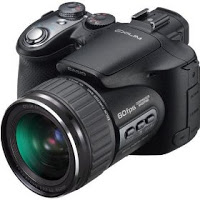
 Several days ago I posted about a new high-speed video camera that I recently purchased for my research lab. The Casio Exilim EX-F1 is an amazing piece of technology, allowing us to record extremely quick events at high-frame rates (as many as 1200 frames per second), and it is already proving itself worthy as a tool for analyzing running gaits and foot-strike patterns. I’ll admit once again that this is a new area of study for me, as I have only published research on frog and tadpole anatomy and biomechanics to this point (yes, I’m an amphibian biologist – you don’t come across those too often!). However, I’ve decided to pursue a new line of research as a result of both student interest (I have several pre-PT, pre-Med, and pre-Podiatry students working with me this year) and professional need (I’m developing a new course in Exercise Physiology that I will teach for the first time next semester). I thought that pursuing a research project on running form would be a perfect way to meld my personal and professional interests, as well as those of my students.
In addition to the new line of research, one of the things that I’m really interested in is the idea of blogging about scientific research in progress. It’s rare that you get to watch a research project develop from it’s inception, and I’m looking forward to sharing our thoughts and findings as they accumulate. All too often, scientific research is a black box, and all that we ever get to see is the end product published in scientific journals, often filled with so much technical jargon as to make it virtually unreadable (and don’t get me wrong, I’m just as guilty of this as anyone else). I believe that blogging is an effective way to communicate science in an accessible way, and hopefully I can begin doing that a bit more often here or on my lab blog (currently under construction). At the same time, science can just as easily be a two-way street, and we’d love to hear feedback and ideas from anyone who might be reading about our ongoing work.
So, back to the camera. On Thursday, four of my students and I took the Casio EX-F1 for a little workout behind our science building. We set it up so that it filmed roughly at the level of an asphalt walkway, and took turns running by to see just how effectively it might be able to capture the motions that we are thinking about analyzing. I’m happy to report that it produced some very nice footage, and I’ve provided some examples below. Enjoy!
Super Slow-Motion Running in Saucony Progrid Guides from Pete Larson on Vimeo.
High-speed video of me running in Saucony Progrid Guides. Clear heel-strike, then the forefoot slaps down quickly. Filmed at 300fps with a Casio Exilim EX-F1 and slowed further in Virtualdub.
Super Slow-Motion Running in Nike Free 3.0’s from Pete Larson on Vimeo.
High-speed video of me running in Nike Free 3.0’s. Clear heel-strike, but I find the flex in the heel at footstrike to be fascinating in the Free’s. The siping (horizontal grooves) on the sole seems to be doing it’s job to allow more flex, and this is one of the first things I noticed while running in the Free’s – unbelievable flexibility. Filmed at 300fps with a Casio Exilim EX-F1 and slowed further in Virtualdub.
Super Slow-Motion Running in Vibram Fivefingers KSO’s from Pete Larson on Vimeo.
High-speed video of me running in Vibram Fivefingers. Need to work on that heel-strike! Filmed at 300fps with a Casio Exilim EX-F1 and further slowed in Virtualdub.
Super Slow-Motion Barefoot Running from Pete Larson on Vimeo.
High-speed video of me running barefoot. Slight heel-strike – need to work on proper form. This one does appear to be the best of the four in terms of the degree of heel-strike. Angle between the foot and the ground at footstrike also appears to be lowest here. Another thing to note is the contraction in my calf muscles when the foot hits the ground. When barefoot, these muscles, which attach to the heel via the Achilles tendon, are stretched more than when wearing shoes due to the lack of a heel-lift (i.e., cushioning). My guess is that this is what leads to the burning calf soreness we typically experience after running barefoot or in Vibram’s for the first time – probably a result of increased eccentric contraction in the soleus (and maybe gastrocnemius) muscles when a heel-lift is absent. I should note that this was my first time running fully barefoot on asphalt. Filmed at 300fps with a Casio Exilim EX-F1 and slowed down in Virtualdub.
Slow Motion Huarache Running from Pete Larson on Vimeo.
High-speed video of one of my students running in huarache’s that he made himself out of tire-rubber. Nice mid-foot strike – he clearly has more experience with minimalist running than I do! This one is just regular slow-mo. Filmed at 300fps with a Casio Exilim EX-F1.
So what have I learned from watching these videos? First, the data don’t lie – whether I like it or not, I’m still a pretty consistent heel-striker. Even in the Nike Free’s and Vibram Fivefingers, in which I feel like I’m striking on the mid-foot, I’m clearly landing heel-first (and the wear pattern on the bottom of my Free 3.0’s would support this). No matter how badly I want to feel that my gait has changed as a result of running in Nike Free 3.0’s all summer, the video and wear pattern data are conclusive, and I obviously need to spend some additional time focusing on my stride if I want to avoid getting hurt while running in shoes like the Vibram Fivefingers. Although the barefoot video shows a mild heel-strike, frame-by-frame playback suggests that it’s less pronounced than with any of the footwear types, and the angle between my foot and the ground at landing is clearly much lower. Foot angle at landing is one of the variables we plan to measure (there’s good published data out there showing that it changes when running barefoot).
I’d also like to emphasize that these videos were taken as a means to show my students what the camera can do, and we have a long way to go as far as standardizing protocols and developing research questions and the like. One of the challenges with doing this type of filming on solid ground (instead of a treadmill) is that it’s difficult to ignore the presence of the camera, and thus it takes serious focus to maintain a normal stride when running by it. I found myself on a few occasions adjusting my footfalls to try and make sure that they fell in the view of the camera. This should improve with practice, and it actually felt better even today when I took my second group of students out for some filming. The other problem is that it’s difficult to reach a smooth running pace without a decent length warm-up or lead-in. We were running from a cold-start, with maybe a 50ft lead-in before we hit the camera. This is going to be a more difficult challenge to overcome, but something we need to keep in mind.
We’d love to hear what you think, and any and all suggestions are welcome. We’re also receptive to any ideas, thoughts, and questions that you might have. I’ve got 8 undergraduate students working with me right now (we’re at a small college), and we’re beginning to formulate our plans, but could certainly address questions of interest if you have any.
Thanks for stopping by!
You might also like:
 Slow Motion Video of Elite Women at the 5th Avenue Mile Road Race
 Ryan Hall in Slow Motion from the 2010 Boston Marathon
Footwear and Pronation – A Slow-Motion View from Behind
Ryan Hall in Slow Motion from the 2010 Boston Marathon
Footwear and Pronation – A Slow-Motion View from Behind
 Relationship Between Running Footstrike and Footwear: From Stability Shoes to Barefoot
Science of Marathon Running: Great Video From It’s OK To Be Smart
Relationship Between Running Footstrike and Footwear: From Stability Shoes to Barefoot
Science of Marathon Running: Great Video From It’s OK To Be Smart


 About Peter Larson











Peter, looks like you made a good start. Coming from a research background myself (PhD Chemical Engineering), I remember one of the early textbooks I read on statistics had a detailed example on how changing the setup of a bicycle affected the time it took to climb a set distance up a hill. Of course, with today’s technology, you can collect a lot more data (hr, pace, etc) so you can explore more effects.
One area that I’m thinking a lot about with respect to my running is how to maximize fitness while controlling the risk of injury at a certain level. This summer I felt great about 6 weeks away from my 10 mile race so I stepped up my intensity while the program I was using also increased the miles. Suddenly in one run I definitely injured myself: pulled hamstring, plantar fasciitis. So it appears the line between fitness and injury is very fuzzy and may hold some interesting areas for research.
It certainly would be much more a long-term project but certainly of interest to many long-distance runners.
I’ll certainly be looking out for future blog entries with interest.
Barry- Thanks for the comment! Funny that you mention the bike example –
one of my students is a serious cyclist and wants to look at how wearing
clip-in shoes affects cycling mechanics. He’s got some really interesting
ideas that he wants to address. Also, the whole injury question is really
why this type of project works perfectly for pre-health students and
runner’s alike. We’re on the very ground floor right now, and it will be
interesting to see where this takes us. One thing I had thought was to look
at how gait changes after running for a period of time – that might get a
little at what you were suggesting. In other words, how much does form
break down when we are tired. Problem with that is I’d probably have to
volunteer myself as a subject since running people to exhaustion would be a
hard sell for both our IRB and any potential test subjects! -Pete
Great post. Find a treadmill and film while running on that.
Thanks for the comment – the lab is outfitted with a treadmill now and video
should be coming soon! -Pete
I think that something is wrong with you. How come that you cannot feel that you are striking on your feet and not on your forefoot ? Unbelievable. And, are you serious , that you thought , that bcse of a nike free, you will be a midfoot striker ?
It is so so easy to transform your stride, just takes time to get used to it, for me it took 20days, every day 3 hours of stride work, started with 6*30min at the very end 3 hours of run. Only offroad, after started to run on concrete.